
Bearing Fruit from Private Equity: Venture Capital, Growth Equity, and Buyout
- Venture capital invests in early-stage startups with high-risk, high-reward potential, targeting breakthroughs in tech and innovation despite frequent losses.
- Growth equity supports companies with proven products, offering steadier returns and lower risk by fueling scalable growth and profitability.
- Buyouts reshape mature enterprises, typically through operational improvements and leverage.
- In 2025, platforms like Crystal’s allow advisors to mix venture capital’s bold bets with growth equity’s stability, aligning investments with client goals in a dynamic market.
Through platforms like Crystal Capital Partners, which have an open-architecture and transparent manager selection process, advisors can access private equity managers who are investing in companies in distinct stages of their life cycle.
Having a robust offering of private equity funds allows advisors to align client portfolios with varying risk tolerance and return goals, whether targeting early-stage innovation or scaling established businesses.
Private Equity in the Business Cycle
Private equity spans a spectrum of investment strategies, each tied to a company’s maturity. Venture capital fuels nascent ideas, growth equity accelerates expansion, and buyouts reshape mature enterprises. Understanding these stages helps advisors and investors navigate opportunities effectively.
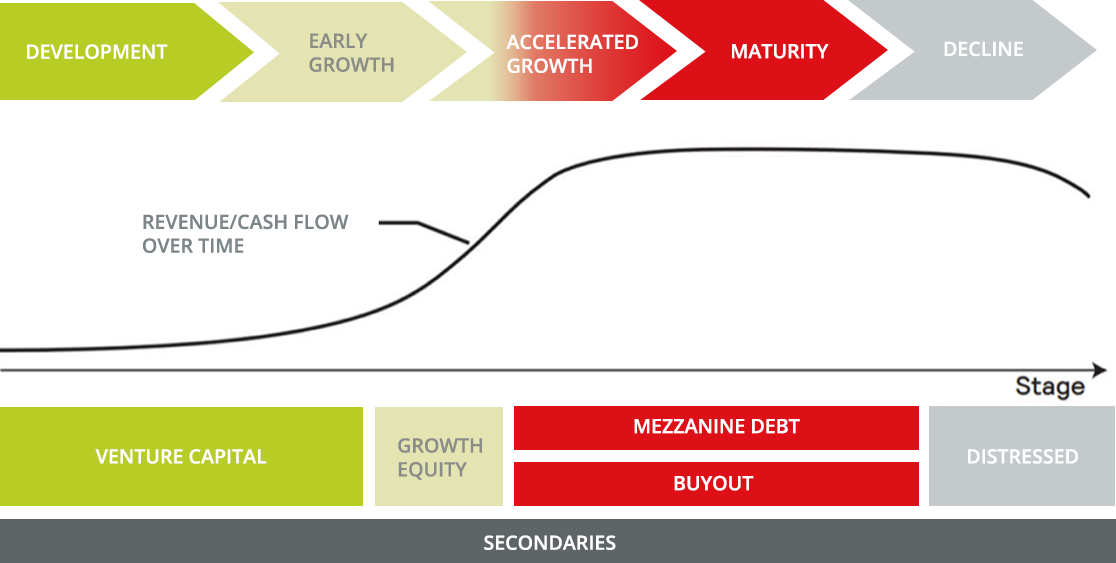
Venture Capital
Venture capital (VC) targets early-stage companies—often pre-revenue startups—through to later-stage VC, where businesses have a product and initial sales. The mission? Back the next big thing—be it a revolutionary app, a life-changing biotech breakthrough, or a trend-defining consumer product. VC firms typically take minority stakes (less than 50% ownership) in these high-growth, often tech-driven companies, trading capital for equity.1
VC is a high-stakes game. Returns vary widely: many investments fail, but a few “unicorns” deliver outsized gains that offset losses. This dispersion stems from inherent risks—unproven markets, untested products, and operational uncertainty. In 2025, amid rapid advancements in AI, clean energy, and biotech, VC remains a magnet for investors chasing exponential growth, despite the volatility.
Advantages of Venture Capital
For startups with limited track records, VC is often the lifeline to capital when banks and debt markets aren’t an option. Beyond funding, VC investors bring expertise—securing board seats, shaping strategy, and guiding founders through uncharted waters. This hands-on support can be pivotal for young companies aiming to disrupt industries or scale fast.
Growth Equity
Growth equity bridges the gap between venture capital’s risk-laden early stages and the stability of buyouts. It targets companies with proven products or services, shifting the focus from “Will it sell?” to “Can it scale profitably?” These businesses may not yet be cash-flow positive but often boast growing ARR—say, $10M to $50M for SaaS firms—and are on a clear path to profitability.
Positioned in the private equity continuum, growth equity fuels rapid expansion—think new markets, bigger operations, or strategic acquisitions. Valuations here blend revenue multiples (e.g., 5x-10x ARR for high-growth tech) with early earnings potential, reflecting traction and scalability. Target companies often challenge industry giants with established offerings, yet execution and management risks linger as they maximize growth.
In today’s market, growth equity thrives in sectors like SaaS, e-commerce, and sustainable tech, where firms leverage data-driven insights to amplify revenue and refine operations.
Benefits of Growth Equity
Growth equity offers a more balanced risk-return profile than VC. While it sacrifices some of VC’s moonshot potential, it reduces steep losses compared to VC while delivering a steadier potential for 2x-5x gains. For companies, it provides cost-effective capital and seasoned partners. General partners (GPs) often join boards or offer mentorship, helping refine strategies and boost efficiency—key as valuations stabilize around proven revenue streams.
Buyouts focus on mature companies with established operations, steady cash flows, and often predictable earnings—think EBITDA in the tens or hundreds of millions. Private equity firms acquire majority stakes (50%+ ownership), aiming to enhance value through operational improvements, debt restructuring, or strategic exits like IPOs or sales. Valuations here are grounded in earnings multiples (e.g., 8x-12x EBITDA), reflecting a company’s ability to generate consistent profits.2
In 2025, buyouts appeal to investors seeking lower volatility and tangible returns, often in industries like manufacturing, healthcare, or consumer goods. The strategy involves less “build-from-scratch” risk than VC or growth equity, but success hinges on execution—streamlining costs, boosting margins, or repositioning the business.
Advantages of Buyouts
For mature firms, buyouts unlock capital and expertise to optimize operations or fund new growth phases (e.g., acquisitions). Investors benefit from more predictable returns compared to VC and growth equity —often 1.5x-3x over 5-7 years—backed by real earnings, making it a cornerstone for portfolios balancing VC’s upside with growth equity’s momentum.
VC vs. Growth Equity vs. Buyouts: Key Differences
| Aspect | Venture Capital | Growth Equity | Buyout |
|---|---|---|---|
| Stage | Unproven startups | Companies with traction | Mature, established firms |
| Risk Profile | High risk/high reward | Moderate risk/consistent returns | Lower risk/stable returns |
| Return Potential | 10x+ outliers | 2x-5x reliable gains | 1.5x-3x steady gains |
| Valuation Metrics | Market potential, pre-revenue | ARR, revenue multiples | EBITDA, earnings multiples |
| Involvement | Building from scratch | Refining and scaling | Optimizing and restructuring |
Source: Table generated by AI
Why It Matters in 2025
Today’s economic landscape—marked by inflation concerns, tech innovation, and shifting trade dynamics—underscores the value of private equity diversification. Platforms like Crystal Capital Partners enable advisors to curate portfolios by blending VC’s bold bets, growth equity’s steadier growth, and buyouts’ operationally driven returns, aligning with client goals. Whether funding the next AI pioneer, scaling a sustainable brand, or optimizing a mature business, these strategies offer distinct paths to value creation.
In short, early-stage venture capital might rely on ARR forecasts and big visions. Growth equity looks for proven revenue models that are ripe for expansion. Buyouts turn to stable earnings and operational improvements. This spectrum of private equity investments can help advisors build well-rounded portfolios that navigate various market conditions and client objectives when blended thoughtfully.
Learn more about the private market opportunities available on our platform and how your clients can participate.
For financial advisors only.