
Published on June 24, 2025
Current State of Humanoid Robotics
2025, The Year of the Humanoid Robot
Amazon deliveries are extraordinarily speedy. Yet, we should all be grateful that the country’s leading e-retailer is striving for more. Developments in humanoid robotics have exploded, so much so that Amazon is opening its very own “humanoid park.1
Unlike a dog park or Disneyland, Amazon’s humanoid park will be a training ground. Most humanoid robots can already perform one job singularly well. By combining cutting-edge technology such as agentic artificial intelligence (AI), Amazon is now tinkering with a new group of bots empowered to perform autonomously while making real-time decisions. A workforce complemented with robots to move heavy objects and take on general, assistant-level tasks, Amazon is expecting to significantly reduce preparation and final customer delivery times.
Corporate Venture Capital Flooding into Humanoid Robotics
At the end of March 2025, OpenAI, the California-based behemoth behind ChatGPT, closed a record $40 billion in corporate venture capital (CVC) funding.2 The first quarter of 2025 absolutely dwarfed previous Q1s, including Q1 2023 that had raised an impressive (at the time) $70.35 billion.
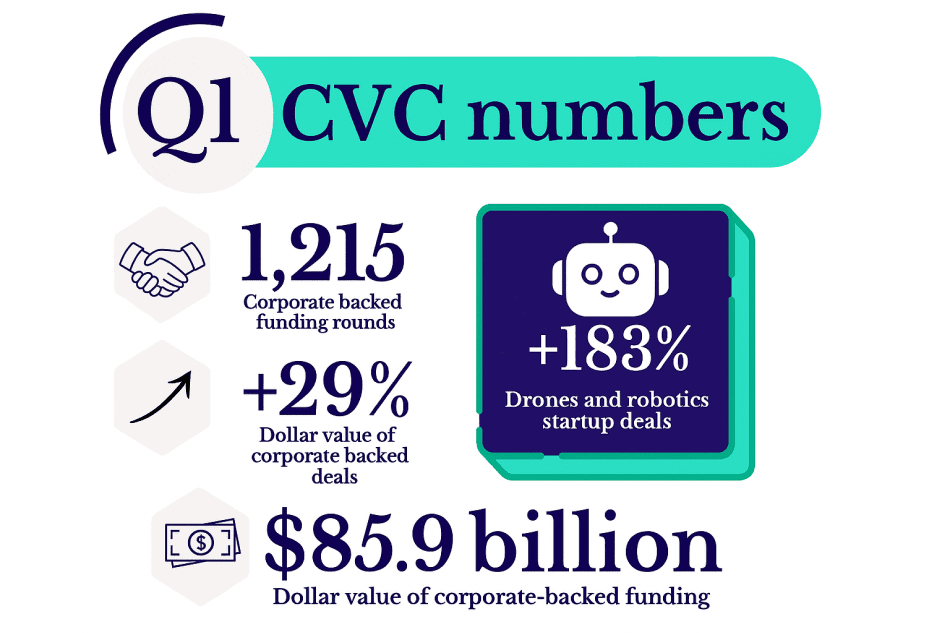
While the overall numbers were notable, the “industrial” category, which includes drones and robotics, registered the largest percentage change in start-up deals of any of its sub-sectors.3 Humanoid robot manufacturer Apptronik raised $350 million in February, with Germany's Neura Robotics and China’s Fourier Intelligence raising $124 million and $109 million, respectively.4
One of the humanoid robotics companies that Amazon funded through its Industrial Innovation Fund is Agility. Digit, Agility’s signature bipedal humanoid warehouse robot, is pursuing $400 million in new funding and announced in April some tantalizing new capabilities and advancements.5
- Expanded battery capabilities
- Autonomous charging station docking
- Wider grasping angles via improved limbs and “end effectors,” the bot’s hands
Digit can maneuver a payload of up to 35 pounds, and with legs akin to those of an ostrich, the 5-foot-9 robot moves effortlessly across a variety of warehouse terrains.
Humanoid Robotics Growth Trajectory
Similar to AI, the humanoid robotics market is dominated by the U.S. and China. As the humanoid robotics manufacturing hub for sensors, semiconductors, and general electronic components, analysts posit that China will grow the fastest over the short term.6
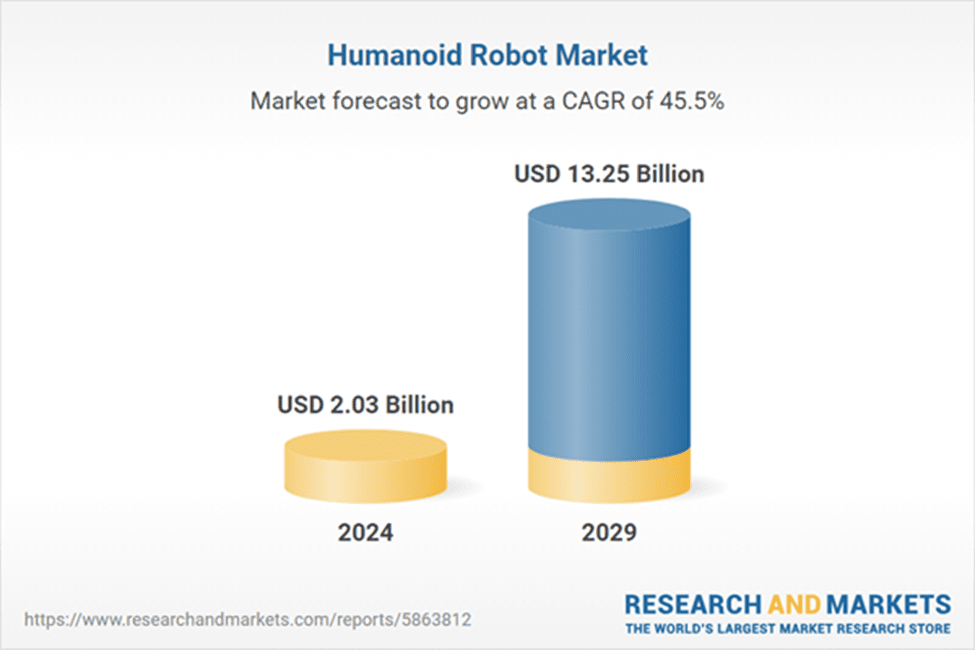
During the recent 2025 J.P. Morgan Global China Summit, humanoid robotics took center stage. The summit touched on a wide range of topics that influence China and the global economy, and three key challenges facing most developed world economies emerged:7
- Current and pending labor shortages
- High costs
- Efficiency demands
Developed countries, on average, are having fewer children, and large metropolises are becoming increasingly expensive to live. Efficiency demands are omnipresent, and humanoid robotics, at the right price, can address all three.
Take, for example, labor costs in the European Union. From 2023 to 2024, EU labor costs rose by 5%. Between 2022 and 2024, the average humanoid robotics unit cost dropped by roughly 40%.8 The price point remains high - an estimated $200,000 per humanoid bot in high-income countries.9 Morgan Stanley estimates that by 2050 a humanoid robot could cost $50,000, at which point the U.S. penetration rate would range from 3% of households earning up to $75,000 per year, to 33% for those households exceeding $200,000 per year.10
Humanoid robots are poised to integrate into sectors such as healthcare, construction, protective services, food preparation and serving, and installation and maintenance. There is additional space for traditional mechanization coupled with humanoid robotics in logistics, manufacturing and agriculture. Taken as a whole, these industries represented 76 million human jobs in 2023.11
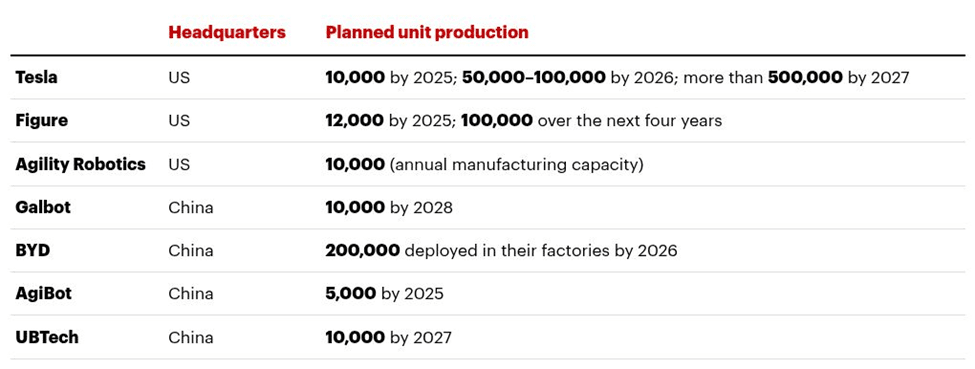
Leading companies are ramping up production of humanoid robots
Robotics-as-a-Service (RaaS)
It wouldn’t be long before the Software as a Service (SaaS) model was applied to humanoid robotics. Still in its infancy stage, RaaS is advancing at a steady clip. A company could expect to invest between $2 million and $4 million to bring in anywhere from 50 to 100 robots to a warehouse setting.12 A RaaS subscription model, however, would break that investment into manageable intervals over time. The two most popular RaaS models are:
- Leasing humanoid robots
- Pay-per-transaction/task that the bot performs
RaaS models are increasingly attractive for companies that have pronounced peak seasons. Leasing or paying-per-task for a concentrated 3-month period and then returning the bots is cost-efficient and does not lock the company into a pricey capital expenditure. Other firms might opt to purchase a select few, integrate them into year-round activities, and then lease more during peak months.
Keep An Eye on Waymo
While not technically a humanoid robot, the Michael Jordan of the robotaxi sphere is Waymo - for now. Robotaxis are an important inflexion point as the growing prevalence of “robot chauffeurs” is the first entry point to more advanced bipedal bots in the home and workplace. Alphabet’s Waymo has grown from 10,000 California paid rides per week in August 2023 to over 250,000 currently.
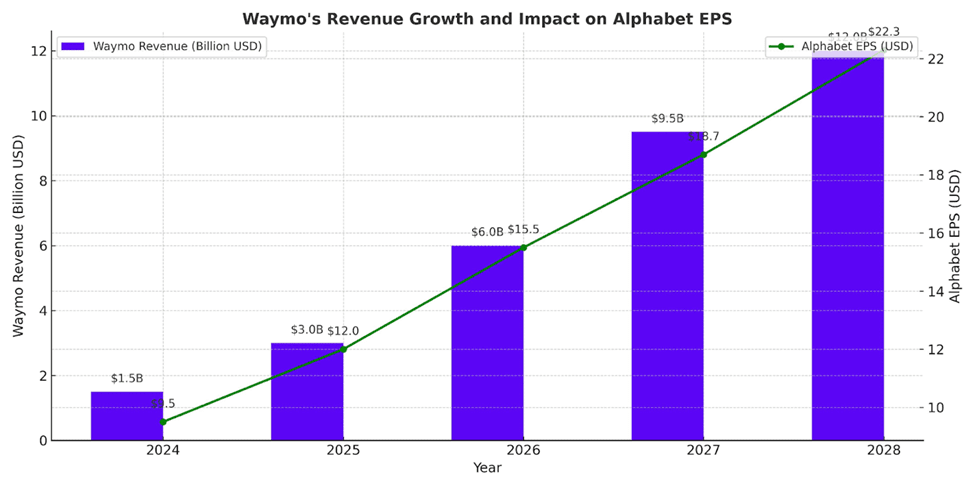
Now that Elon Musk has some more time on his hands, Tesla robotaxi rides are set to begin on June 22 in Austin, Texas.13 Musk had taken some heat for falling behind in the robotaxi race, and judging by Waymo’s performance, catching up will be no small feat. Waymo is pushing now into Atlanta, Miami, and Washington D.C., and Waymos are actively mapping San Diego, Las Vegas, Nashville, Boston, New Orleans, and Dallas.
Conclusion
The short term impact of humanoid robotics will be felt either at the consumer level (expedited deliveries) or as an employer with further mechanized warehouse work. As competition continues to heat up and prices fall, higher-income household will undoubtedly begin experimenting with bipedal robotic assistance in-house.
News headlines will play up the U.S./China humanoid robotics rivalry, but like electric vehicles (EVs), if China can maintain its manufacturing dominance and “unique” labor laws, the U.S. will struggle to keep pace.
Sources:
- Kaur, Gursimran. June 4, 2025. “Amazon prepares to test humanoid robots for deliveries.” Reuters.
- Lavine, Robert. April 1, 2025. “SoftBank leads OpenAI’s record-breaking $40bn round.” Global Corporate Venturing.
- Hurford, Stephen. April 8, 2025. “Corporates backed more startups in Q1, event stripping out the AI mega-deals.” Global Corporate Venturing.
- Ibid.
- Schlosser, Kurt. April 1, 2025. “Agility Robotics reportedly raising $400M for humanoid warehouse robots.” GeekWire.
- Yahoo Finance - Research and Markets. February 5, 2025. “Humanoid Robot Market Research Global Forecast Report 2025-2029: Rising Demand for Humanoid Robots from Logistics Sector and Increasing Adoption of Humanoid Robots in Search and Rescue Operations.” Yahoo Finance.
- J.P. Morgan. May 22-23, 2025. “21st Annual J.P. Morgan Global China Summit.
- Hanbury, Peter, Dutt, Arjun, and Veratti, Emanuele. April 2025. “Humanoid Robots at Work: What Executives Need to Know.” Bain and Company.
- Morgan Stanley. May 14, 2025. “Humanoids: A $5 Trillion Market.”
- Ibid.
- Ibid.
- Biba, Jacob. May 15, 2025. “What Is Robotics as a Service (RaaS)?” Built In.
- Kolodny, Lora. June 10, 2025. “Austin ‘tentatively’ set to begin June 22.” CNBC
Learn which exposures on our platform are investing in AI and Automation, and how your clients can participate in the next wave of innovation.
For financial advisors only.