
Published on April 4, 2024
AI vs. Dotcom: Are AI Startups the Next Wall Street Bubble?
On March 1, 2024, leading technology company Nvidia, which supplies high-end AI processing chips to Microsoft, Google, Meta and OpenAI, reached the $2 trillion market cap milestone, becoming the third most valuable company in the world behind Microsoft and Apple.
And so it begins. The AI boom.
The frenzied obsession with artificial intelligence (AI) and its impact on life, work, privacy, national security, and investment opportunities appears to have reached a high point.
If it sounds familiar, it should. These are the same sentiments expressed 25 years ago when all things "Internet" threatened to disrupt our lives, for better or for worse.
During the dotcom era, there was concern that the Internet would disrupt entire industries, put companies out of business, eliminate jobs, and make some individuals wealthy. What really happened was a mixture of disruption, evolution, and opportunity.
Flashback: The Dotcom Boom, Bubble and Burst
Most will point to the 1995 IPO of internet pioneer Netscape as the start of the internet-based investment frenzy. Despite no revenue stream and operating at a loss, Netscape was able to generate $2.9 billion in market capitalization on its first day as a public company, based purely on speculation and hype.
What followed was a frenzy of IPOs for anything internet-related. During the dotcom era, excitement exploded for the potential of these companies to revolutionize industries and create new markets. Investors poured billions of dollars into startups, many of which had little or no profits but were valued based on their potential for future growth.
But in March of 2000, the bubble burst, as stock prices fell sharply, leaving many companies worthless. The dotcom heavy NASDAQ fell by more than 75% between March 2000 and October 2002, wiping out more than $5 trillion in market value.1
Giants like Google, Yahoo, Amazon, eBay, and Expedia all survived the crash. But for every dotcom that survived, there were hundreds of casualties. Who remembers Etoys, Pets.com, Boo.com, Lycos, and PSINet?
The postmortem was that the crash was caused by severe overvaluation of companies, low interest rates, and media-generated excitement for new technology.
The dotcom era serves as a prime example of the risks of speculative investing and the importance of sustainable business models. Will we remember history and lessons learned in today’s AI boom?
Ai: The Next Technology Revolution
Just like the dotcom revolution, the AI revolution has the potential to change the world – and be nothing like we initially expected.
For many, AI is something that seems to have suddenly appeared in our lexicon and threatens to take over the world. However, in the tech world, AI is not new as machine learning models go back to the 1950s, and Large Language Models were introduced a decade ago.
The introduction of deep learning (AI that learns as it interacts) and generative AI (programs that can generate text, images, music, and more) has been a game-changer. These technologies have pushed AI into the spotlight and created a wider understanding by consumers, thus driving the biggest players into the commercial use race.
Google initially had been leading the charge into the commercial introduction of simple AI with technology that we all use and can't live without. Google has long used AI algorithms to deliver search results, and functionality such as sentence autocomplete, spell correction, and Google translate, which are all AI-driven.
However, Microsoft more recently has stepped up the pace with substantial investments (estimated to be around $10-13 billion)2 into OpenAI's generative AI platform ChatGPT, and more recently $2.1 billion into French start-up Mistral AI, Europe’s version of ChatGPT.3
These two heavyweights, making big investments and headlines, maybe that "Netscape" moment and catalyst for kicking off the AI investment boom – for both venture capitalists and individual investors.
How Does the AI Boom Resemble the Dotcom Boom?
It’s impossible not to compare the hype around AI with the dotcom hype of the late 1990s. Just like the internet, AI technology has the potential to impact nearly every industry. While generative AI is commonly understood as a tool for generating code, content, imagery, audio, and video – its reach is potentially much longer.
AI is being used in healthcare to help diagnose, treat and/or discover cures for disease. It is being used in finance for predictive analytics and cybercrime detection. In fact, it is being used in most industries, including manufacturing, transportation, telecommunications, energy, robotics, education, marketing, media, and government.
But beyond the excitement for the technological impact AI might have on the world, there is also a great deal of marketing spin that many companies feel obligated to participate in.
Just like during the dotcom era, when many companies scrambled to build a website, many established businesses today are looking to leverage AI to make them better or more profitable. However, most companies are still trying to grasp its potential and application.
And just like the frenzy of startups during the dotcom era, AI startups are popping up quicker than a ChatGPT response, wooing venture capitalists and individual investors into the new gold rush.
Startups Driving the Frenzy
While the AI boom is being driven by established, profitable tech giants such as Google, Microsoft, IBM, Apple and Amazon, their additional investments in AI startups are what may create a bubble. Once Microsoft made its first investment into ChatGPT in 2019, investment in AI was off to the races. Top funded AI startups in the U.S. include Cruise Automation, OpenAI, Anthropic, Waymo, Databricks, Aurora, Argo AI, CoreWeave Palantir Technologies, and Anduril.4
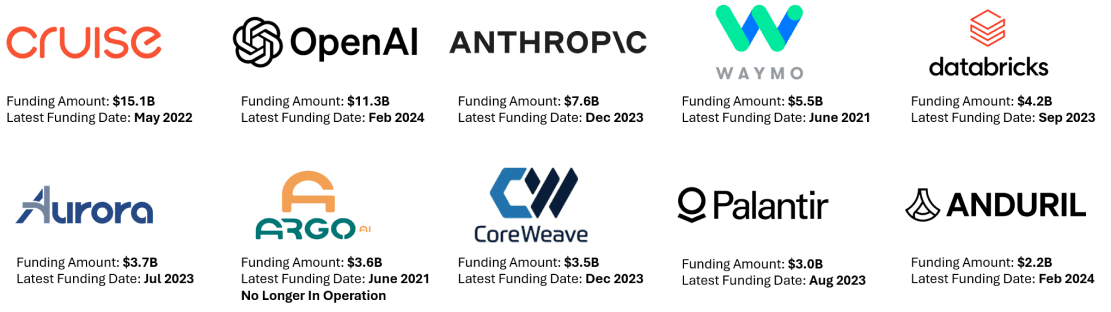
Over the past three years, investors have poured billions of dollars into AI startups, many of which have little or no profits and are being valued on their potential for future growth. Investments in global AI startups since 2021 is estimated to be in the $170 billion range – with $50 billion in 2023.5
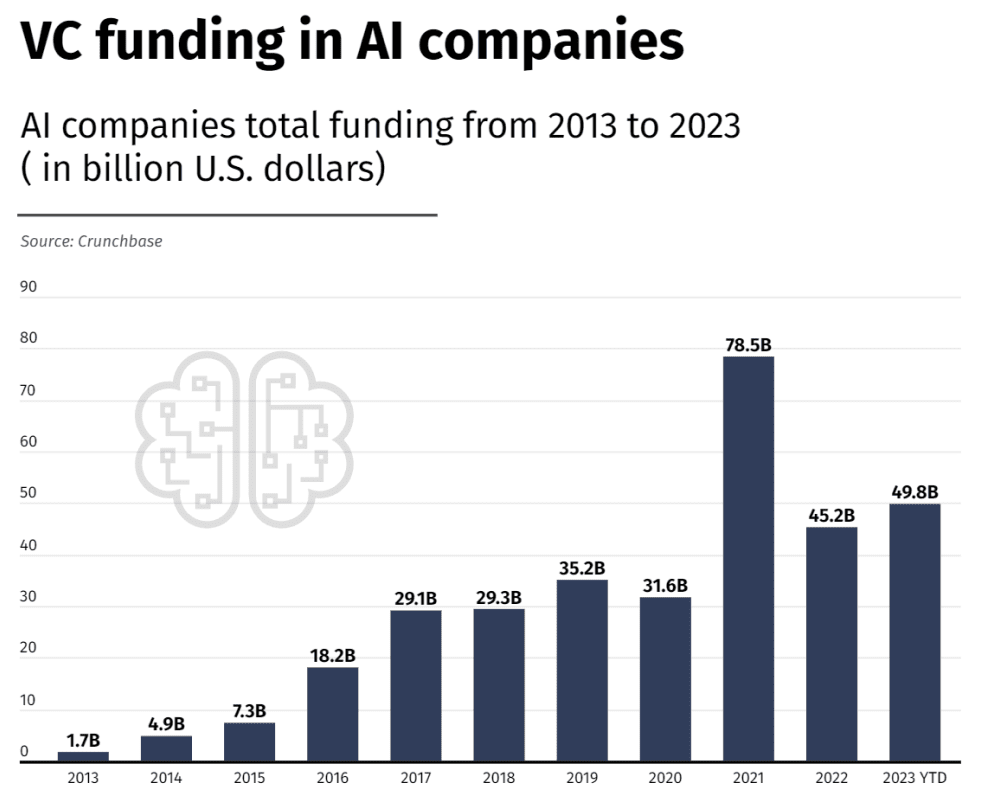
Source: Crunchbase. Data as of 12/21/23.
The United States is leading the world with an estimated 5,700 AI startups, with China and the United Kingdom far behind with approximately 1,000 each.6
Is History Repeating Itself?
The dotcom bubble, and subsequent burst, were driven by the sheer number of unprofitable startups with unsustainable business models that went to IPO. Today, there are similar concerns with the speed at which AI startups are being capitalized. As tech giants invest in AI startups, there may be a side effect of rising valuations for those giants – not based on profitability, but on potential future earnings of those investments.
Investment firm Apollo Global Management's chief economist Torsten Sløk stated, "The top 10 companies in the S&P 500 today are more overvalued than the top 10 companies were during the tech bubble in the mid-1990s."7
At the top of the S&P 500 (by weighted value) are Microsoft, Apple, Nvidia, Amazon, Alphabet (Google) and Meta (Facebook). They are all top investors in the AI space.
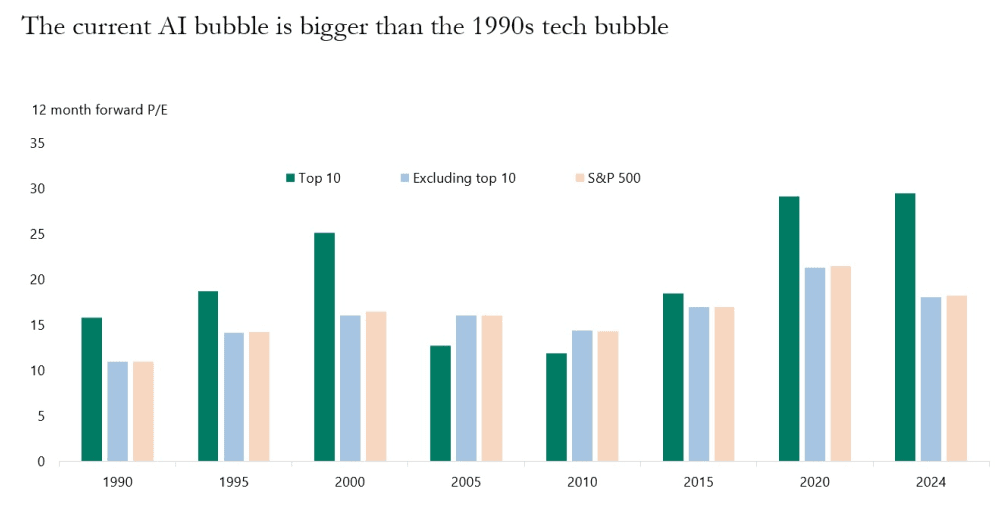
Still, some data is pointing towards a lower risk of the AI bubble bursting. Most notable is the comparative differences in the collective valuation (or overvaluation) between dotcoms and AI. In March 2000, the forward P/E ratio of the dotcom bubble was estimated at 60.1x. Whereas current (as of November 2023) valuations for AI firms are estimated at 26.4x.8
Also, consider that while there is a considerable amount of AI startups gathering financial backing from venture capital, there are more stringent guidelines for going public today than during the dotcom era. Today, profitability, sustainability, and demonstrated revenue growth are more important for reaching the IPO stage. There is also a greater emphasis on corporate governance and transparency, with companies expected to have strong internal controls, independent boards of directors, and clear disclosure practices.
The most critical difference between this AI boom and the dotcom revolution is the practical and demonstrated application of AI technology across almost every industry. At the start of the dotcom era, there was a lot of speculation on all things internet. Eventually, those companies that couldn’t demonstrate the practicality and usefulness of their technology disappeared. AI technology is not just about future projections; it is currently being used successfully across multiple industries. AI is here and demonstrating clear value.
The internet ultimately transformed the world. AI will do the same. But just like the dotcom era, there will be winners and losers.
Sources:
- Dotcom Bubble (CFI)
- Microsoft Bets Big on the Creator of ChatGPT (New York Times)
- Microsoft Invests In Europe’s Mistral AI (CNBC)
- https://www.ai-startups.org/country/USA/
- Artificial Buildup: AI Startups Were Hot In 2023 (Crunchbase)
- AI Startups’ Statistics (Content Detector)
- The Current AI Bubble Is Bigger Than The 1990s Tech Bubble (Apollo Academy)
- Three Reasons Why AI Enthusiasm Differs From The Dot-Com Bubble (Visual Capitalist, CNBC, Barron’s)
See the private funds that are investing in AI.
For financial advisors only.