
Published on April 23, 2024
Are CEO salaries getting too high?
Whenever you see another headline about Elon Musk and Jeff Bezos trading places -- yet again -- as “The World’s Richest Man,” it’s hard not to think: Aren’t CEO salaries getting a little too high?
You’re not alone. Seventy-four percent of Americans believe that an average CEO salary is too high relative to the average worker. Tellingly, both sides of the political isle feel largely the same about the high CEO salaries, with only a small gap between Republicans and Democrats. What’s also interesting, Americans hugely underestimate just how high an average CEO salary is: about $1 million is a common answer, when in reality the average CEO salary is ten times that much: $10.3 million, to be exact.1
Of course, when it comes to the richest CEOs like Musk, $10 million is a gross understatement. While Tesla’s U.S. factory workers make between $22 and $39 an hour2, in 2023 Musk topped the CEO pay chart with $10.077 billion3. Ahem.
So, do CEOs really make too much money?
Well, that depends on how you look at it. Consider that CEOs like Musk, for example, for all his awkward public faux-pas and social media blunders, spearheaded a revolution in the global auto industry (and the size of screens in our cars), forcing everyone from the Big Three U.S. automakers to German luxury brands to play catchup in the electric vehicle race.
Or CEOs like Tim Cook, under whose leadership Apple, Inc. became the world’s most valuable company. And let’s not forget that prior to that, the same company first revolutionized the way the world listens to music (remember iPod?) and later, how the world communicates when in 2007 they launched the first smartphone.
Or CEOs like Jeff Bezos, whose Amazon.com revolutionized the way Americans shop and whose delivery boxes with a smile on their side pile up daily on porches across the U.S. as the company continues to “sell everything to everyone.”
If you look at it from this perspective, then maybe the huge CEO salary these company leaders enjoy is well-deserved. After all, why shouldn’t the founders of companies whose products and services quite literally changed the world -- and for the better! -- be able to become rich, even obscenely rich? Last we checked, the U.S. is still a capitalist country, so who’s to say if someone is “making too much money?”
Of course, another way of looking at it would be from the perspective of an average worker and the gap between their salary and a CEO salary. That gap has grown by multiples over the past few decades and today is simply staggering. It doesn’t seem fair to many people.
But just how is it that a CEO's salary has gotten so high?
First, there is a base CEO salary. Here in early 2024, an average U.S. CEO salary is $834,479, with the upper range of $1,075,177. That’s multiples higher than an average U.S. CEO salary of $59,3845. And while “pay for performance” remains the corporate motto when it comes to CEOs, critics often say that the high base CEO salary, which is not tied to the company’s performance, offers little incentive for the CEO to try harder.
Ah, but for that, there is a bonus – a performance bonus, which can range from a hefty percentage of the base CEO salary to many times that. Factors like the company’s profit and revenue growth, return on equity (ROE) to the shareholders, as well as share price appreciation6 all go into the pot when the size of the bonus is determined. And who makes that determination? The company’s board of directors does, the same people who appoint the CEO in the first place.
And then, of course, there are stocks and options of the company itself that the CEO usually owns. In fact, for CEOs like Elon Musk, that’s where the bulk of their wealth resides. Musk actually “lacks significant tranches of cash; his money is largely tied up in ownership stakes of his companies” (Washington Post):
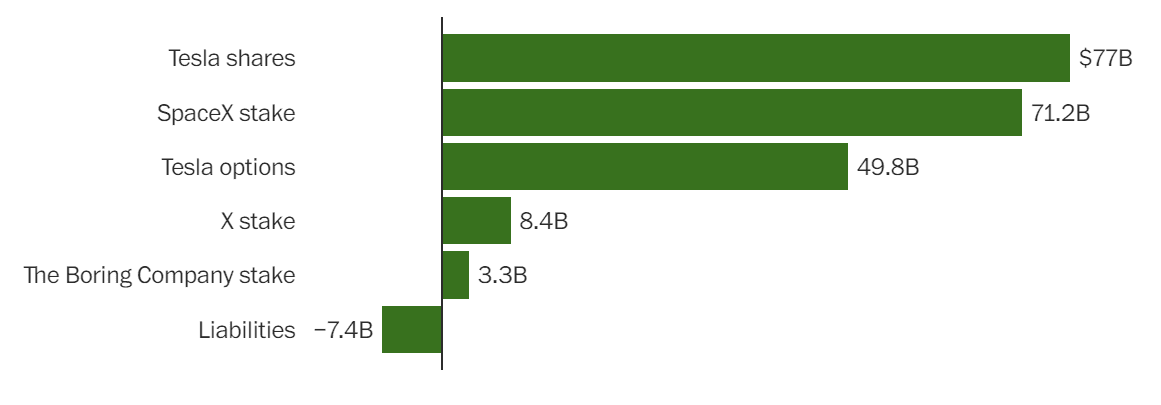
So, taking home a CEO salary doesn’t always mean diving into piles of cash and gold coins like Donald Duck. A lot of CEO wealth is on paper only.
Which CEO salaries are the highest?
That’s the question that’s on the tip of everyone’s tongue, so let’s look at the ever-changing list of the highest-paid U.S. CEOs (as of November 2023, source: fool.com):


$10.077 Bn
$2.289 Bn
$853 Mm
$575 Mm
$343 Mm
1Elon Musk - Tesla
2Robert Scaringe - Rivian Automotive
3Tim Cook - Apple
4Peter Rawlinson - Lucid
5Tom Siebel - C3.ai
Now, while the name in the #1 CEO salary spot needs no introduction, you probably had to look up a couple of other names on this list. That’s because not every CEO also enjoys celebrity status. But isn’t it interesting that #2 on this list is a CEO of the company which, when it went public in November 2021, was widely expected to be the “Tesla killer”?
Rivian had a spectacular, highly reviewed product. It had backing from Ford and Amazon; it had a big pile of cash; and shortly after the IPO, Rivian’s market cap was higher than that of Ford Motor Co and General Motors combined8.
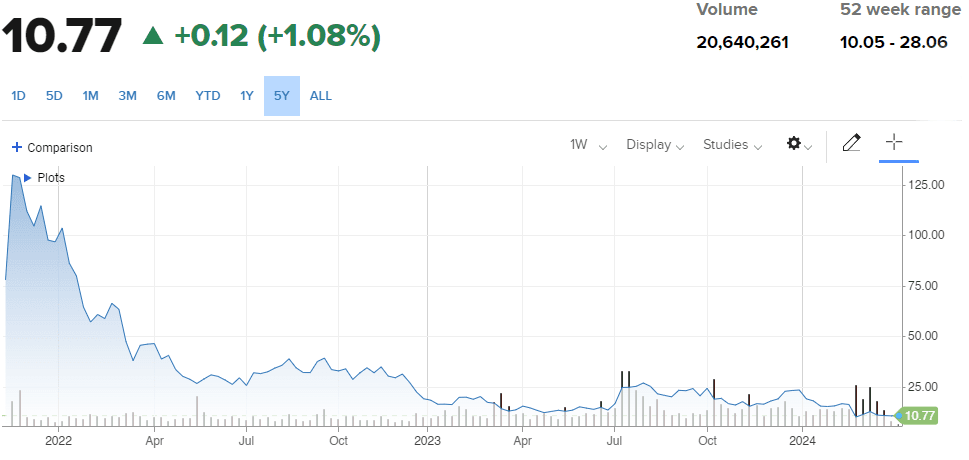
But since its well-received IPO, the price of RIVN has done this:
Source: Cnbc.com
Yes, the price of Rivian shares collapsed more than 90% in two years, despite the company’s glorious market fundamentals. Yet, Rivian CEO Robert Scaringe came in second as the highest-paid CEO in America for 2023. We’ll see where he lands in 2024, but it seems that the performance of the company’s stock is not on his “pay for performance” CEO salary checklist.
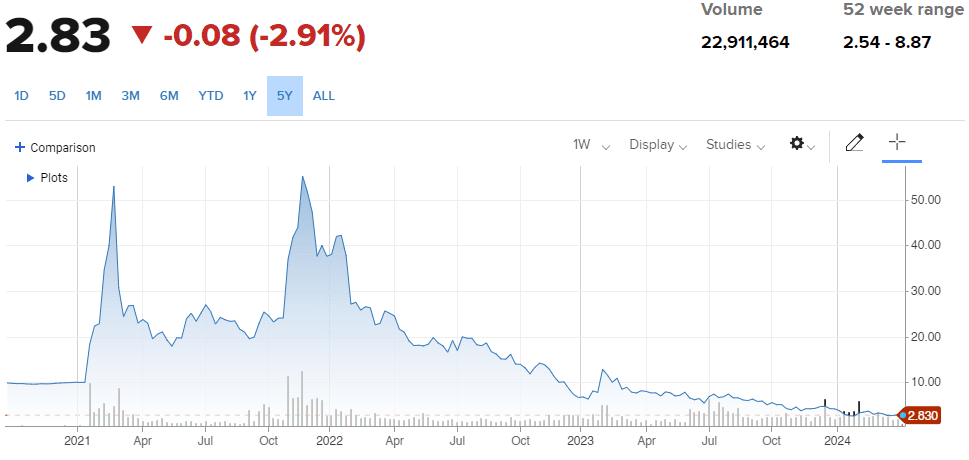
And Scaringe is hardly the only CEO whose salary seems to be going in the opposite way from the performance of the company’s shares. The #4 on the list above is the CEO of Lucid, who made half a half-a-billion dollars in 2023 while the company’s shares (LCID) went from an all-time high of almost $58 in October 2021 down to just over $3 today.
Source: Cnbc.com
Conclusion
In conclusion, the scrutiny of CEO salary through the sharp lens of institutional hedge fund analysis underscores a broader dialogue about corporate performance and value generation. The seemingly exorbitant earnings of top executives often invite public criticism, spotlighting issues of income disparity and calling for a responsible balance between wealth accumulation and societal contribution.
However, we must recognize that within the framework of a free market economy, exceptional leadership that trailblazes innovation, disrupts industries, and delivers unprecedented value to shareholders might be deserving of equally outstanding remuneration. Yet, it is this balance between merit and excess, between reward and equity, that remains at the heart of the discussion.
Most hedge funds, in their methodical approach to investment, fold CEO salary into the fundamental analysis of companies, gauging not only its immediate impact on financials but also its relevance in signaling corporate health and stability. They are watchful of the dynamics that an executive's salary implies — from talent retention to motivational incentives, from governance quality to investor confidence.
The narrative of CEO salaries thus evolves beyond simple figures into the territories of strategic corporate development, ethical governance, and ultimately, wider socio-economic implications. Whether or not these salaries are warranted requires evaluation of a mosaic of factors including both the quantifiable and qualitative contributions of a company's leadership.
It is this nuanced interplay of performance, ethics, and shareholders' interests that corporations and their investors, including hedge funds, will continue wrestling with. Potentially competing interests seek not only to reward exceptional leadership but also to uphold the principles of fairness and social stewardship indispensable in the evolving landscape of the modern economy.
We are tasked, then, not merely to criticize or comply with the status quo, but to engage in these crucial conversations, ensuring they are both forward-thinking and deep-rooted in the collective goal of fostering transparency – where compensation reflects contribution and responsibility is held in as high regard as innovation and success.
Sources:
- CEOs Vastly Overpaid, Most Americans Say – SHRM.org
- Elon Musk's $56 Billion Pay Package Might Have You Wondering: How Much Should You Pay Yourself? – Inc.com
- Highest-Paid CEOs – Fool.com
- Chief Executive Officer Salary in the United States – Salary.com
- Average salary in the U.S. in 2024 – USAtoday.com
- A Guide to CEO Compensation – Investopedia.com
- Elon Musk is unfathomably rich. Here’s where his money is stashed. – WashingtonPost.com
- What’s Wrong with Rivian Stock, and Will RIVN Recover and Go Back Up?
See the list of third-party Private Market and Hedge Funds on our platform.
For financial advisors only.