
Published on October 24, 2024
The Public Solution for Private Equity: Corporate Acquisitions
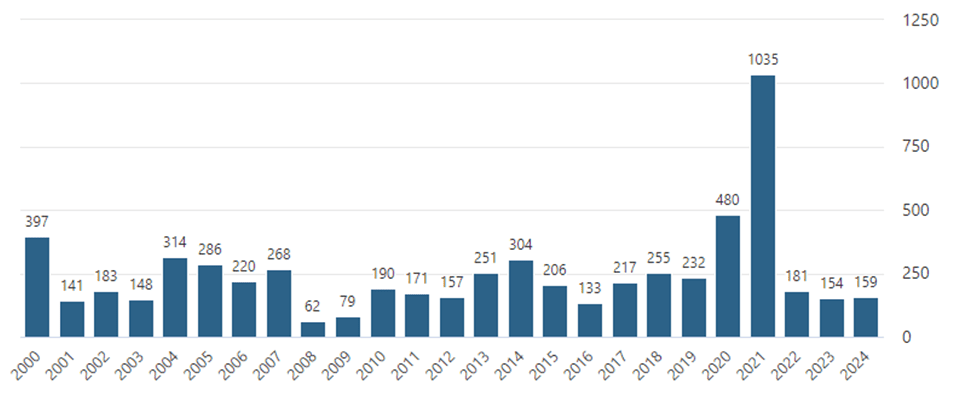
The IPO market has cooled down over the last few years after a historic boom in 2021 when market conditions were ripe for offerings with easy money going around.1 Amid the cooling, private equity groups have been looking for alternative avenues to return capital to investors and exit investments. While the IPO market has been slow, public markets are still very much in play, as public companies are often incentivized to acquire businesses to show innovation and growth trajectories. In lieu of a slow IPO market, private equity groups have increasingly been tapping public market capital and securing exits through corporate acquisitions.2
For entrepreneurs and investors, IPOs are seen as the gold standard of exits. Aside from the excitement of ringing the opening bell of a major exchange, an IPO can be incredibly lucrative. In good times for IPOs, returns can be almost 6 times higher than M&A exits.3 However, much of that success relies on market conditions. Considering the cyclical nature of markets, IPO numbers tend to go through their own cycles as well. In 2021 when interest rates were low, IPOs skyrocketed.4 As rates have gone up in the years since, IPOs have come back down to earth.
In 2024, numbers have remained relatively muted with the activity set to slow through the end of the year. “The IPO window for 2024 is really starting to narrow now,” said Matt Kennedy, senior strategist at Renaissance Capital. “Companies will continue to price through the end of the month, but we might see only one active week in November due to the election and Thanksgiving, and then only one or two active weeks in December.”5
Annual IPOs, 2000-2024
Amid a slower IPO market, private equity groups have been looking for alternative ways to deliver liquidity to investors. Some firms have been resorting to taking on risky debt to pay dividends to investors.2 However, this practice has the downside of potentially over-leveraging and straining a business. Other firms have gotten more creative and have successfully found alternate paths to tap public capital through corporate acquisitions.
IPO Winter, Corporate Summer
While IPOs have slowed down, corporate acquisitions have heated up and private equity groups have increasingly looked to public companies with access to the necessary capital for exits. Public companies are incentivized buyers as they face pressure from shareholders to show growth and deliver returns of their own. While conventional wisdom might suggest that growth should come from internal innovation and optimization, many companies lack the R&D strategy and execution to successfully innovate internally.6 For example, pressure from shareholders may lead to executives pushing R&D teams to produce results more quickly than is possible, leading to missed deadlines, inferior products and poor morale.6 On the other hand, well-funded start-ups that don’t have to spend as much time answering to shareholders can put more focus into developing disruptive innovations. If a public company is being threatened by an innovative start-up, it can be riskier to not consummate an acquisition than to go through with one. One only needs to look at companies like Myspace, AOL, or Nokia to see the risks of stagnation in the face of up-and-coming competitors. All three were companies that looked indestructible at their peak but failed to innovate and are virtually worthless now. On the other end of the spectrum, there are successes such as Google acquiring YouTube, Facebook acquiring Instagram, and Apple acquiring NeXT, all leading to the continued success of market juggernauts. With the risk of falling behind start-up competitors, public companies are highly motivated to innovate through acquisition, contributing to a hot M&A market for private equity groups.
M&A exits for private equity groups have begun to heat up again alongside an increase in corporate acquisitions. The recovery comes as corporate buyers have been showing an increased appetite for large businesses amid an easing interest rate environment. Global M&A volume through the first nine months of the year increased by 18.8% YoY to 2.5trn with each quarter outperforming last year’s respective quarter.2 This has been fueled in part by private equity groups selling large assets to public companies looking for growth. For example, just this year Salesforce acquired Own Company for $1.9B and Zoomin for $45mm, is rumored to be acquiring Informatica for $11B, and acquired Tenyx, Spiff and PredictSpring for undisclosed terms.7, 8 That’s six exits for several private equity firms from one public company through corporate acquisitions. Other behemoths, such as Google and Facebook, have made several acquisitions of their own and are always looking for opportunistic acquisitions after roaring successes in YouTube and Instagram. While the IPO market might be cool, tapping public capital is still very much in play for private equity firms through corporate acquisitions.
Mergers & Acquisitions Worldwide
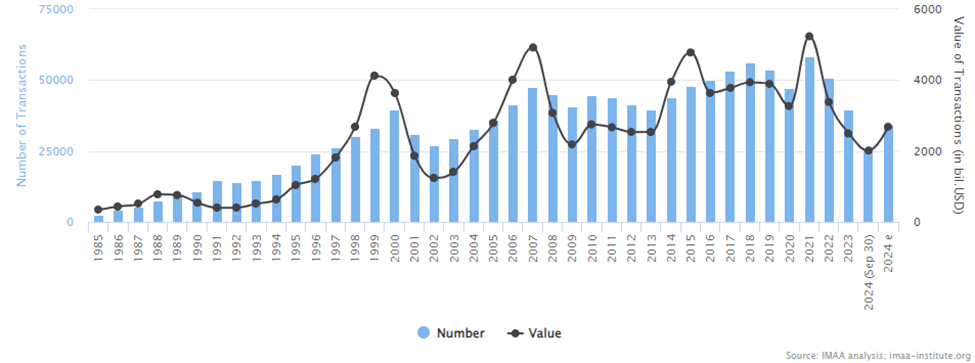
After a historic year for IPOs in 2021, the market was bound to cool off. The boom led to many successful exits for private equity groups, which meant they were in turn flush with cash and made new investments. As those investments have started to mature and firms look for exits amid a cooling IPO market, they have not given up on public markets. On the other end, public companies are constantly under pressure from shareholders to innovate and grow. Often, the best way to show innovation and growth is through acquisition, which makes public companies a natural trading partner for private equity groups looking for exits. In lieu of a cooling IPO market, M&A has been heating up and private equity groups have been able to tap public markets and secure exits by through corporate acquisitions. As interest rates ease, expect acquisitions from public companies to continue heating up and private equity groups to secure more exits through public companies.
Sources:
- Stock Analysis. October 2024. “IPO Statistics”
- Dealogic. October 2024. “M&A Highlights 9M24”
- M&A Community. July 2024. “Navigating exit options: IPOs and acquisitions explained”
- Macro Trends. October 2024. “Federal Funds Rate - 62 Year Historical Chart”
- Wall Street Journal. October 2024. “Paltry IPO Proceeds Spell More Trouble for Venture Investors”
- Financier Worldwide. November 2022. “Innovation-driven acquisitions”
- Tracxn. October 2024. “List of Salesforce's Acquisitions”
- The Channel Co. April 2024. “Salesforce May Acquire Informatica For More Than $11B: Reports”
- Institute for Mergers, Acquisitions & Alliances. October 2024. “M&A Statistics”
See our roster of institutional private market funds.
For financial advisors only.