
Published on October 4, 2024
The Defense Technology Challengers Launching an Industry Revolution
There has never been a more action-packed time for defense investors.
Over the next three years, the world’s top 15 defense contractors will rake in a record $52 billion in free cash flow as rising geopolitical tensions fuel a surge in demand by global governments for the latest weapons and aerospace technologies, according to a study1 by Vertical Research Partners published in The Financial Times.
These longtime defenders of the Western military landscape — including reigning U.S. giants Lockheed Martin, Northrop Grumman, Raytheon, and Boeing as well as Europe’s BAE Systems, Rheinmetall and Saab — are now backed by more financial firepower than ever.
More is yet to come: combined defense spending increased by over 10% in 2023 from 2022, reaching a global total of $2 trillion. This is expected to continue until 2030 as countries increasingly expand their defense budgets amid global conflicts including the Ukraine and Israel/Hamas wars as well as escalating tensions between China and the West, according to a report2 by M&A and debt advisory MCF Corporate Finance.
The Lockheeds and Boeings of the world won’t be the only ones to benefit. In Silicon Valley, a new legion of defense technology disruptors is challenging the global dominance of their far larger rivals for a piece of the pie.
And defense investors are following suit.
A defense coupe d'état?
Earlier this year Anduril Industries, the defense technology upstart launched in 2017 by Oculus VR founder Palmer Luckey and Founders Fund general partner Trae Stephens among others, closed a series F round that raised $1.5 billion from Peter Theil’s Founders Fund and other defense investors.3
The fundraise, which valued the company at $14 billion, marked a major turning point for the industry. Anduril, which specializes in fusing artificial intelligence with the latest defense technology, aims to disrupt heavyweights like Lockheed and Raytheon by speeding up the manufacturing timeline and developing its own products before selling them to clients. Historically, defense contractors have done it the other way around.
The war in Ukraine “exposed a critical vulnerability in the United States’ ability to respond to crisis,” Anduril argued following the funding round, adding that “slow and low production rates, inflexible processes and the development of exquisite, defense-specific, bespoke systems have hindered the ability to respond quickly to need.”
The Costa Mesa, California-based company isn’t the only defense technology start-up capturing investors’ eyes.
German AI defense software maker Helsing raised approximately $489 million in funding from General Catalyst among other investors in July. The company says its defense technology can expand weapon capabilities in drones and fighter jets and improve decision-making on the battlefield.
Dealmakers spring into action
For potential defense technology investors, it’s not a battle between traditional defense contracts or bold new entrants.
Escalating competition in the field paired with the flood of new cash into the sector means that more M&A could be on the horizon.
Recent developments suggest that a healthy pipeline of defense transactions that are already in the works is a good sign for the market overall. Czechoslovak Group recently sweetened its bid4 for Vista Outdoor’s ammunition business to include a 7.5% stake in its outdoor division in an attempt to beat out a rival bid from MNC Capital, while Airbus, Thales and Leonardo are considering merging some of their space activities, according to reports.5
Meanwhile, this month a new private equity firm, Axle Point Capital (launched by a team of defense industry veterans including a former US Navy SEAL) has formed to target opportunities in defense technology6, underscoring a new era for defense M&A as new opportunities land on defense investors’ radars.
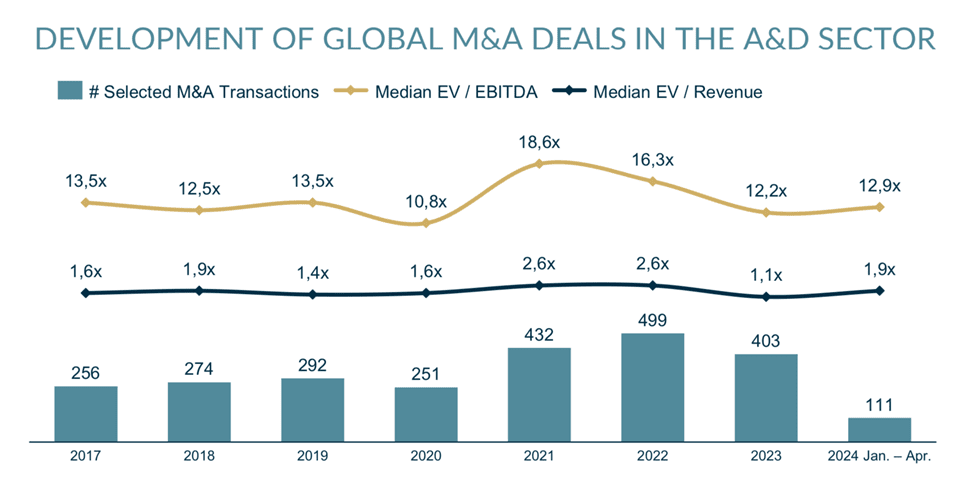
Source: MCF Corporate Finance
Any mega-deals between the world’s largest defense contractors and other large corporations will likely be quashed by regulatory authorities, meaning that defense investors will find the most action will occur in the middle market.
The real opportunities lie with companies on the cutting edge of technologies, including AI, autonomous and unmanned systems, cybersecurity, drones, and surveillance, all of which MCF cites in its report as key drivers for future deal activity as companies look to digitize their operations.
Risks and Conclusion
From AI-powered systems to quantum computing to the latest in drone warfare, the players wielding the most advanced technologies have the most power in the lucrative yet hard-to-penetrate world of aerospace and defense.
The windfall raised by Anduril could be the catalyst to even greater disruptions to the old guard of America’s top defense contractors and their global counterparts.
But the billions pouring into the sector are a direct result of geopolitical factors that could change on a dime, as history has shown, presenting risks for defense investors even in a time of record cash flow.
While defense spending is likely to remain robust in the years to come, the recent spike in weapons orders won’t last forever, especially if the war in Ukraine comes to an end.
Global competition authorities from the US to the EU are also ramping up their scrutiny of large-scale M&A and industry roll-ups given the sensitive nature of national security.
What’s for certain is that a race to develop the most sophisticated defense technology is on, and those who fail to embrace change will be left behind.
Sources:
- Financial Times. “Top defence contractors set to rake in record cash after orders soar.”
- MCF Corporate Finance, May 2024. “Aerospace & Defence M&A Industry Update”
- Anduril, Aug 2024. “Anduril Raises $1.5 Billion to Rebuild the Arsenal of Democracy.”
- Vista Outdoor, Sep 2024. “Vista Outdoor Announces Cash Consideration for CSG Transaction Increased to $28 Per Share.”
- Reuters, July 2024. “Airbus, Thales looking at merging some of their space activities – sources.”
- Morningstar, Sep 2024. “New PE Firm Targets M&A Opportunities in Aerospace and Defense, Government Services.”
Learn about the institutional private funds on our platform seeking compelling opportunities in the defense industry.
For financial advisors only.