
Published on March 7, 2024
Expiring Pharmaceutical Patents - How to Mitigate the Fall
Introduction
Covid aside, bringing a drug to market is a laborious affair. While advances in genomics and biotechnology have decreased costs, it can take a potential drug a decade to pass through clinical trials and a regulatory maze before it can be prescribed. Once the drug is patented, the pharmaceutical company has exclusivity, helping firms not only benefit from the sales of the drug but also to recoup losses from the countless failed drugs that never made it to market. So, while a single drug can be wildly profitable, it often subsidizes the costs of its failed siblings.
The Coming Cliff
When pharmaceutical patents expire, a revenue drop follows as generic drugs enter the market. Depending on the size of the revenue share for the company, an expiring pharmaceutical patent can be a drop akin to a handful of stairs or a cliff.
Pharmaceutical patent cliffs are not new, but the size of the impending cliff has the industry concerned. By 2030, approximately 190 drugs will lose pharmaceutical patent protection. Historically speaking, the last decade also featured some pricey expirations.
Pharmaceutical Patent Expiration 2000 - 2017 (US billions)
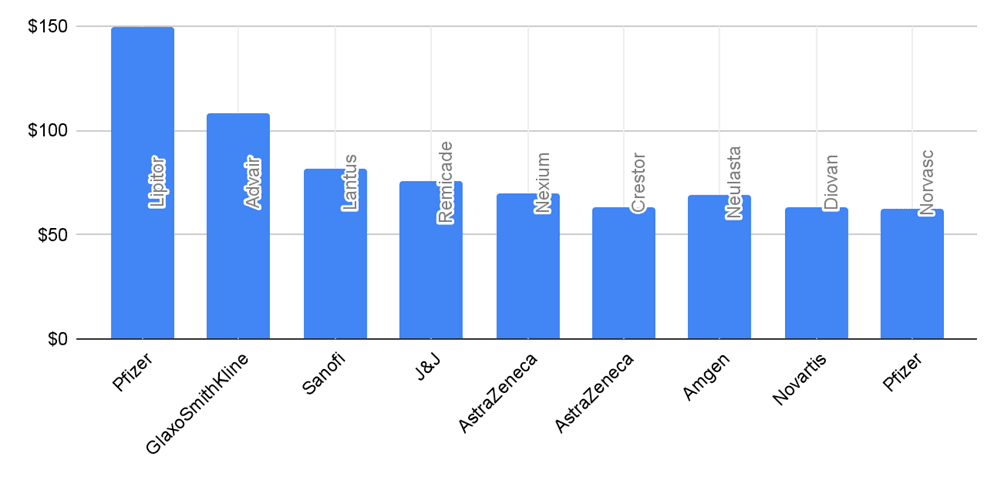
Looking forward to 2030, the pharmaceutical patents landscape is challenging:2
- 46% revenue decline of the world’s top 10 pharma companies (over the coming decade)
- $236 billion in sales at risk over the coming six years
- $59 billion in sales at risk in 2029 alone
Mergers and Acquisitions
The pharmaceutical patent cliff is not the only issue firms are facing. Further interest-rate movements, an uncertain November presidential election, a questionable IPO and overall market climate for early-stage companies, and regulatory uncertainty have executives focused on strategic dealmaking.3 This is not the time to sit passively on the sidelines.
The total mergers and acquisitions (M&A) value for 2023 was nearly $215 billion.
Top Pharmaceutical and Life Sciences Deals (2023)4
| Target Name | Transaction Value $USD (bn) | Acquiror | Transaction Status |
|---|---|---|---|
| Seagen Inc. | 44.5 | Pfizer | Announced |
| Karuna Therapeutics | 13.8 | Bristol Myers Squibb | Announced |
| Prometheus Biosciences | 10.8 | Merck & Co. | Closed |
| ImmunoGen | 9.5 | AbbVie | Announced |
| Cerevel Therapeutics | 9.1 | AbbVie | Announced |
| Reata Pharmaceuticals | 7.7 | Biogen | Closed |
| Syneos Health | 7.5 | Veritas Capital; Elliott Investment; Patient Square Capital | Closed |
| Dechra Pharmaceuticals | 6.1 | Luxinva SA; Eqt Fund Management | Announced |
| Mirati Therapeutics | 6 | Bristol-Myers Squibb | Announced |
| IVERIC bio | 6 | Astellas US Holding | Closed |
While only growing 2% compared to 2022, 2023’s M&A agreements were notably larger. The looming pharmaceutical patent cliff will naturally augment the industry’s growth gap, which is predicted to be over $120 billion by 2028. Because there are currently not enough drugs in the pipeline to cover this gap, M&As are front and center. EY estimates approximately $1.37 trillion in available capital for future deals.5
Insider Look at Merck
Known as Merck in the US and Canada and MSD everywhere else worldwide, the pharmaceutical giant needs potential new treatments as the cliff inches closer. Critical patents for Keytruda, a cancer-immunotherapy drug, are set to expire in 2028, and the $10.8 billion acquisition of Prometheus Biosciences, a biotech firm from California, is seeking to offset some of Keytruda’s future losses.
Prometheus has neither approved drugs nor profits but does have a promising drug, PRA023, that is approaching the late stages of clinical trials. Merck paid $200 per share for Prometheus (75% over the closing price).6 Keytruda had been a cash cow for Merck, accounting for just over a third of all 2022 sales.
What We Can Learn from the Past
When former Novartis CEO Joseph Jimenez arrived in 2007, the firm’s mammoth anti-hypertensive drug, Diovan, was set to lose its pharmaceutical patent protection in 2012. Diovan was responsible for over 20% of the pharmaceutical division’s revenue, and it was Jimenez’s principal challenge from Day 1.
Jimenez spent his initial months brainstorming with personnel at all levels and arrived at two key areas to counteract the pending revenue hit:7
- Intensify Oncology Drugs
- Afinitor was a drug initially designed to treat renal cell carcinoma. Scientists felt it could be used to treat many other cancers, so instead of limiting the drug to a small portion of carcinoma patients, Novartis accelerated clinical trials. Afinitor, along with others, were eventually approved to treat advanced breast cancer - a much broader swath of the population.
- Chinese Ramp Up
- Novartis had been expanding slower than its competition in BRIC countries (Brazil, Russia, India and China). In 2007, the Chinese business unit was only onboarding 150 - 200 new salespeople annually. Jimenez wanted 500, and an idea emerged surrounding the establishment of a training center. Novartis invested heavily in the Novartis China Commercial University, and by 2011, business in China had grown by 38%.
Concluding Thoughts
As the Novartis example showed, positioning drugs to capture a larger market share is a critical tool. Moving forward, the oncology market is poised to grow tremendously.
Pharmaceutical Patents Therapeutic Area Driving Market Growth
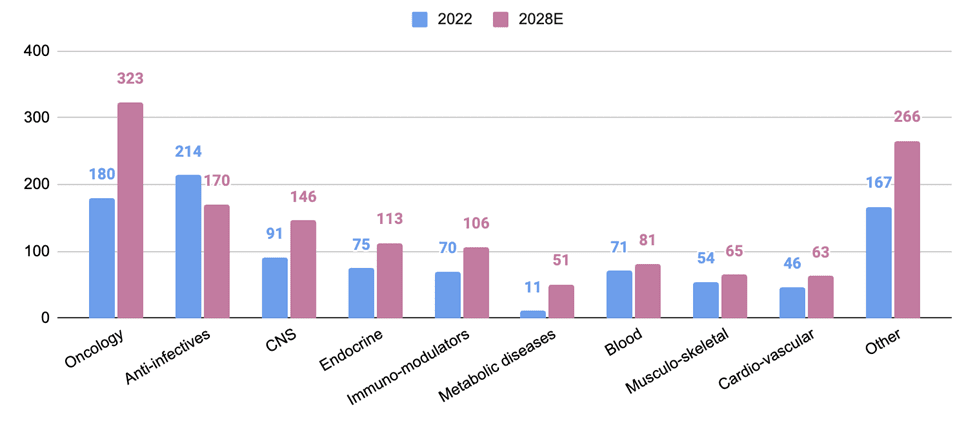
M&A deals like that of Merck and others and global expansion into BRICs and similar developing markets hold great potential. Many countries have different patent expiration regulations and timelines, so a pharmaceutical patent expiring in one will likely remain intact elsewhere.
The industry credit outlook for the pharmaceutical, medical device, and life science products subsectors of the healthcare industry is stable.
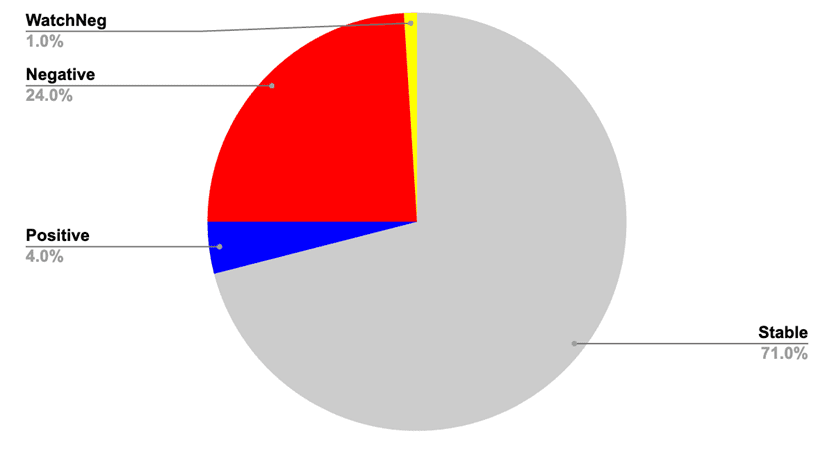
The pharmaceutical patent cliff will undoubtedly result in a flurry of activity, while the larger sector hopes to buck the underperformance trend during an election year. According to Dow Jones Market Data analysis of S&P 500 data from 1928 to date, technology, and healthcare suffered their worst performance during the year Americans hit the polls for president.8
Private Fund Involvement in Pharmaceuticals
The landscape of investment in the pharmaceutical and medical devices industry has been substantially shaped by strategic moves of private market funds. With the healthcare sector's relentless pace of innovation and an increasing demand for effective medical solutions, the role of private market funds has been amplified. A noticeable surge in mergers and acquisitions has led to the consolidation of companies within this sector. Private market sponsors enable the formation of larger, competitively equipped, and diverse organizations, preparing them to tackle the volatile nature of the healthcare market. These larger, capital-backed, companies are better equipped to survive market pressures and deliver robust product pipelines. By backing expansion strategies, private market investors have propelled companies into new territories, directly impacting global healthcare access. This has not only broadened the market for healthcare solutions but has also contributed to global health advancements.
The dance between private funds and healthcare sectors continues to evolve, reflecting a dynamic partnership that drives innovation, consolidation, and market growth. The growing sophistication of private market investment strategies further signifies its critical role in shaping the pharmaceutical and medical devices industries of the future.
Sources:
- Dutton, Gail. June 7, 2022. “Looming Patent Cliff will be Pharma’s Moment of Truth.” Biospace.
- Dutton, Gail. June 7, 2022. “Looming Patent Cliff will be Pharma’s Moment of Truth.” Biospace.
- Christel, Michael. January 26, 2024. “The Twists and Turns in Biopharma Dealmaking: 2024 Trends.” PharmExec.com
- PricewaterhouseCoopers. “Pharmaceutical and life sciences: US Deals 2024 outlook.”
- Baral, Subin. Jan 8, 2024. “How life sciences can make the right deals in a time of change.” Ernst & Young.
- The Economist. April 20, 2023. “Big pharma’s patent cliff is fast approaching.”
- Jimenez, Joseph. Dec 2012. “The CEO of Novartis on Growing After a Patent Cliff. Harvard Business Review.
- Langley, Karen. Jan 21, 2020. “Health-Care and Tech Stocks Tend to Underperform in Election Years.” The Wall St. Journal.
See the managers on our platform investing in pharma and healthcare-related sectors
For financial advisors only.