
Published on September 30, 2024
The Fed Rate Cut: What It Means for the U.S. Dollar
The U.S. Dollar’s Downward Path: Impacts of the Fed Rate Cut and Global Market Dynamics
The U.S. dollar has long been considered the world's dominant reserve currency, a safe haven asset in times of global economic uncertainty. However, recent developments, most notably the Fed rate cut in September 2024, have signaled a shift in the dollar’s trajectory. This article delves into the reasons behind the dollar's decline, the consequences of the Fed rate cut, and the potential future for the greenback in an increasingly volatile global financial landscape.
A Brief Overview: The Dollar Smile Theory
To understand the U.S. dollar's recent movements, it is helpful to revisit the Dollar Smile Theory, a concept first introduced by Stephen Li Jen nearly two decades ago. The theory suggests that the dollar tends to outperform other currencies in two contrasting scenarios: during times of U.S. economic strength or during global economic crises when risk appetite falls and investors flock to its relative safety (Schroders, 2023).
The Dollar Smile
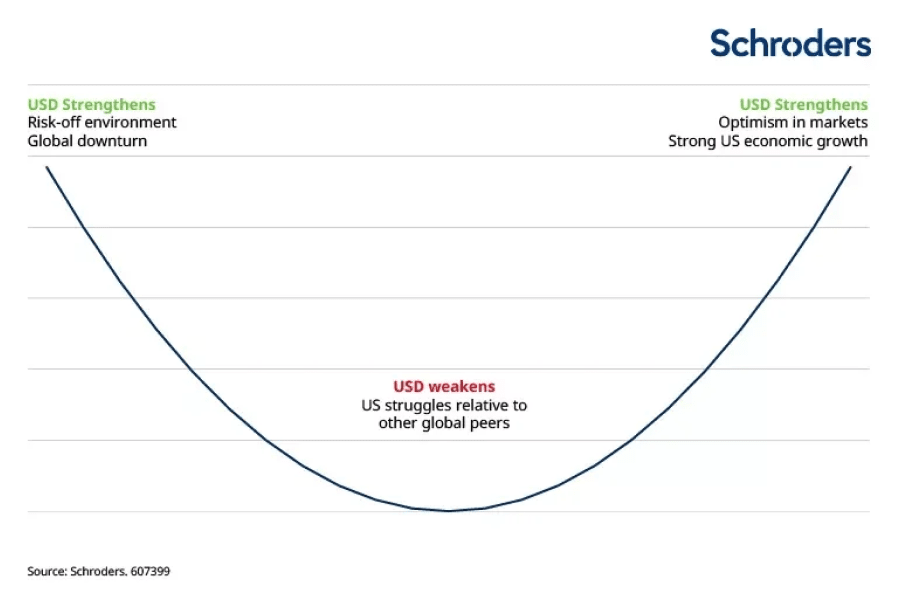
The "Dollar Smile" theory has generally applied over the past few years, especially during the initial stages of the COVID-19 crisis and the Fed's aggressive tightening cycle in 2022. As the pandemic caused global economic turmoil, the U.S. dollar surged due to its safe-haven status, aligning with the left side of the smile, which predicts dollar strength during crises (Richmond Fed, 2022). In 2022, as the U.S. economy experienced strong growth and the Fed raised rates, the right side of the smile took effect, with the dollar strengthening significantly (UBS, 2023). However, the dollar weakened in late 2022 and 2023, reflecting moderate global growth and expectations of a more dovish Fed, corresponding to the middle dip in the smile (Markets Insider, 2023; Richmond Fed, 2022).
These two extremes create a “smile” pattern when charting the dollar’s performance. But in recent months, the smile has faded.
A Turning Point in 2022
The U.S. dollar began its current decline in October 2022, as inflation in the U.S. appeared to peak. This marked a turning point for the Federal Reserve, which had spent much of 2021 and 2022 raising interest rates aggressively to tame inflation. Starting with 75 basis point (bps) hikes, the Fed eventually slowed its pace, cutting the increase to 50 bps in December 2022 and then to 25 bps in early 2023 (CMC Markets, 2023).
While the Federal Reserve's rate hikes helped strengthen the dollar for much of 2022, the slowdown in rate increases signaled to investors that the peak might be behind us (Investopedia, 2023). The U.S. dollar began to gradually weaken as markets priced in a more dovish Federal Reserve (Investopedia, 2023).
This weakening has been exacerbated by inflation persisting in key economies such as the U.K., Australia, and New Zealand. As these countries face rising price pressures, their central banks have remained hawkish, keeping interest rates higher than those in the U.S. As a result, their currencies have gained strength against the dollar, adding further pressure to the greenback (Reuters, 2024).
Global Volatility and Japan’s Surprise Move
The summer of 2024 introduced a new source of volatility for global currency markets. On August 5th, the Bank of Japan (BOJ) surprised markets by raising interest rates for the first time in years. This move had far-reaching consequences, particularly for the yen carry trade, a popular strategy where investors borrow in low-yielding currencies like the yen to invest in higher-yielding assets elsewhere (Reuters, 2024).
The BOJ’s rate hike effectively interrupted the yen carry trade, causing sharp declines in major global indices. Japan’s Nikkei 225 index dropped by over 12%, while South Korea’s Kospi fell by nearly 9%. U.S. markets were also affected, with the Dow Jones Industrial Average and the Nasdaq declining by 2.6% and 3%, respectively (Reuters, 2024).
This global selloff was further fueled by concerns about a looming U.S. recession, especially after a disappointing jobs report. Non-farm payroll growth came in far below expectations, and the U.S. unemployment rate ticked up to 4.3%. Market fears surged, with the Cboe Volatility Index (VIX)—often referred to as the "fear gauge"—reaching its highest levels since 2020 (Reuters, 2024).
In an attempt to stabilize markets, the BOJ intervened to cap the yen at 140 against the dollar. While this intervention helped prevent further turmoil, it underscored the significant uncertainty in global financial markets and highlighted how diverging monetary policies between the U.S., Japan, and other economies were creating volatility (Reuters, 2024).
Powell’s September 2024 Rate Cut: A Dollar Game Changer?
On September 18, 2024, the Federal Reserve announced its first rate cut since 2021, lowering the federal funds rate by 50 bps, bringing it to a target range of 4.75% to 5%. This aggressive move had been anticipated by markets, with expectations for the cut rising from 14% to over 60% in the days leading up to the decision. The Fed’s rationale was clear: with a cooling labor market and inflation inching closer to its 2% target, there was room for easing (Reuters, 2024).
Historically, the U.S. dollar has closely followed the Fed's interest rate decisions and U.S. bond yields. As rates rise, the dollar tends to strengthen, and as rates fall, the dollar weakens. The September cut was no exception; it confirmed the market’s bearish stance on the dollar (CFTC, 2024). Following the Fed rate cut on September 18, 2024, the U.S. dollar showed signs of decline as markets reacted to the news. Although the Fed's move was anticipated, indicating that some effects were already "baked in," the dollar's drop reflects a shift towards a more dovish monetary policy (American Century, 2024; Kiplinger, 2024).
Adding to this sentiment were the mounting bearish bets on the dollar. According to the Commodity Futures Trading Commission (CFTC), there were $15 billion worth of bearish positions against the U.S. dollar leading up to the Fed’s rate cut (CFTC, 2024).
Diverging Central Bank Policies and the Dollar’s Resilience
While the Federal Reserve has taken a dovish turn, other central banks, particularly the Bank of Japan (BOJ) and European Central Bank (ECB), have pursued differing paths. The BOJ’s decision to raise rates and then cap the yen at 140 against the dollar, for example, has helped prevent the yen from gaining too much ground on the dollar, keeping the dollar more resilient than anticipated (Reuters, 2024).
Meanwhile, persistent inflation in Europe and other regions has kept the ECB on a hawkish course, further complicating the outlook for the U.S. dollar (Reuters, 2024). This divergence in monetary policies adds to the uncertainty around the dollar’s future, with some traders suggesting that the dollar may remain more stable than bearish positions would imply.
The Road Ahead for the U.S. Dollar
While the U.S. dollar faces downward pressure due to the Federal Reserve’s recent rate cut, its decline is unlikely to be straightforward. The global economic landscape is increasingly characterized by uncertainty, with diverging monetary policies across key economies adding complexity to the dollar's trajectory.
As central banks around the world react to inflation, employment data, and other key economic indicators, the future of the dollar remains uncertain. The greenback may face further declines, but its role as a global reserve currency and the contrasting policies of other major central banks will likely prevent a full collapse.
In conclusion, the U.S. dollar is likely on a downward path, driven by Fed rate cuts and global economic headwinds. However, the nuances of global monetary policy and ongoing economic uncertainties mean that while the dollar may face more pressure, it remains a critical player in the global financial system.
Sources:
- CFTC. (2024). U.S. Dollar Bearish Positions. Commodity Futures Trading Commission Report.
- CMC Markets. (2023). U.S. Dollar Performance and Federal Reserve Policies. CMC Markets Analysis Report.
- Reuters. (2024). Japan's Interest Rate Shock and Its Global Implications. Reuters Financial News.
- Schroders. (2023). The Dollar Smile Theory: What It Means for Investors. Schroders Economic Insights.
- Markets Insider. (2023). Dollar Seen Set for 'Ongoing Weakness' With Fed Likely to End Rate Hikes: UBS Strategist.
- Richmond Federal Reserve. (2022). Dollar Smile: Understanding Exchange Rate Movements During the Pandemic.
- UBS. (2023). Dollar Weakness Expected as Fed Slows Tightening Cycle.
- Investopedia. (2023). "How Moves in the Fed Funds Rate Affect the U.S. Dollar."
- American Century. (2024). What Happens to the Dollar When the Fed Cuts Rates?
- Kiplinger. (2024). What Should Investors Do After the Fed Rate Cut?
See our roster of institutional hedge funds.
For financial advisors only.