
Published on November 7, 2024
Healthcare AI: Big Data, Big Breakthroughs
One of the biggest breakthroughs in healthcare right now isn’t a miracle drug or medical device — it’s artificial intelligence.
From streamlining clinical trials to delivering life-changing medicines to patients faster and more efficiently than ever before, healthcare AI is giving the industry a major reboot.
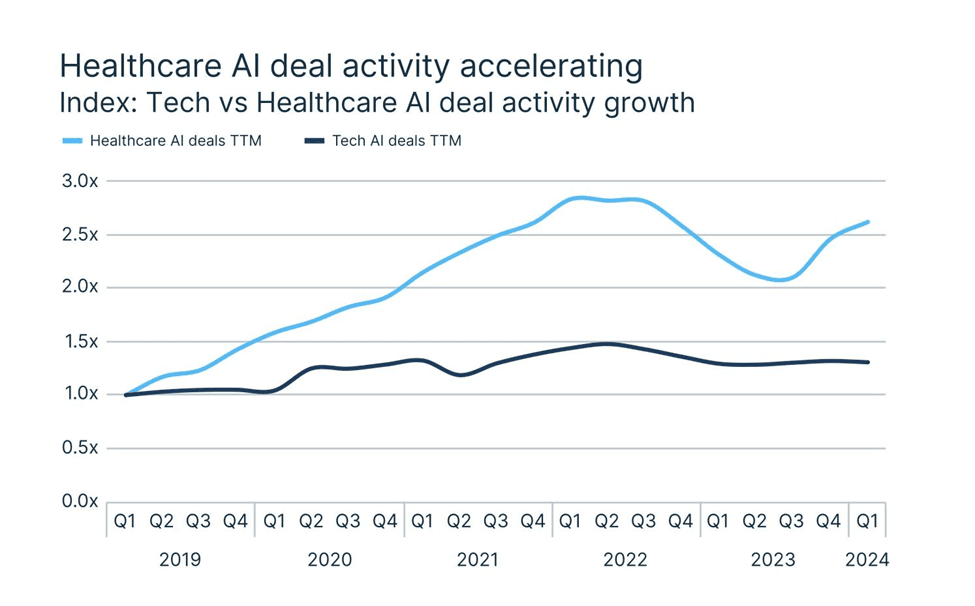
Healthcare AI is dominating M&A in the sector, according to a report1 by Silicon Valley Bank, with 1 in every 4 dollars invested in healthcare going toward companies that leverage AI technology.
Meanwhile venture capitalists invested $7.2 billion into healthcare AI in 2023, with 2024 on track to hit $11.1 billion — the most AI-powered healthcare groups have seen since the AI frenzy of 2021.
Source: Silicon Valley Bank
Already, AI-powered algorithms are increasing the accuracy of surgical robots, mining data to identify diseases faster, and have even been shown to outperform radiologists in spotting malignant tumors.2
And with far more developments on the horizon – powering the latest advancements in gene editing3 and diagnostic equipment4, for example – it’s clear that scientists have only just begun to unlock what’s possible in harnessing the power of healthcare AI, as well as machine learning, natural language processing, and other rapidly advancing technologies.
Source: Accenture
Medical providers and organizations across the spectrum face a similar choice: embrace the transformative power of healthcare AI, or risk being left behind.
Investors looking to back this lucrative space will encounter no shortage of opportunities, although each comes with unique risks given that many healthcare AI technologies are still in the early phases of development, and implementing them too quickly could bring up ethical concerns.
Speeding up the science
Investing in biopharma has historically been a bitter pill to swallow for many investors. It can take anywhere from 10-12 years and cost upwards of $2.6 billion to bring a new drug to market, not to mention that approximately 90% of new medicines fail in early development stages, according to a study5 by professional services group Accenture.
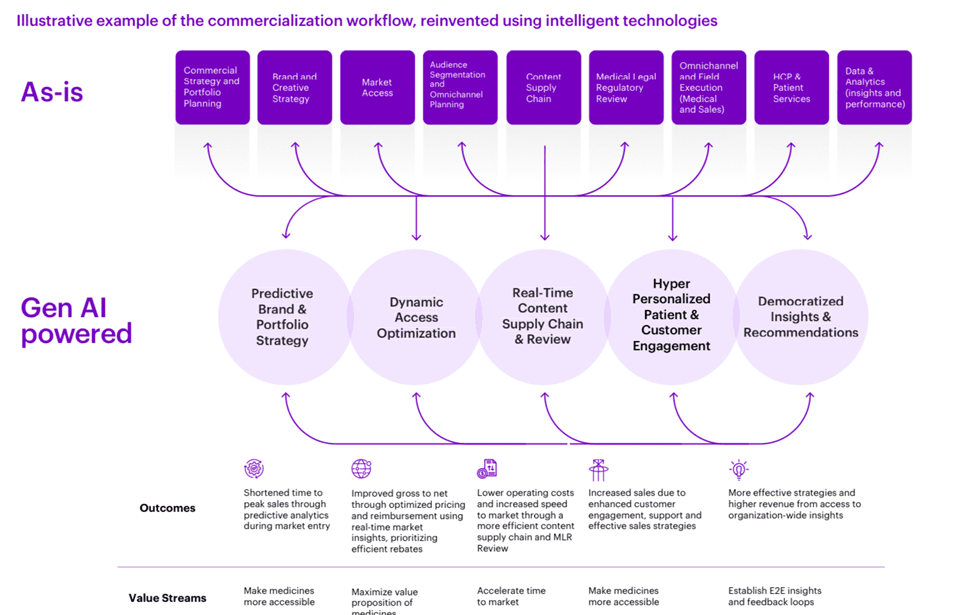
Even if a drug does manage to survive the R&D phase, the complications don’t end there. Manufacturing and commercializing new therapies are highly complex and arduous processes, often requiring the development of brand-new supply chains that could take years to optimize, Accenture’s findings noted.
Healthcare AI can accelerate that timeline dramatically.
A 2022 study6 by consulting group BCG analyzed the drug development timelines of “AI-intensive” companies and found that of the 8 drugs with data available, 5 had reached clinical trials at a faster rate than average.
A separate BCG analysis7 published last year surmised that AI-driven drug development, from the discovery phase to preclinical trials, could deliver time and cost savings of at least 25-50% respectively. But there are still major hurdles when it comes to AI and pharmaceutical development, the study cautioned, including a lack of high-quality data sets and access to healthcare AI technology.
Source: Accenture
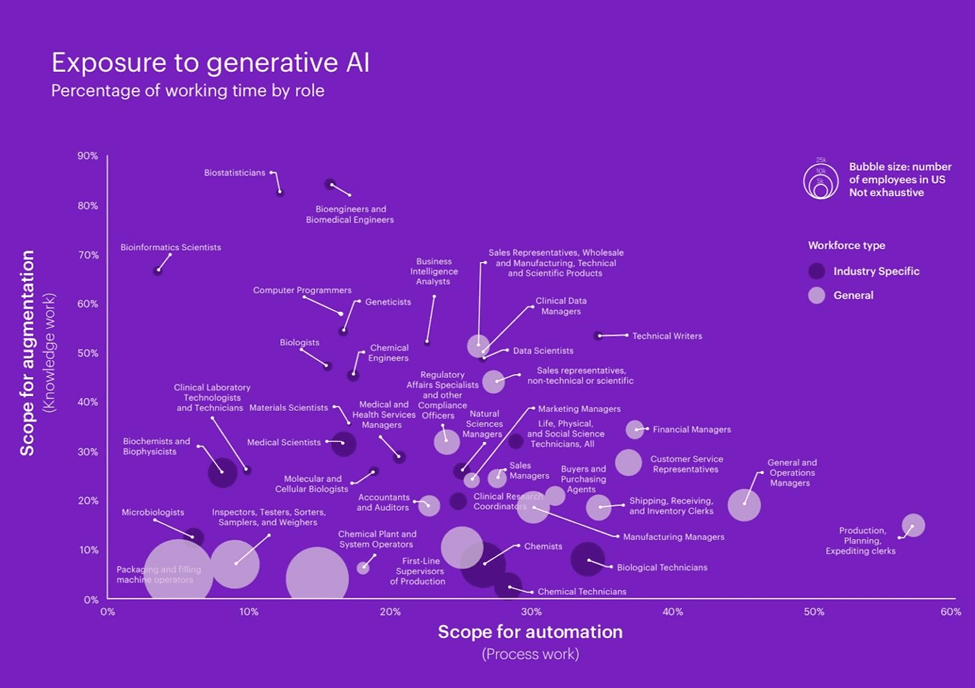
Leading biotech group Amgen, for example, is utilizing generative AI via what it calls "generative biology" to turbocharge drug discovery by engineering protein-based drug candidates using machine learning models, enabling them to create and study thousands of different scenarios at rapid speed.
AI is also helping identify new applications for existing drugs to help predict the side effects of new drugs and spot potentially dangerous interactions or bad patient reactions before they happen.8
Faster, more reliable diagnoses
AI algorithms are designed to spot patterns that extend across pools of data and use them to predict new hypotheses surrounding human biology and disease. One study9 found that ChatGPT was 77% accurate in making diagnoses for patients, though the program was less adept when quizzed on general knowledge.
As another example, these technologies are helping to make the cancer screening process faster and more efficient. Pathologists are using AI-based programs to pinpoint areas of prostate biopsy images that could resemble cancer10, while radiologists are processing medical images, including mammograms, faster with the assistance of AI.11
Healthcare organizations get an AI boost
From the pediatrician’s office to the emergency room, AI’s potential to streamline administrative process and help providers develop best practices are seemingly limitless.
In the operating room, hospitals have used deep learning technologies to analyze surgical video captured during surgery, opening up opportunities for education, medical research and quality-improvement strategies.12
Healthcare AI can also help providers of all kinds automate tedious and time-consuming tasks such as responding to messages, billing practices and analyzing medical charts, allowing them to spend more time focusing on their patients.
Conclusions
Healthcare AI’s potential to improve medical practices and help deliver better care to patients is ever-expanding.
But even the most established of these technologies are still relatively new, and it could take years for the next generation of healthcare AI tools to be seen as less speculative investments.
Investors looking to back the future of medical technology ought to take the scientific approach: identifying companies on the cutting edge of AI-powered medicine, carefully weighing the risks, and developing a hypothesis accordingly.
Sources:
- Silicon Valley Bank, June 2024. “The AI-Powered Healthcare Experience.”
- Future Healthcare Journal, June 2019. “The potential for artificial intelligence in healthcare.”
- NYU Langone Health, January 2023. “New Artificial Intelligence Tool Makes Speedy Gene Editing Possible.”
- Springer Nature, January 2022. “Artificial intelligence in disease diagnosis: a systematic literature review, synthesizing framework and future research agenda.”
- Accenture, January 2024. “Reinventing life sciences in the age of generative AI.”
- Nature Reviews, March 2021. “AI in small-molecule drug discovery: a coming wave?.”
- Boston Consulting Group, January 2023. “Unlocking the potential of AI in Drug Discovery.”
- Harvard Medical School, September 2024. “Researchers Harness AI to Repurpose Existing Drugs for Treatment of Rare Diseases.”
- US Food and Drug Administration, September 2021. “FDA Authorizes Software that Can Help Identify Prostate Cancer.”
- National Library of Medicine, November 2018. “Artificial intelligence in radiology.”
- Journal of Medical Internet Research, May 2023. “Assessing the Utility of ChatGPT Throughout the Entire Clinical Workflow: Development and Usability Study.”
- JAMA Network, July 2024. “Deep Learning Analysis of Surgical Video Recordings to Assess Nontechnical Skills.”
See the funds actively investing in healthcare AI.
For financial advisors only.