
Published on September 12, 2024
Riding High: The Impact and Implications of a Strong U.S. Dollar
The U.S. dollar (USD) is pivotal in the global economy. Its value impacts trade balances, investment strategies, and economic stability worldwide. But the dollar’s appreciation presents both opportunities and challenges. This insight explores the implications of a strong dollar through key lenses: global trade dynamics, economic indicators, investment strategies, impacts on emerging economies, and the long-term outlook.
Global Trade Dynamics: Winners and Losers of a Strong Dollar
A strong dollar impacts global trade dynamics, creating distinct winners and losers. U.S. consumers and businesses that import goods benefit from increased purchasing power, as a stronger dollar makes foreign products and services more affordable. This leads to Americans buying more stuff, increasing imports, and boosting retail, technology, and manufacturing sectors that depend on imported components.
However, a strong greenback makes business more challenging for U.S. exporters. American goods and services become more expensive abroad, reducing competitiveness and dampening demand. This can negatively impact industries like agriculture, automotive, and aerospace, which rely heavily on international markets for a large chunk of their revenue.1
A strong greenback can be a mixed bag for foreign companies doing business in the U.S..2 Those exporting to the U.S. benefit from the increased demand for their cheaper goods but might be burdened by more expensive debt as their local currencies weaken against the dollar.3
As the U.S. general election nears, the political debate surrounding the dollar's value is heading up. Some elected officials and high-profile candidates like Sen. J.D. Vance have advocated for a weaker dollar policy, arguing that the strong dollar disadvantages American manufacturers by making exports less competitive and encouraging reliance on cheaper imports. This challenges long-standing strong dollar policy and supports the political goal of boosting domestic industries and reducing trade deficits.4
Economic Indicators Driving Dollar Strength
The strength of the U.S. dollar is influenced by key economic indicators, notably interest rates, inflation, and economic growth. Higher interest rates set by the Fed attract foreign capital seeking better returns, strengthening the mighty greenback and (hopefully) curbing inflation.
Lower inflation isn’t just helpful for the domestic market; it makes the dollar even more appealing. As investors react to shifting risks and uncertainties from geopolitical tensions, cross-border trade disputes, instability in major economies, and armed conflicts, the U.S. dollar’s strength is impacted.5
The U.S. dollar's status as the world's reserve currency was formally established through the Bretton Woods Agreement, a currency exchange system established in 1944 to help the world rebuild after World War II. Initially, the 44 countries that signed the agreement committed to peg their currency to the U.S. dollar, backed by gold.
In the 1970s, the gold standard system collapsed, and participating economies were given the choice to let their currency float freely, peg it to a different currency or group of currencies, adopt another country’s currency (i.e., dollarization), or form a currency bloc, like the Eurozone. The U.S. dollar, however, has remained the world’s dominant reserve currency of choice.6
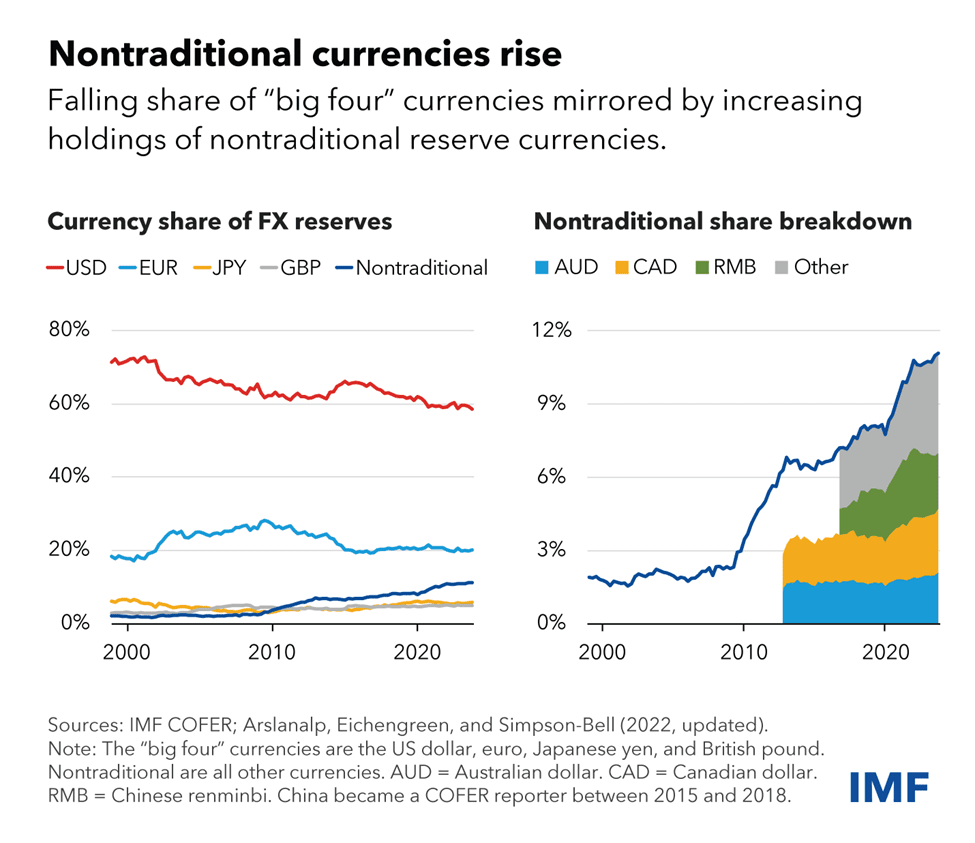
The dollar's dominance in global finance provides the U.S. with various economic advantages, including lower borrowing costs and the ability to manage trade deficits more easily. This widespread use ensures a consistent demand for dollars, reinforcing its position during global economic fluctuations.8
Despite the U.S. dollar's dominant status, gold prices have risen significantly, reflecting increased demand for the precious metal as a safe-haven asset (though gold as a percentage of overall reserves is still at historic lows). Many central banks have diversified their reserves, holding gold as a hedge against currency risks, potential declines in the value of the U.S. dollar, and protection against inflation.9
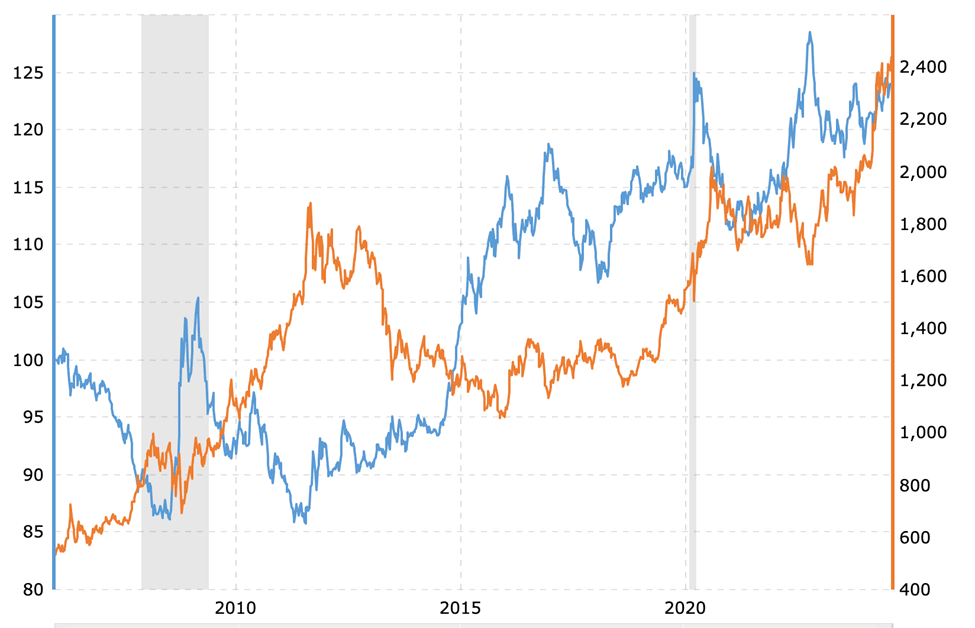
U.S. Dollar and Gold prices over time. Blue represents the price of the U.S. Dollar, orange the index price of gold.
Note that the vertical lines represent recessions.10
Investment Strategies in a Strong Dollar Era
Investing in a strong dollar environment requires strategic consideration of currency risk and market conditions. One effective approach is investing in domestic companies that benefit from lower input costs due to cheaper imports. This includes retail and consumer goods sectors, where reduced costs can lead to improved profit margins.
Industries less exposed to international market fluctuations, like utilities and healthcare, offer stability and resilience. Investors might also consider hedging strategies, such as currency-hedged exchange-traded funds (ETFs), to mitigate the risks of adverse currency movements.11
For those willing to embrace higher risk, emerging markets present potential opportunities. A strong dollar makes investments in these markets cheaper, offering significant returns if these economies stabilize and their currencies appreciate.12
Another viable strategy is focusing on sectors that historically perform well in a strong dollar environment. Financial institutions, for example, often benefit from higher interest rates, which typically accompany a strong dollar. Additionally, companies with substantial cash reserves in dollars can leverage their increased purchasing power for strategic acquisitions or investments.13
The Ripple Effect: How a Strong Dollar Impacts Emerging Economies
Emerging economies often face considerable challenges due to a strong U.S. dollar. Many of these economies rely heavily on exports, which become more expensive and less competitive in the global market as the dollar strengthens. This can lead to reduced demand for their goods, slowing economic growth.
Countries with significant dollar-denominated debt are particularly vulnerable. As the dollar appreciates, these nations find it more expensive to service their debts, leading to financial strain. This situation can force governments and businesses to cut spending or increase prices, potentially stalling economic growth and causing social unrest.
Brazil and Turkey are examples of emerging economies affected by a strong dollar. Brazil, a major exporter of commodities like soybeans and iron ore, faces reduced competitiveness as these products become more expensive for foreign buyers. Meanwhile, Turkey, which also holds significant U.S. dollar debt, struggles as the cost of repaying loans rises. This threatens inflationary pressures and can cause economic instability.14
For developing economies that have dollarized—adopted the U.S. dollar as their official currency or used it extensively in everyday transactions—the impact is more nuanced.
Countries like Ecuador and El Salvador have dollarized to stabilize their economies and curb hyperinflation. A strong dollar can lead to losing export competitiveness in these economies, as they must maintain their currency to adjust prices. This rigidity can stifle economic growth and make responding to external shocks challenging. However, the use of a strong and stable currency like the U.S. dollar can also help attract foreign investment and provide a much-needed stable economic environment, which is beneficial in the long run.15
USD/JPY Daily Chart
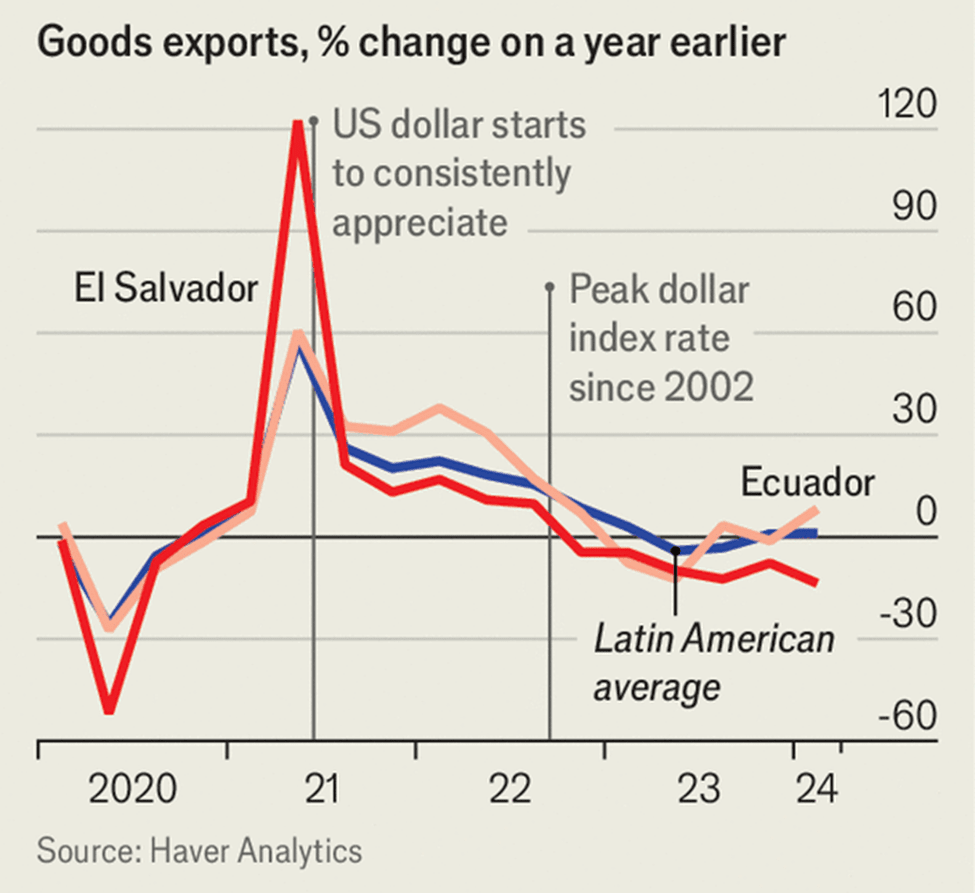
While assets in emerging markets may become cheaper, the risk of inflation due to currency depreciation can erode returns. Moreover, capital flight, where investors withdraw funds from these markets in favor of safer assets in the U.S., can exacerbate economic instability in these countries.
Yet, not all emerging markets are equally affected. Countries with strong foreign exchange reserves, low external debt, and diversified economies are better equipped to handle the pressures of a strong U.S. dollar. Additionally, commodity-exporting countries may benefit from higher revenues in local currency terms, even if global demand for their exports fluctuates.17
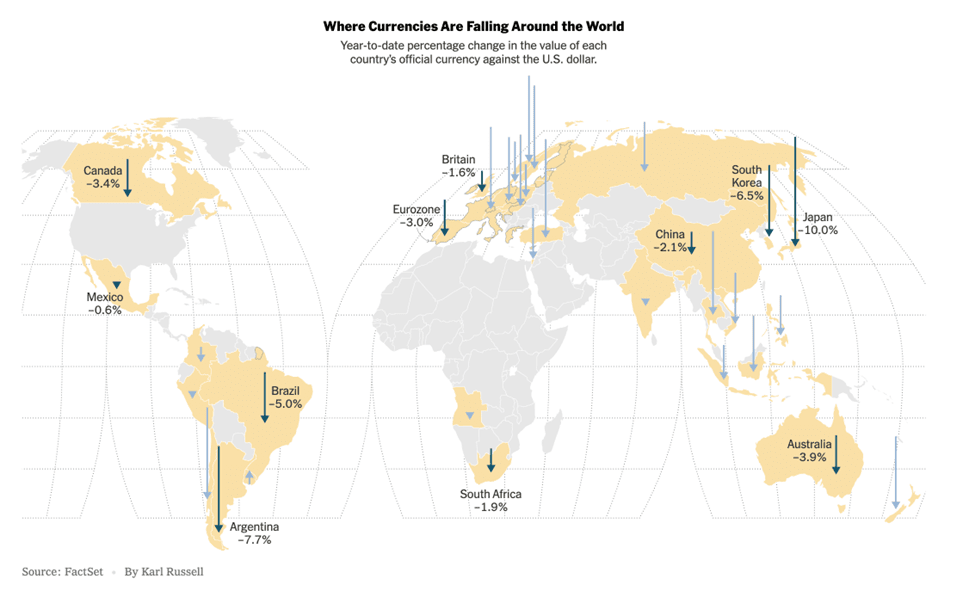
Where Currencies are Falling Around the World
YTD percentages change in the value of each country’s official currency against the U.S. dollar.18
Long-Term Outlook: Is the Strong Dollar Here to Stay?
The long-term outlook for the U.S. dollar depends on economic policies, global conditions, and geopolitical events. In the near term, the dollar’s strength could continue to be bolstered by high U.S. interest rates and robust economic growth.19
A potential weakening of the U.S. dollar could occur if global economic conditions improve, prompting other countries to raise their interest rates. This would decrease the relative attractiveness of the dollar. Shifts in global trade dynamics, such as the rise of alternative currencies or trade blocs, could challenge the dollar's dominance.
Conversely, the dollar may maintain its strength if the U.S. continues to attract capital due to strong economic fundamentals and if global uncertainties persist. The Federal Reserve's policy decisions will be pivotal, particularly regarding interest rates. Maintaining higher interest rates could support the dollar, while a shift towards easing could weaken it.
Future scenarios could include a gradual decline in the dollar's dominance as the world's reserve currency if countries diversify their reserves into other currencies like the euro or yuan. Alternatively, the dollar could remain preeminent if global markets view U.S. financial markets as the most secure and liquid. Technological advancements in digital currencies and global payment systems might also influence the dollar's future role.20
The U.S. dollar's strength has far-reaching implications for the global economy. While it benefits U.S. consumers and importers, it presents challenges for exporters and emerging markets. Senator J.D. Vance's call for a weaker dollar highlights the complexities of balancing domestic and international economic interests and the politics that go with it.21
Conclusion
The relative strength of a currency can have significant investment implications on interest rates and fixed income, as well as stocks that are either domiciled in another country or earn revenues in different countries. Currency strength or weakness also often morphs into a political issue that can be meaningfully impacted by legislative or executive policy. When complex investment opportunities need to be analyzed in concert with potential macro implications, we at Crystal Capital Partners believe that institutional hedge funds have a competitive advantage. They employ highly effective investment professionals and have built technology resources to source and process data faster than other market participants, allowing them to capitalize on this ever-changing financial landscape.
Sources:
- Investopedia. August 2023. “Strong Dollar: Advantages and Disadvantages.”
- Board of Governors of the Federal Reserve System. Speech. February 2024. “Speech by Governor Waller on the Dollar’s International Role.”
- Council on Foreign Relations. July 2023. “The Dollar: The World’s Reserve Currency.”
- New York Magazine. Intelligencer. July 2024. “Why J.D. Vance Wants a Weak Dollar. Is That a Good Idea?.”
- Bloomberg. Quicktake. May 2024. “US Dollar Dominance: Why USD Is the World’s Reserve Currency.”
- Statista. Financial Markets. August 2019. “Chart: The U.S. Dollar Still Dominates Global Reserves.”
- International Monetary Fund. June 2024. “Dollar Dominance in the International Reserve System: An Update.”
- Board of Reserves of the Federal Reserve System. FEDS Notes. June 2023. “The International Role of the U.S. Dollar Post-COVID Edition.”
- International Monetary Fund. IMF Blog. June 2024. “Dollar Dominance in the International Reserve System: An Update.”
- Macrotrends. Gold Prices and U.S. Dollar Correlation-10 Year Chart. 2024. “Gold Prices and U.S. Dollar Correlation - 10 Year Chart.”
- FDIC. Trust Examination Manual. April 2024. “FDIC: Section 3 - Asset Management - Part I: Investment Principles, Policies and Products.”
- International Monetary Fund. IMF Blog. June 2024. “Emerging Markets Show Resilience Despite Global Monetary Tightening.”
- Barron’s. July 2024. “The U.S. Dollar Is Strong. Time to Look at These Asset Classes.”
- Deutsche Welle. Business Global Issues. April 2024. “Dollar strength: Why Developing Countries Are Nervous.”
- Berkeley University. Business Review at Berkeley. February 2024. “Javier Milei’s Dollarization Vision: A New Era for Argentina’s Economy.”
- The Economist. July 2024. “The strong dollar is hurting exports from Latin America.”
- International Monetary Fund. May 2024. “Speech: Geopolitics and its Impact on Global Trade and the Dollar.”
- The New York Times. 2024. “A Strong Dollar Weighs on the World.”
- Oxford University. Oxford Economics. May 2024. “Why Dollar Strength Looks Set to Go On.”
- Financial Times. Currencies. June 2023. “US Dollar to Maintain Dominance Over Next Decade, Say Central Banks.”
- Council on Foreign Relations. Renewing America. August 2023. “The Future of Dollar Hegemony.”
See our roster of institutional private market funds.
For financial advisors only.