
Published on September 25, 2024
Investing in the Fertility Industry: Private Equity’s Latest Breakthrough
M&A bankrolls the baby-making revolution
The baby business is booming.
Between 2012 and 2021, the number of infants born in the US who were conceived through assisted reproductive technology services (ART) increased by nearly 50%1. And with the U.S. fertility market set to reach approximately $16.8 billion by 20292, the trend has shown little sign of ending.
So, it’s hardly a surprise that investors are eager to get in on the action.
Off-the-charts growth
The global fertility market is estimated to have grown to more than $40 billion3 as an ever-evolving landscape of technologies and services — from vitro fertilization (IVF) to egg freezing to donor services — empowers individuals to start families on their own terms.
Cultural shifts, such as the increase in same-sex couples looking to have children4 and the increasing average age of expecting mothers5, continue to stoke demand for ART services.
That’s on top of a rise in chronic health conditions including obesity6 and polycystic ovary syndrome7 that have been linked to rising infertility rates.
IVF services alone are poised to grow by approximately 10% annually through 20258, potentially creating ample opportunity for investing in the fertility industry as ART services become an integral part of the global healthcare system.
IVF services alone are expected to grow at a compound annual growth rate of 5.54% from 2024-2030, according to a report by Grand View Research.13
Fertile ground for dealmaking
From an M&A perspective, investing in the fertility industry may offer benefits unlike any other field in medicine.
The industry has been proven to weather economic downturns relative to other healthcare sectors, as potential parents’ desire to prolong the biological clock tends to outweigh the costs.
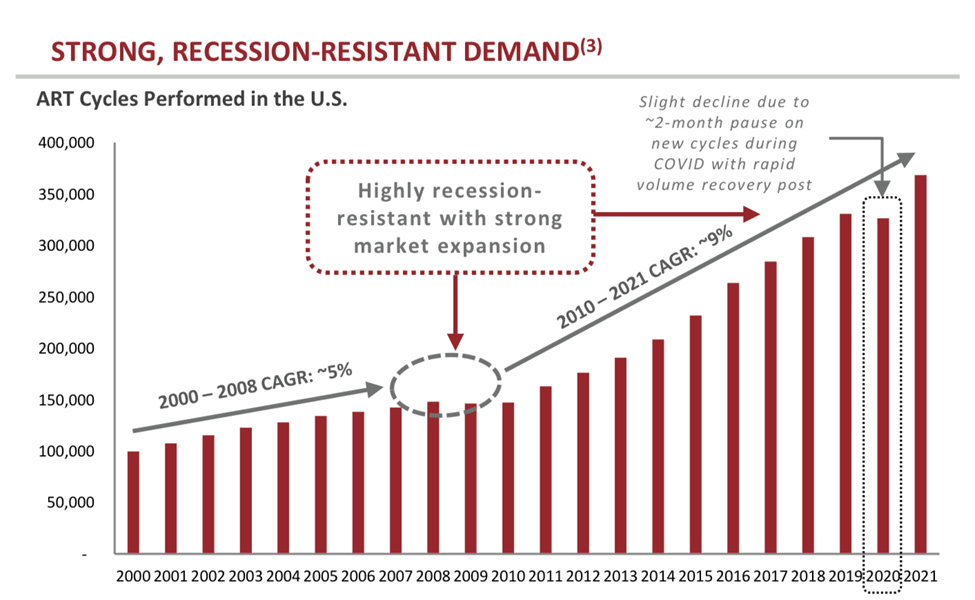
Source: Harris Williams
The sector is also ripe for consolidation. 11 of the market’s largest players, including with CNY Fertility Center, Colorado Center for Reproductive Medicine (CCRM), New Hope Fertility Clinic, and NYU Langone Fertility Center, account for only 17.2% of the market9. That leaves plenty of room for more deals.
And out of the more than 450 fertility clinics across the US, according to a 2023 report by healthcare investment bank Westcove, only 135 of them performed over 500 IVF cycles each year10. Further, only 70 of those clinics performed more than 1000 cycles.
Fertility Inc: the next generation
According to PitchBook data, Venture capital firms spent a record $874 million investing in the fertility industry in 2023, apparently emboldened by unicorns like women’s health clinic Kindbody and MavenClinic, the digital fertility provider backed by Reese Witherspoon and Natalie Portman.
Meanwhile, private equity firms have continued to pour billions into the sector with blockbuster deals, including KKR‘s $3.2 billion acquisition of Spain’s IVI-RMA Global in 2022 and GED Capital’s €500m purchase of Eugin Group, a unit of German healthcare company Fresenius.
As investors look to achieve scale and broaden their customer bases, the biggest opportunities in the fertility industry are the companies confronting the industry’s biggest problems: affordability and accessibility.
Most fertility don’t accept insurance, shielding them from the risk faced by large insurers as they brace for further potential rate cuts by the Fed amid wavering inflation. While that may create upside in the current macro environment, the eye-watering cost of care and lack of options threaten to detract from the industry’s turbo-charged growth.

Source: Westcove
In the US, a single round of IVF can set you back IVF anywhere from $15,000 to $30,000 or more, according to a Forbes analysis of top fertility clinics’ prices11, making the procedure highly unattainable to the average American family.
A new league of so-called femtech upstarts like InsurMedix — an AI-powered insurance platform offering fertility coverage — and Carrot Fertility — the Tiger Global Management-backed corporate fertility benefits provider — are aiming to break down those barriers, with many more industry disrupters on the rise.
Conclusion
The fertility industry has a supply and demand problem.
From so-called “fertility care deserts”12 to the high cost of treatment to a lack insurance options and billing practices, the number of families who want fertility care but are unable to access it far outweighs those who receive it.
Regulatory challenges also threaten to curb the industry’s rapid growth, particularly in the US, where a fluctuating political landscape has forced many providers to rethink their services in order to assist patients living in states with more restrictive fertility laws.
Investing in the fertility industry presents two key opportunities: a fast-growing, high cash flow sector with massive growth prospects, and a promising crop of new disrupters aiming to tackle its biggest challenges.
Learn more about the fund managers on the platform investing in biotechnologies.
Sources:
- U.S. Department of Health and Human Services, March 2024.
- Yahoo Finance, July 2023.
- Harris Williams – Fertility Market Overview Q3 2023.
- Yahoo Finance, July 2023.
- Yahoo Finance, July 2023.
- National Library of Medicine
- National Library of Medicine
- Harris Williams – Fertility Market Overview Q3 2023.
- Yahoo Finance, July 2023.
- Westcove Fertility Services Industry Insights
- Forbes, Aug 2023
- National Library of Medicine
- Grand View Research
See our roster of institutional private market funds.
For financial advisors only.