
Published on June 18, 2024
Market Bubble Watch? The Return of Roaring Kitty
Introduction
Keith Gill, also known as by his Twitter/X handle Roaring Kitty, had been radio silent since 2021. The investor credited for the boom in GameStop, growth of Robinhood, and the rise of the retail trader had basically disappeared. Then he posted the below tweet and markets, and GameStop stock, reacted. For those uninitiated in videogame parlance, the tweet underscored that the game had just become more intense.
— Roaring Kitty (@TheRoaringKitty) May 13, 2024
In the following days, Gill posted more memes and videos implying that he was back. GameStop stock rallied over 100%, then was down more than 60%, then rallied over 100% again, and then came down again 40%. As of the close on June 12th, the famed stock was again on the move up.1
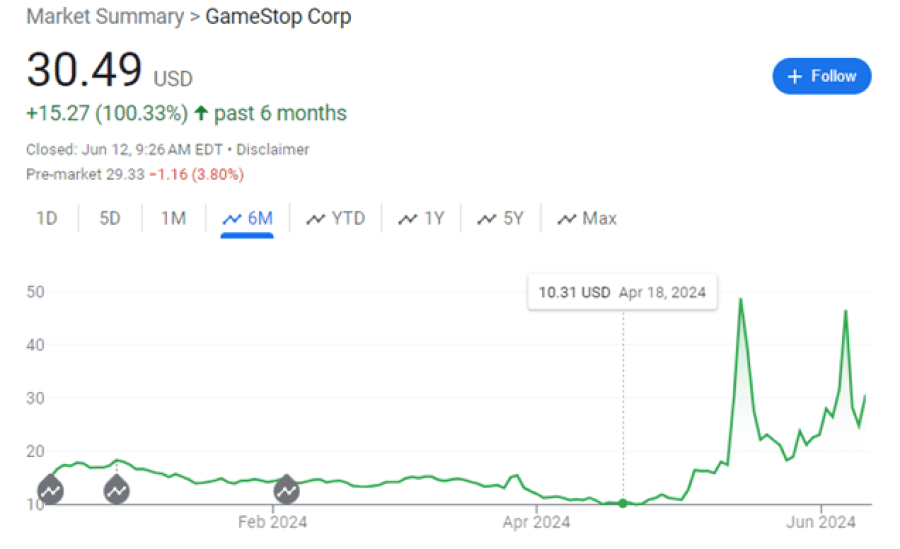
Similar to 2021 when the world first met Roaring Kitty, the volatility in GameStop, record highs in the S&P 500, and potentially unrecognized risk hiding beneath the surface of market optimism have many market participants asking if there is a market bubble.
Risk Assets
It isn’t just the price action in GameStop that has investors wondering if there is a market bubble. Every sector of the S&P 500 is up YTD as of end of May, and every sector other than energy and real estate is above their 20-year average Price to Earnings ratio (P/E)2. Before considering the economic backdrop in a potential market bubble, let’s first look at risk assets.
Looking at U.S. markets, the data does not necessarily show that there is a market bubble when you look at index-level valuations. Forward P/Es are higher than their long-term averages, but within a reasonable range, and referencing other valuation ratios like Price to Book and Price to Free Cash Flow tells a similar story.
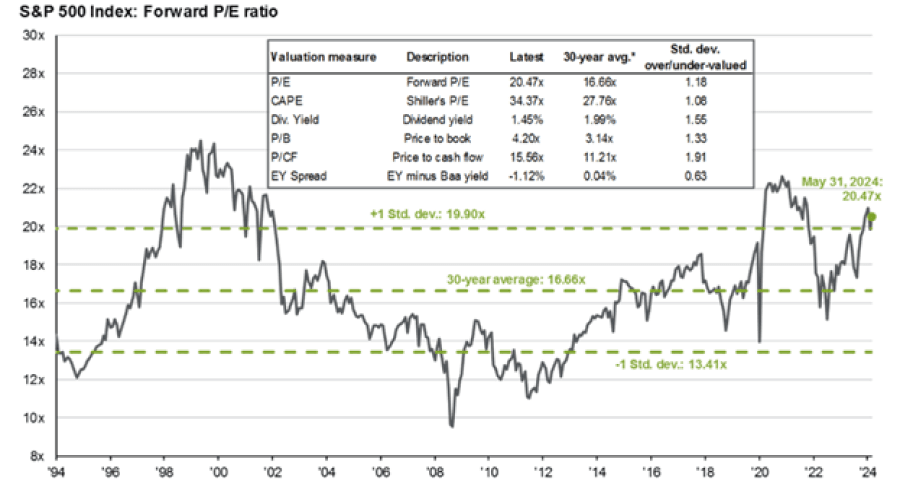
However, the index-level metrics do not show the level of concentration in the S&P 500. According to JP Morgan, the top 10 stocks constituted 35.4% of the S&P 500 as of end of May, an all-time high. This group is trading at a much higher PE Ratio relative to the rest of the index and the long-term average.2 Perhaps this is where the market bubble lies. Goldman Sachs posits that high concentration may introduce new risks and these stocks inflicted the most pain during the drawdown in 2022.4
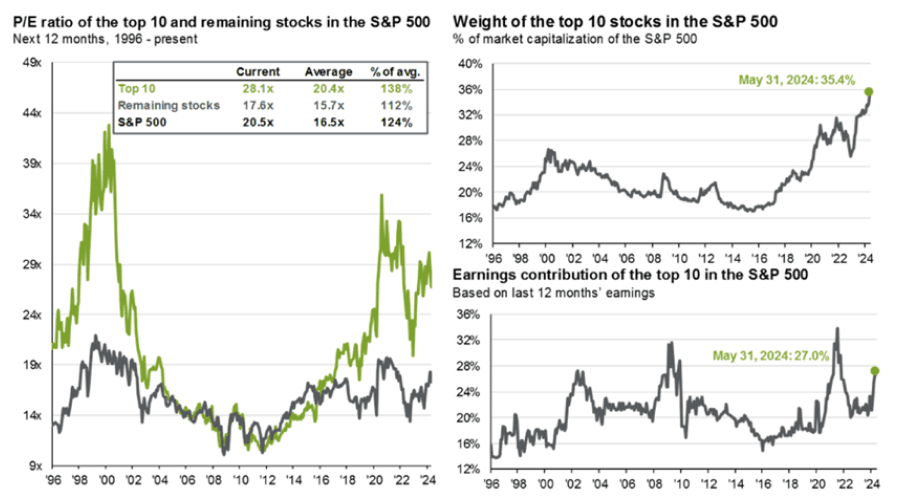
Similar to the early 2000s, perhaps there is not a broad-based market bubble, but rather a market bubble in a specific subset of stocks, in this case the Magnificent 7 or the top ten of the S&P. Positive price action and record highs alone do not constitute a market bubble. There needs to be a lack of fundamental drivers. So the next step in this appraisal of a potential market bubble is to investigate what fundamental drivers exist and whether the price and valuation are reasonable considering the fundamentals.
Innovation and The Fundamentals
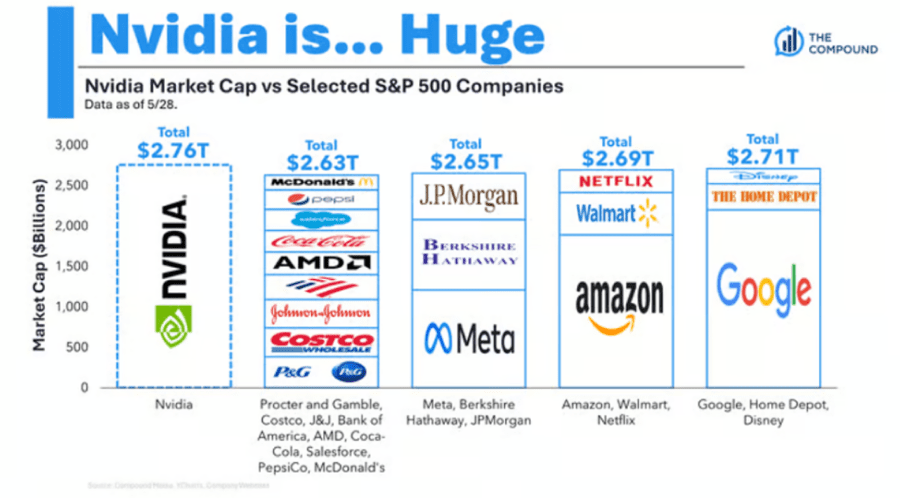
One of the drivers for the recent market rally and the stock-specific rally in Nvidia has been innovations around artificial intelligence (AI). With Chat GPT, AI became mainstream and market participants have appreciated the necessary semiconductor investment that will be required for companies to successfully integrate AI. Nvidia’s stock has rallied meaningfully and is often used as a talking point when discussing a market bubble. As of the end of May, this stock has traded 42x forward earnings. However, this may not tell the full story as Nvidia has nearly doubled its margin over the past year and the company's earnings guidance went up 7x between 2023 and 2024.6 So, it may not be overpriced. Still, looking at the market cap of Nvidia compared to some of its S&P 500 peers, it is hard to believe its relative valuation is rational.
Conclusion
It’s possible that GameStop is overvalued and part of a market bubble, while Nvidia is not. When concerns of a market bubble are on the rise, it is probably a good time to reexamine portfolio level risk management. And if investors believe they are properly diversified, and allocated to low correlation strategies, sticking to their plan is likely prudent. Research shows that timing market drawdowns is nearly impossible and even if you invested at all-time highs, research shows that choice generally doesn’t change the long-term outcome.2
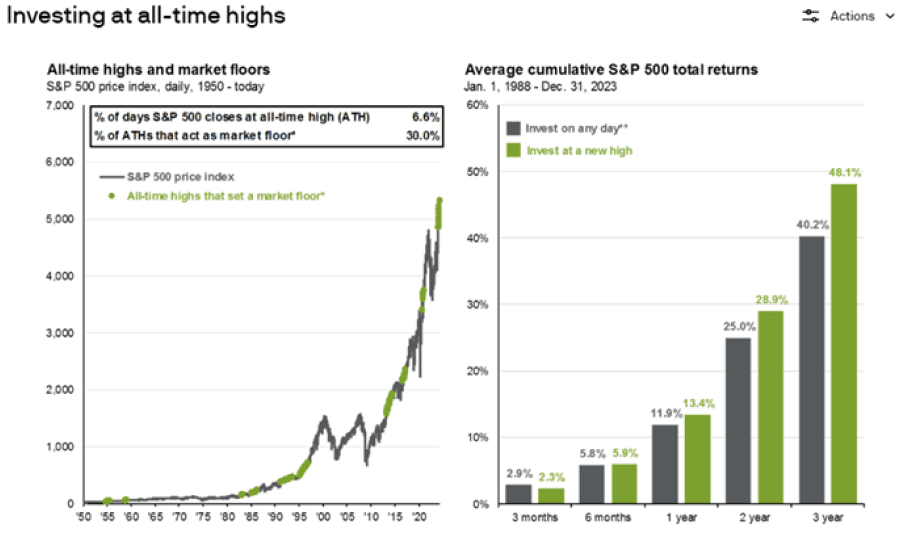
On the other hand, Alternatives have proved to help portfolios when market bubbles pop. According to Goldman Sachs, Alternatives, on average, outperform stocks by 27% during bear markets.7 In scenarios where data is mixed, and stocks are trading based Twitter/X personalities, it is best to stay the course, try to ignore the noise, and continue to consider risk and diversification. These principles are the core of Crystal Capital Partners’ philosophy. We work to provide our clients with diversified, non-correlated, portfolios of alternatives that provide better outcomes during times of market stress.
Sources:
- GME $30.49 (▲22.80%) GameStop Corp | Google Finance
- Guide to the Markets | J.P. Morgan Asset Management (jpmorgan.com)
- BTC/USD 67,313.00 (▼3.14%) | Google Finance
- A Closer Look At Concentration (gsam.com)
- Bitcoin Breakout: 2 Top Ranked Stocks for the Next Leg Higher (yahoo.com)
- Is Nvidia too Big to Fail? (theirrelevantinvestor.com)
- Diversifying with Alternatives (gsam.com)
- Cover Image: Bankrate.com
See the list of alternatives that can help diversify your portfolio during market drawdowns.
For financial advisors only.