
Published on May 31, 2024
More Semiconductors Will Soon Be Manufactured in the U.S. So What?
Semiconductor chips have become a critical component of almost all electronics. The device you use to read this Insight operates thanks to at least one semiconductor. They power LED lightbulbs, microwaves, and refrigerators. These chips, usually made from a silicon base, allow electricity to be conducted or blocked on demand.1 Computers operate by using tiny transistors on these chips that send signals of ones and zeros.
How tiny and complex are some of these semiconductor chips? The iPhone 13’s A15 Bionic Chip contains approximately 15 billion microscopic transistors.2 If you’re using Apple’s M3 chip, there are up to 92 billion transistors on a piece of silicon slightly larger than your fingernail.3
It’s more likely than not that these chips were manufactured in Taiwan. The U.S. Government, concerned about supply chain security, wants to bring that manufacturing process home.
How Taiwan became a semiconductor manufacturing superpower

Apple’s primary chip manufacturer is Taiwan Semiconductor Company (TSMC), a foundry that controls about 55% of the international chip fabrication market.4
In the years following the Cold War conflicts in Korea and Vietnam, small Asian nations were nervous that they could be the next epicenter of great power conflicts. In the U.S., meanwhile, the nascent semiconductor industry was desperate for inexpensive workers to manufacture its growing technology products.
Taiwan, governed by the Nationalist Government that fled Mainland China at the end of the Chinese Civil War, was eager to create economic ties with the U.S. It sought protection from the Communist Government across the Taiwan Strait and hoped that the Americans would want to protect its high-tech investments and, consequently, its island.In 1968, Western-educated Taiwanese government officials lured Texas Instruments (TI) to build a semiconductor plant on its island. Taiwan provided TI an eager, low-cost workforce and a favorable business climate. About twenty years later, they recruited TI engineering executive Morris Chang to build Taiwan’s semiconductor industry, which became TSMC.
Chang was born in China, raised in Hong Kong, educated in the U.S. at Harvard, MIT, and Stanford, and is a naturalized U.S. Citizen. Instead of seeking to compete with U.S. firms like TI, Chang founded TSMC as a company focused on manufacturing other companies’ designs. TSMC leveraged support from the Taiwanese government to train its employees and keep costs low, enabling it to produce semiconductor chips of better quality at a lower price point than its competitors.5
Today, TSMC is arguably the most important company in the world, and its capabilities are keeping Western powers engaged in the region.6
CHIPS and Science Act
Putting so much trust in one company headquartered eighty miles from Mainland China with a population comparative to Florida’s has made U.S. lawmakers understandably nervous.7 Further, the COVID-19 Pandemic sparked semiconductor chip shortages resulting from firms struggling to predict demand accurately. American consumers looking to buy a new car during the early days of the Pandemic were shocked to learn that they would have to wait as much as fifteen weeks for their new wheels to be delivered. The culprit? A semiconductor chip shortage.8
Politicians on both sides of the aisle called for investments to develop semiconductor chip manufacturing in the U.S. to prevent future shortages and compete with China. The 2022 CHIPS and Science Act authorized $280 billion over ten years to boost semiconductor chip research, development, and manufacturing in the U.S.
Since then, U.S. semiconductor firms including Micron Technology, Intel, GlobalFoundaries, and Microchip Technology have announced significant investments in economically struggling communities like Syracuse, New York. TSMC, eager to maintain U.S. Government support of Taiwan, is investing $40 billion in building new manufacturing plants in Phoenix, AZ.9
The development of TSMC’s new American plants has been slow. TSMC managers have expressed frustration about the lack of American skilled workers, and American new hires have complained about the Taiwanese company’s intense work culture. And, even with significant U.S. Government investments, production costs are higher, expenses the company worries will be passed onto consumers.10
China’s Chip Bans
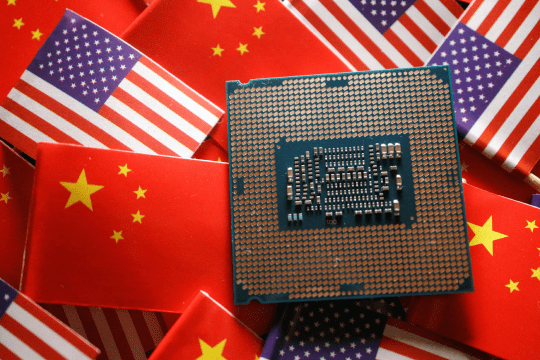
In addition to investing in the semiconductor manufacturing process in the U.S. and wooing TSMC, the CHIPS and Science Act banned exports to China of the most complex American chips and components. In response to U.S. lobbying, Japan, Germany, and the Netherlands also announced restrictions on exports of advanced chips to China.11
Some experts have estimated that China’s capability lags about ten years behind the technology currently produced by Taiwan and its Western partners.12 But China has been racing to prove them wrong. In 2023, Chinese electronics company Huawei unveiled its Mate 60, a new smartphone that has cut into Apple’s market share in China. The Mate 60 features a powerful chip fabricated in China by Semiconductor Manufacturing International Corporation (SMIC), a partially Chinese state-owned company.
SMIC’s new domestically produced chips have been shown to rival those of TSMC manufacturers for Apple’s latest 5G phones. China’s overall production of semiconductor chips is thought to have grown by more than 40% in the first quarter of 2024.13
The Chinese have also tried to hit back against the U.S. restrictions, announcing their export controls on gallium and germanium, elements like silicon that are used in semiconductor manufacturing. While China produces most of the world’s gallium and germanium, U.S. allies like Germany, Japan, and Australia can supplement this supply chain.14
Supply Chain Security
Protecting the supply chain security of semiconductor chips is complex, and it’s unclear whether bringing the manufacturing process to American soil will be a panacea. Apple’s M3 chip, for example, can be made on a silicon wafer produced in South Korea, Japan, Taiwan, Germany, or France. Transferring intricate semiconductor patterns onto these wafers requires photomask and photoresist materials made by Japanese, Taiwanese, and South Korean companies and often designed by Dutch companies.15
Indeed, “friendshoring”, the growing practice of strengthening relationships with allies and key trading partners, has become an integral way of ensuring supply chain security. U.S. Treasury Secretary Janet Yellen has advocated for building supply chain security by strengthening trade ties with friendly, trusted countries.16 Apple, for example, recently moved some of its iPhone production from Mainland China to India.17
Beyond physical manufacturing, supply chain security is also threatened by increasingly frequent and complex cyber-attacks. Attacks on third-party partners and suppliers can directly affect firms and governments.
These data breaches are becoming more complex like the supply chains they disrupt. Preventing and mitigating the impact of these attacks requires proactive supply chain security investment and collaborative teams. Isolating and disarming bad actors is certainly helpful, but it’s only part of the solution.18
Conclusion
Understanding advancements in semiconductor manufacturing and addressing the multifaceted challenges of supply chain security are crucial. The intricacies of international cooperation, the geopolitical landscape, and the escalating sophistication of cybersecurity threats demand a comprehensive and proactive strategy. Ensuring the resilience and integrity of the semiconductor supply chain will require concerted efforts and collaboration among global stakeholders.
Sources:
- Stanford University, Stanford News. September 2023. “Engineering Professor Explains Semiconductors.”
- CNet. September 2021. “Apple’s A15 Bionic Chip Powers iPhone 13 with 15 Billion Transistors, New Graphics, and AI.”
- PC Magazine. January 2023. “Apple M2 Pro and M2 Max: The Newest Mac Processors, Explained.”
- Time Magazine. October 2022. “The Chips that Made Taiwan the Center of the World.”
- Chip War. October 2022.
- The New York Times. January 2024. “Visiting the Most Important Company in the World.”
- Al Jezeera. April 2022. “How Difficult Would it be for China to Invade Taiwan?”
- Bloomberg. March 2021. “How a Chip Shortage Snarled Everything From Phones to Cars.”
- The White House. April 2024. “Fact Sheet: President Biden Announces up to $6.1 Billion Preliminary Agreement with Micron Under the CHIPS and Science Act.”
- Rest of the World. April 2024. “TSMC’s Debacle in the American Desert.”
- Bloomberg. March 2024. “US Urges Allies to Squeeze China Further on Chip Technology.”
- The Economist. February 2024. “China is Quietly Reducing Its Reliance on Foreign Chip Technology.”
- Trendforce. January 2024. “Intel CEO Claims China’s Chip Manufacturing Lags Behind by 10 Years, Gaps to Persist.”
- CSIS. July 2023. “Understanding China’s Gallium Sanctions.”
- CSIS. May 2023. “Mapping the Semiconductor Supply Chain: The Critical Role of the Indo-Pacific Region.”
- Atlantic Council. April 2022. “Transcript: US Treasury Secretary Janet Yellen on the Next Steps for Russia Sanctions and ‘Friend-Shoring’ Supply Chains.”
- World Economic Forum. February 2023. “What’s the Difference Between ‘Friendshoring’ and the Other Global Buzzwords?”
- Boston Consulting Group. October 2023. “Is Your Supply Chain Cyber-Secure?”
Learn which institutional private equity and hedge funds on our platform are investing in the semiconductor space and how your clients can participate.
For financial advisors only.