

Published on April 11, 2024
The Opportunities for AI in the Private Equity Industry
AI mania is continuing and attracting a surge of investment from investors, including private equity firms. Generative AI could provide a dramatic ability to disrupt across a wide range of occupations and industries. The opportunities of AI in private equity extend far beyond cost savings and efficiency gains, reaching into the heart of deal sourcing, portfolio management, and, ultimately, value creation for investors.
AI in Private Equity - Sparking Innovation and Investment
AI is revolutionizing industries with potential applications in scientific discovery, personalized medicine, and human-computer collaboration. Its scientific and engineering advancements are poised to disrupt entire industries and professions, fundamentally changing how we work and live.
Advancements like virtual assistants and chatbots demonstrate AI's ability to convincingly simulate human conversation in written formats. Yet, AI’s most significant influences are yet to come. One survey suggests that there will be more smart robots than frontline workers in manufacturing, retail, and logistics due to labor shortages in just a few short years.1
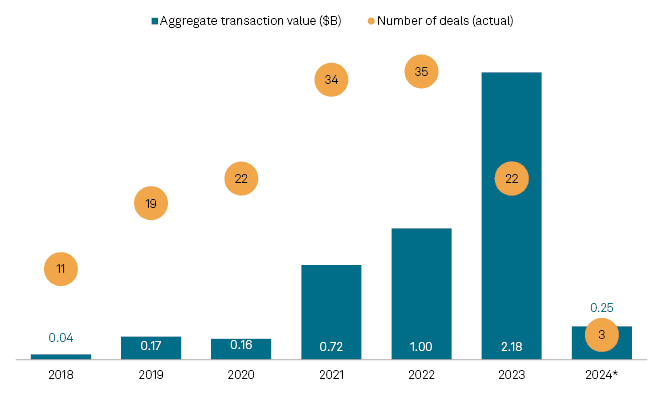
Private equity is already using AI to transform companies. According to S&P Global Market Intelligence data, private equity firms' disclosed value of generative AI investments totaled over $2 billion in 2023, compared to $1 billion in 2022, and defied the slump across other industries. The trend is continuing into 2024, as deals recorded from Jan 1. to Feb. 15 have already surpassed the total from the first quarter 2023.
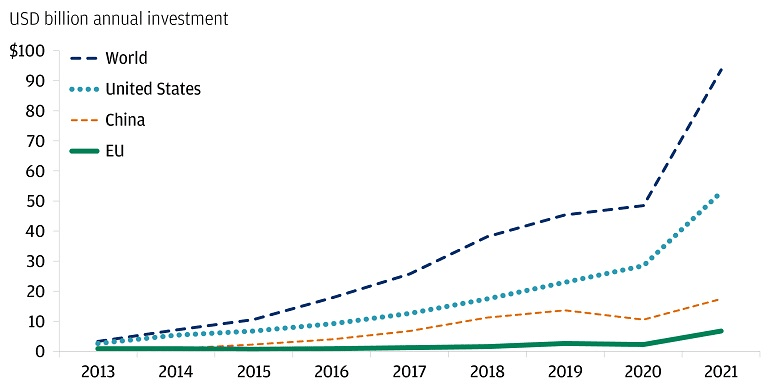
Global private investment in AI
What are some of the areas that AI has revolutionized?
AI in Content Creation. The launch of ChatGPT sparked a wave of investment and innovation in generative AI (gen AI) applications. Gen AI applications combine foundational models with the deep learning of large language models (LLMs) that consume and train on massive datasets to excel in language processing tasks, creating new combinations of text that mimic natural language based on its training data.
Boasting a quick learning curve, Gen AI’s uses have quickly evolved, starting with text generation based on prompts and progressing to creating pictures from descriptions and even generating videos from text instructions.
Through AI tools, companies can significantly reduce content creation costs by automating repetitive tasks and even generating creative content. This fundamentally alters how investors view content creation and has caught the attention of private equity firms.
Some of the more established players using generative AI for content creation include:
- NVIDIA: enhancing content with AI powered graphics
- IBM: using cognitive computing to automate content
- Autodesk Inc.: integrating AI to revolutionize digital content creation
AI is not without its faults. If its results are not double checked, the consequences can be embarrassing and damaging. There have been two reported cases of lawyers inadvertently including false case citations generated by AI tools in a court filing, resulting in possible disciplinary actions for the lawyers involved.
And the errors are not limited to everyday people using AI. Google acknowledged that its generative AI program Gemini took cultural concerns a step too far, by refusing to show pictures or achievements of Anglo-Americans. Google took down the feature to further fine-tune.2
Gen AI Defies Private Deal-Making Slump
Self-driving cars. Automated cars use a complex interplay between sensors, software, and AI to navigate the roads safely and autonomously. The majority of today’s self-driving cars operate on a spectrum between reactive AI, which reacts to the immediate environment, and more advanced AI that has the ability to learn, adapt, and handle complex situations. The technology needed to further proliferate this innovation will lead to increased investment in the firms that develop and manufacture robotics, sensors, cameras and GPUs.
AI for increased efficiency across various industries. By automating processes and streamlining workflows, AI may unlock opportunities in other business areas. AI will affect all industries, although some are particularly ripe for disruption.
-

Manufacturing: AI-powered robots can handle dangerous or repetitive tasks on factory floors, increasing production speed and reducing human error.
-

Retail: AI can analyze customer purchase history, browsing behavior, and demographics to recommend products that are most likely to interest them.
-

Healthcare: AI algorithms can analyze medical images (X-rays, MRIs) with high accuracy, assisting doctors in diagnosing diseases and recommending treatments.
-

Finance: AI can analyze transaction data to identify fraudulent activity in real time.
Estimated Spending on AI-Centric Systems in 2023
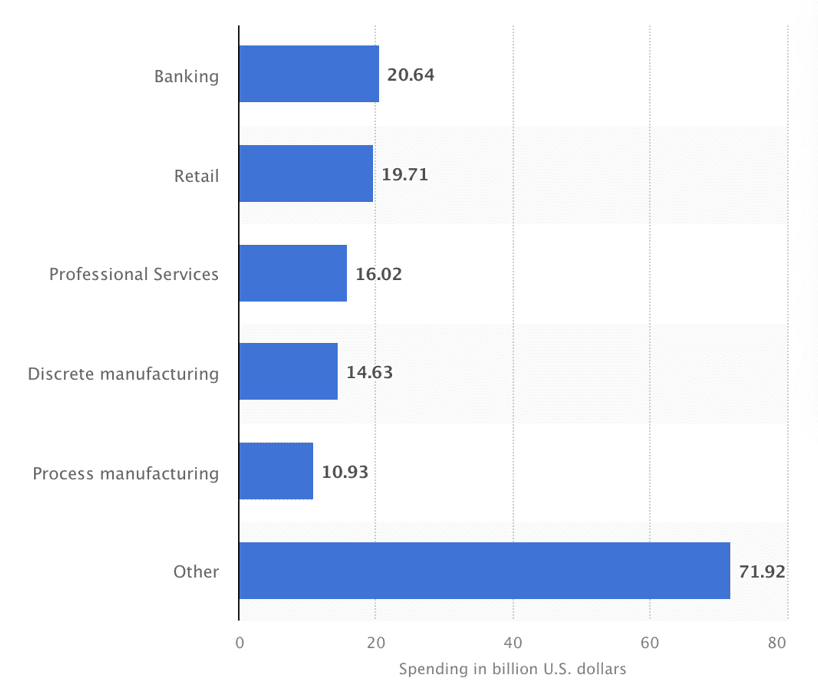
Source: Thormundsson, B. (2024, February 15). Worldwide spending on AI by industry 2023. Statista.
Looking Ahead - AI in Private Equity
With a majority of companies using or planning to use generative AI in the very near future, investors are monitoring potential tailwinds across industries and use cases for indications of future growth.
Even as firms cut spending, AI remains a priority, with one estimate showing that $3 trillion could be spent on AI between 2023 and 2027.4
While private equity is on the cusp of an AI revolution, there are some qualifications to the technology’s potential. Bias in AI algorithms must be examined for the data and outputs to be reliable. The prospect of a data breach is another matter which needs to be monitored given the sensitivity of investor data.
While integration is in its early stages, AI’s potential to transform how businesses operate and generate value is undeniable. Investors who grasp the power of AI will be poised for a significant advantage in the coming years.
The Typical and Not-So-Typical Ways to Invest in AI
What are some ways to invest in the transformation of AI? In addition to the well-known names, the managers on our platform are not only using AI to trade themselves but are also backing companies in the AI industry.
Outside of investing in content generators or firms building digital assistants, another way to invest in AI is the technology and infrastructure behind it, such as data centers. These infrastructures, which can be as large as a football field, enable the training and deployment of complex machine-learning models and algorithms.
Investing in AI can provide attractive opportunities for investors looking to invest in the technology of tomorrow. However, the future performance of any private equity investment is never guaranteed and comes with inherent risks that should be fully understood by financial advisers and their investors. By working with institutional managers who have proven track records of successfully navigating multiple and varied market cycles, investors may be able to weather certain market volatility over the long run and reap the rewards of this burgeoning sector.
Sources:
- Gartner unveils top predictions for IT organizations and users in 2024 and Beyond. (n.d.).
- Wulfsohn, J. (2024, February 23). Google admits its Gemini Ai “got it wrong” following widely panned image generator: Not “what we intended.” Fox Business.
- Generative AI in marketing market size, share and forecast 2032. MarketResearch.biz. (2024, January 25).
- Dylan Thomas, M. I. (2024, March 1). Private equity-backed investment surge in Generative AI defies 2023 deal slump. S&P Global Homepage
See the institutional third-party and hedge funds listed on our platform that are active in AI private investing.
For financial advisors only.