
Published on July 11, 2024
Positioning Portfolios for Interest Rate Policy Divergence
Investors are caught in the conflicting currents of interest rates, as the Federal Reserve holds rates steady while other central banks, most notably the European Central Bank, move rates lower. What are the repercussions of this divergence, and how can investors benefit?
There is a current shift in the major global economies as central banks begin to diverge in their monetary policies. As policymakers make strides in the battle against inflation, interest rate policy divergence has increased. Following COVID-19, emerging markets were among the first to raise and then subsequently cut official rates. Some developed economies, including Canada and the EU, followed suit this year. As Federal Reserve (Fed) officials decide their next steps, there could be interesting repercussions to economies and spending patterns from this policy divergence that may create investment opportunities.
Interest Rate Policy Divergence in Emerging and Developed Markets
A common objective of all central banks is maintaining price stability, however, each country must assess its individual economic conditions to determine monetary policy. Countries with higher interest rates can attract more foreign investment, increasing the value of that country’s currency.
Central banks in developed countries began raising rates in their fight against rising inflationary pressures, including the stimulus following COVID-19. In the United States, this started in March 2022, when rates were hiked from 0% by 0.25% to a level of 0.25–0.50%. The Fed continued to raise rates until July 2023, bringing rates to 5.25–5.50%, where they currently stand.
Current Global Policy Rates
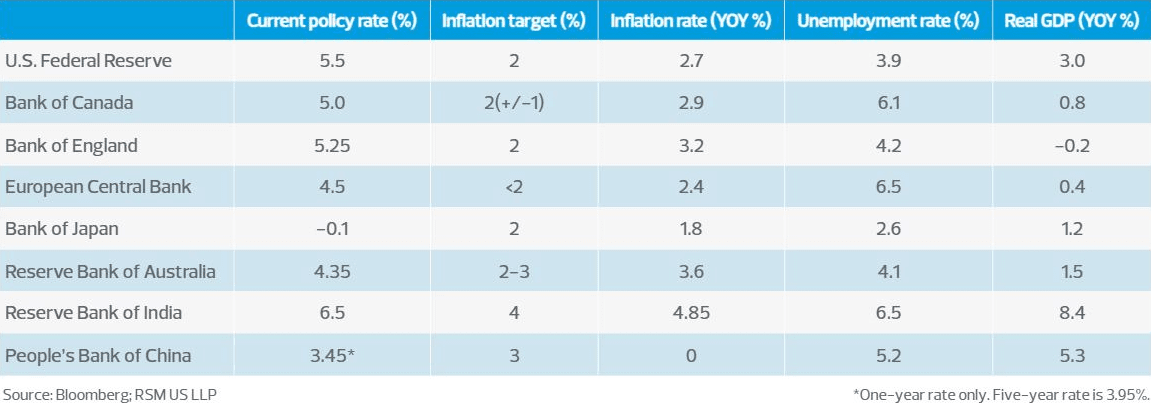
Source: https://realeconomy.rsmus.com/global-central-bank-outlook-reducing-rates-to-bolster-growth/
Emerging markets, such as Brazil, Chile and Peru, were ahead of the curve when it came to hiking rates and also began cutting rates first. Facing different economic circumstances, developed markets left rates untouched throughout 2023. European nations struggled with economic growth, while the United States economy remained resilient. What stayed consistent between the EU and the U.S., however, was “sticky” inflation.
A Historical Context of Interest Rate Policy Divergence
Have the interest rate policies of the major developed banks always been in line? During and after COVID-19, most of the G7 countries—an informal bloc of industrialized democracies including the United States, Canada, France, Germany, Italy, Japan, and the United Kingdom (UK)—cut and then raised rates in similar manners. This excludes Japan1, which recently exited its zero-interest rate policy and raised rates for the first time in 19 years.
Key Policy Rates: U.S. vs EU- Prior to the ECB Rate Cut
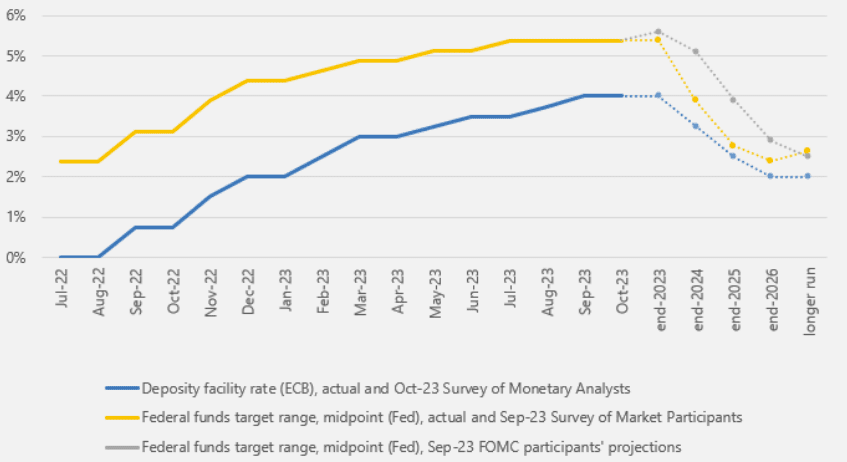
Source: European Parliament, EGOV elaboration based on data from ECB and Federal Reserve.
Prior Periods of Interest Rates Policy Divergence
Indeed, going into 2024, many market pundits expected the Fed to begin its rate-cut cycle first, with the ECB not predicted to cut rates until late 2024. But pricing pressures persisted in the United States, and the Fed remained vigilant2, as Chair Powell reiterated that interest rates needed to remain “higher-for-longer.” However, growth in the European Union began to stagnate, leaving the ECB with no choice but to begin to cut rates in early June.3
Do the United States and the European Union always move interest rates in tandem? Typically, yes, but not always at the same pace; the U.S. moved much higher than its European counterpart from 2000-2002 and then again from 2004-2008.
Fed Funds Rate vs. ECB Deposit Rate
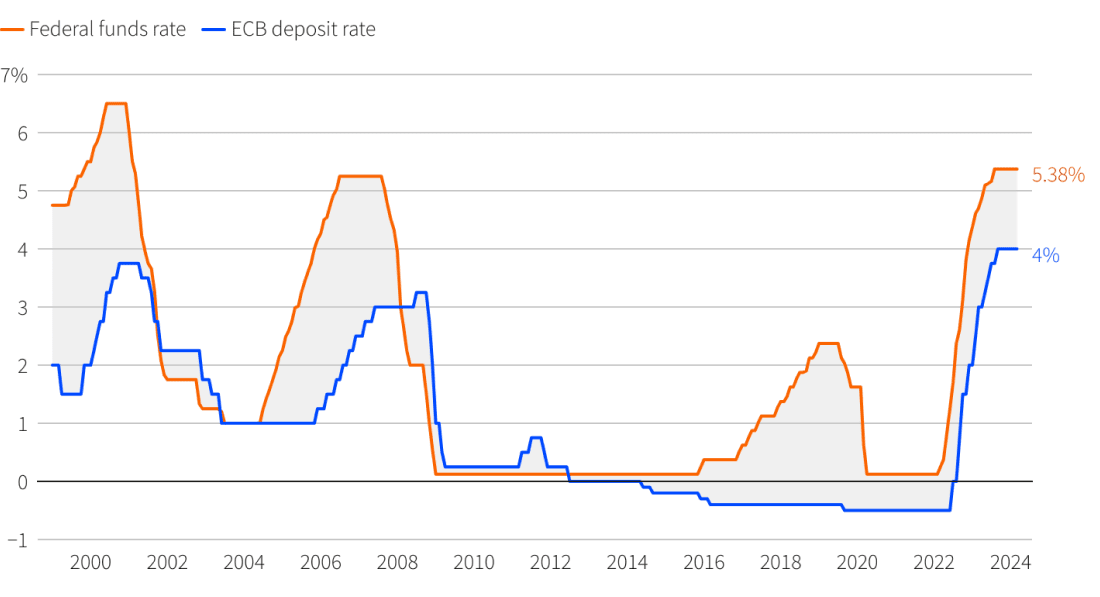
Note: Fed funds rate is the midpoint of the official range
Source: Barclays | F. Guerrera | Breakingviews | May 1, 2024
The Benefits—and—Repercussions to Economies and Markets of Interest Rate Policy Divergence
Between the years 2015 and 2019, there was interest rate policy divergence, when the ECB lowered official interest rates to below zero, while the Fed hiked borrowing costs. With the exception of 2017, the U.S. stock market outperformed its European counterpart.

More recently, EU officials considered moving ahead of the U.S., particularly because of the impact on exchange4 rates. While ECB Vice President Luis de Guindos said that exchange rate movements would need to be taken into account, ECB President Christine Lagarde5 stated that the ECB is “data dependent,” not “Fed dependent.”
The U.S. dollar experiences upward pressure as the Fed keeps rates high, sending ripple effects across international markets. The stronger greenback makes U.S. exports more expensive and foreign imports cheaper, putting downward pressure on other currencies. As such, U.S.-denominated assets experience increased attraction from foreign investors.
Enhancing Traditional Portfolios with Hedge Fund Expertise Amid Global Interest Rate Divergence
Hedge funds may play a pivotal role in traditional portfolios during periods of global interest rate divergence by offering a range of distinctive strategies that can amplify overall portfolio risk-adjusted performance. One key advantage hedge funds bring to traditional portfolios is the ability to introduce diversification through investments in alternative assets with minimal correlation to conventional stocks and bonds, effectively spreading risk across different asset classes. Moreover, hedge funds possess the agility to swiftly adjust their positions in response to evolving interest rate landscapes, potentially acting as a buffer against market volatility stemming from interest rate disparities. Employing diverse strategies like long-short equity, event-driven, and multi-strategy approaches, hedge funds adeptly capitalize on interest rate differentials across various regions and asset categories.
Hedge funds also excel in exploiting pricing inefficiencies in fixed income markets caused by interest rate differentials, potentially yielding alpha for the entire portfolio. Their proficiency in currency trading and hedging serves to mitigate the impact of exchange rate fluctuations in these markets. Additionally, hedge funds offer access to unique investment opportunities not commonly found in traditional markets, such as distressed debt or special situations, that arise can arise from policy choices on interest rates.
By emphasizing consistent returns based on absolute performance, rather than benchmark comparisons, hedge funds offer a pathway to steady, risk-adjusted profitability regardless of fluctuations in interest rates. In essence, integrating hedge funds into a traditional portfolio equips investors with a strategy to successfully navigate the complexities of global interest rate divergence.
Sources:
- Reuters. Bank of Japan scraps radical policy, makes first rate hike in 17 years | Reuters. reuters.com. (2024, March 18).
- Yahoo! (2024, April 22). How Jay Powell and the Fed pivoted back to higher for longer. Yahoo! Finance.
- European Central Bank. (2024, June 6). Monetary policy decisions.
- European Central Bank. (2024a, April 23). Interview with Le monde.
- European Central Bank. (2024a, April 11). Monetary policy statement (with Q&A).
Learn how integrating hedge funds into a traditional portfolio equips investors with a strategy to successfully navigate the complexities of global interest rate divergence.
For financial advisors only.