
Published on March 27, 2025
Private Equity and Venture Capital Trends in 2025
Private equity and venture capital fuel innovation and growth, but both face mounting challenges as aging dry powder pressures firms to deploy capital more strategically, a pause in rate cuts complicates financing conditions, and potential tariffs threaten global dealmaking. Conversely, a resilient economy and strong corporate profits, as well as a regulatory friendly administration are providing tailwinds for exit opportunities.
Impact of Undeployed Capital on Private Equity and Venture Capital Trends
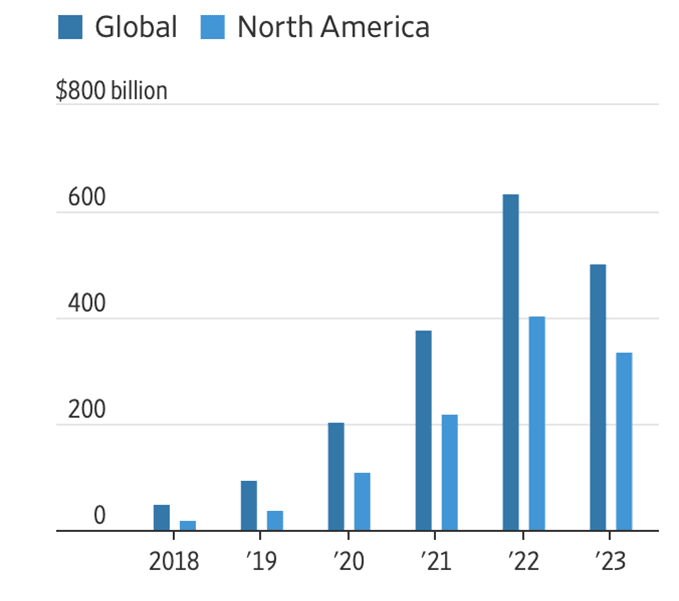
Private equity and venture capital firms have raised record-breaking amounts of money in recent years but deploying it effectively has been challenging and distributions remain at multi-year lows. Data as of March 2024 showed a growing amount of dry powder, including over $500 billion1 in funds solely from the 2020 and 2021 vintage years.
Dry Powder at Private Equity Funds by Vintage Year
As of March 31, 2024
Source: Private Equity’s 2025 ‘Dry Powder’ Countdown - WSJ
Private equity managers must either deploy a fund’s capital typically within 4-6 years—either by investing, returning to investors, or requesting an extension. Based on the above chart, there is approximately $200 million of dry powder that closed in 2020 that is nearing the end of its life cycle. This dry powder, along with lower interest rates and a potentially more favorable regulatory environment, has many bankers and dealmakers optimistic that deal and exit activity will accelerate this year.
Impact of the Trump Administration on Private Equity and Venture Capital Trends
The reelection of Donald Trump boosted the optimism of many dealmakers for many reasons, beginning with the President’s pro-business approach to antitrust enforcement. The new head of the Federal Trade Commission (FTC), Andrew Ferguson2, succeeds Lina Khan. During Khan’s reign, the FTC cracked down and sued scores of big companies, including Ticketmaster, Nvidia, Meta, Microsoft, Apple and Amazon, as well as the agency’s successful lawsuit to block the merger of Illumina and Grail in December 2023.3 Conversely, Ferguson is expected to adopt a less aggressive regulatory approach and one more amenable to mergers and acquisitions, potentially leading to a more favorable M&A environment, and sparking larger strategic transactions previously deemed unfeasible.
President Trump is also striving to reinstate the more permissive regulatory environment from his first term. He has already issued an executive order to eliminate 10 regulations for every new regulation issued4. Among the expected beneficiaries of this deregulation are banks and the financial industry; notably, Trump has put the future of the Basel end game and its increased capital requirements for larger banks into question.5
President Trump campaigned heavily for lowering taxes and recently expressed that he is open to cutting capital gains tax rates. But the President has also revived his goal of eliminating a tax benefit used by hedge funds, private equity and venture capital firms. Dealmakers currently pay a lower tax rate on their share of profits because they are taxed as capital gains rather than ordinary income. However, in a recent meeting with Republican lawmakers, President Trump stated that closing this carried-interest loophole is a priority— a change could reduce the deficit by $13 billion through 2034.6
And there’s the impact of tariffs. Tariffs should not impact private equity or venture capital by themselves. The inherent nature of tariffs as taxes on imported goods makes them less likely to affect intellectual property and service-based sectors, which are typically overrepresented in private equity portfolios, compared to the broader economy. However, any inflation-building side effect from the tariffs will lead to a higher for longer monetary policy stance in the United States.
Key Sectors Shaping Private Equity and Venture Capital Trends
Over the last calendar year, deals were dominated by the consumer products and services, financial services, and technology sectors. Blockbuster deals in 2024 included $5 billion raised by Alphabet’s self-driving unit, Waymo7, and $1 billion by Scale AI.8
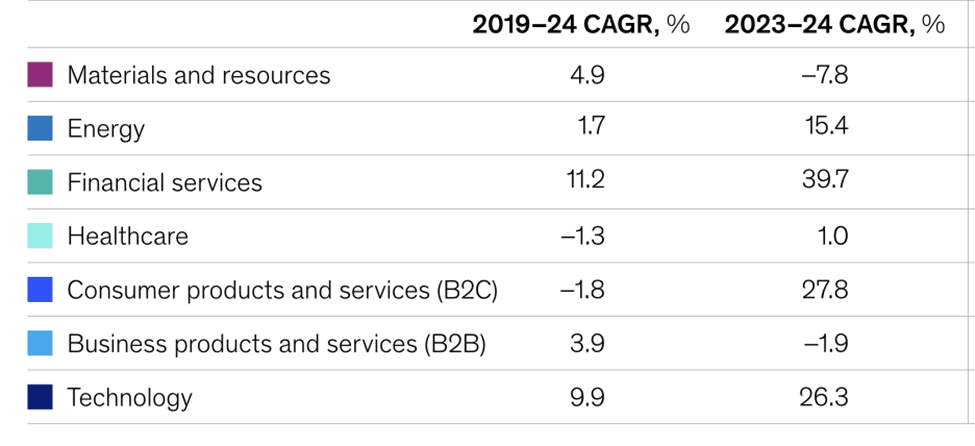
Artificial intelligence dominated venture capital activity in 2024 and that is expected to continue into 2025 with significant investments in applications across various industries. Last year AI-related companies received over $100 billion in funding, an increase of more than 80% over the $55.6 billion invested in 2023.9 So far in 2025, Augmented reality startup Infinite Reality locked up $3 billion,10 while ChatGPT rival Anthropic raised $1 billion from Google in January and another $3.5 billion in March that valued the ChatGPT rival at over $61.5 billion.11
The energy sector is also poised to benefit from the new administration’s move away from ESG and the massive energy needs of running artificial intelligence data centers. Electric companies are projected to invest considerably in grid modernization to support this rising electricity demand.
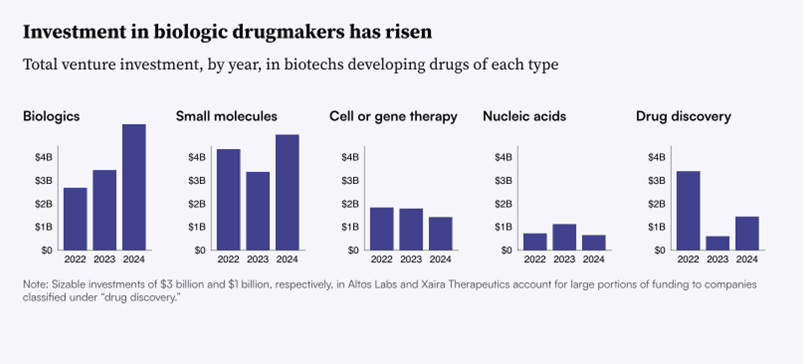
Private equity investment in healthcare focused on expanding manufacturing capacity in 2024, including the $16.5 billion buyout of contract manufacturer CDMO Catalent by Novo Holdings.12 In 2025, biotech firm Retro Biosciences raised $1 billion, and biotechnology firm Eikon Therapeutics, which is developing technology that allows scientists to observe protein movement within cells, has secured one of the largest venture funding rounds for a biotech company this year.13
Source: BioPharma Dive
Strategic Exits in a More Challenging Market Environment
Going into 2025, expectations were high. However, amid the opportunities, private equity and venture capital face a myriad of challenges, including rising inflation trends, which have led the Fed to pause its rate-cutting cycle, as well as ongoing uncertainty surrounding the economic impact of the Trump administration’s tariff policies. However, demand for exits and the administration's business-friendly regulatory environment are expected to lead to an anticipated increase in M&A activity as general partners look to return to dealmaking.
Sources:
- Private Equity’s 2025 ‘Dry Powder’ Countdown - WSJ
- Trump picks Andrew Ferguson to chair FTC | Reuters
- Grail to Begin Trading on Nasdaq as Illumina Completes Divestiture - BioSpace
- Fact Sheet: President Donald J. Trump Launches Massive 10-to-1 Deregulation Initiative
- US bank regulation under Trump: Basel in doubt, digital assets rise & consumer setbacks expected - Thomson Reuters Institute
- Trump Takes Aim at Private Equity’s Favorite Tax Perk Again
- Alphabet's self-driving unit Waymo closes $5.6 billion funding round as robotaxi race heats up in the U.S.
- Data-labeling startup Scale AI raises $1B as valuation doubles to $13.8B | TechCrunch
- The State of the Funding Market for AI Companies: A 2024-2025 Outlook
- The 10 Biggest Rounds Of January: Infinite Reality Tops Busy Month
- Anthropic raises $3.5 billion, reaching $61.5 billion valuation as AI investment frenzy continues | VentureBeat
- Biopharma M&A: Outlook for 2025 - IQVIA
- Eikon raises $351M in one of the year’s largest biotech venture rounds | BioPharma Dive
Learn about the institutional private market fund exposures available on our platform and how you can easily integrate them into your clients’ portfolios.
For financial advisors only.