
Published on January 6, 2025
The Strategic Allure of Direct Lending
As traditional financial institutions face growing regulatory constraints, direct lending has become a vital strategy, reshaping how businesses access capital and how investors secure returns. The sector’s rise has been underpinned by the retreat of traditional banks from middle-market lending, coupled with the appetite of businesses for customized, quick-turnaround financing. This dynamic has created a fertile ground for private lenders to step in and offer tailored solutions that traditional banking structures often cannot provide.
Understanding Direct Lending
Direct lending refers to the practice of non-bank entities—such as private equity firms, hedge funds, and specialty finance companies—providing loans directly to businesses. Unlike traditional loans originated by banks, these loans are often privately negotiated, structured, and held to maturity by the lender. Direct lending focuses primarily on middle-market companies, typically defined as businesses with revenues ranging from $10 million to $1 billion.
This form of lending offers several advantages for borrowers. Direct lenders are often more flexible in loan structuring. They can accommodate bespoke financing needs, such as covenant-lite loans or unitranche structures, which combine senior and subordinated debt into a single tranche. Such customization can be pivotal for businesses in growth phases or those undergoing restructuring.
The Rise of Non-Bank Lenders
The 2008 financial crisis was a watershed moment for the direct lending industry. Stricter regulatory frameworks, such as the Basel III guidelines, constrained the lending capacities of traditional banks. Middle-market companies, often deemed too risky or too small by banks, began turning to alternative financing sources.
Simultaneously, institutional investors—such as pension funds, endowments, and insurance companies—increasingly sought avenues to generate yield in a low-interest-rate environment. Direct lending presented an attractive proposition: relatively higher yields than public debt markets, with risk mitigated through stringent due diligence and collateral-backed loans.
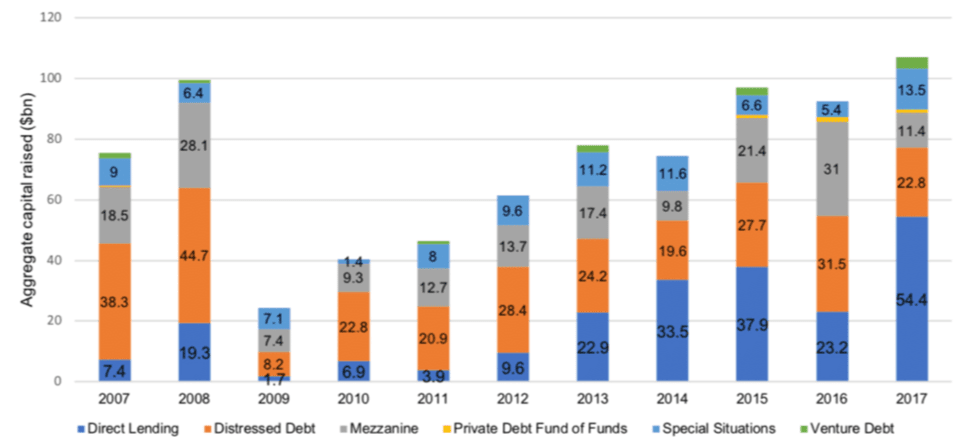
According to the Cliffwater Direct Lending Index (CDLI), as of September 2023, the index encompassed approximately 14,000 directly originated middle-market loans, totaling $295 billion in assets. This marks a substantial increase from previous years, highlighting the expanding role of direct lending in corporate finance.
Annualized Private Debt Fundraising by Type
Benefits of Investors
Investors in direct lending benefit from several key attributes:
- Attractive Yields: Direct loans typically offer higher interest rates than traditional bonds or publicly traded debt instruments. This premium compensates lenders for the relative illiquidity and credit risks of middle-market borrowers.
- Floating Rates: Most direct loans are structured with floating interest rates, which protect investors against interest rate volatility and offer a hedge in rising rate environments.
- Diversification: Direct lending offers exposure to sectors and businesses often underrepresented in public markets, providing portfolio diversification.
- Predictable Cash Flows: The regular interest payments from direct loans create a steady income stream, appealing to investors with liability-matching needs, such as pension funds.
Risks and Challenges
While the rewards of direct lending are enticing, the strategy is not without risks. Chief among these are credit risk and illiquidity. Middle-market companies, while offering growth potential, often lack the financial resilience of larger corporations. Economic downturns can exacerbate default risks, leaving lenders exposed to potential losses.
Moreover, the private nature of direct loans means they cannot be easily traded or liquidated, requiring investors to commit capital for extended periods. This illiquidity can pose challenges for those who need quick access to cash.
Another concern is the competitive landscape. The surge in capital allocated to direct lending has increased competition among lenders, compressing yields and loosening underwriting standards in some segments. As more players enter the market, rigorous credit analysis and portfolio management become paramount.
Strategic Considerations
For institutional investors and asset managers, integrating direct lending into a broader portfolio requires careful strategic planning. Key considerations include:
- Underwriting Discipline: Given the bespoke nature of direct loans, due diligence is critical. A comprehensive analysis of a borrower’s financial health, industry position, and management team can help mitigate credit risks.
- Sector Expertise: Direct lenders with deep sector knowledge can better assess risks and identify opportunities. For instance, lending to a healthcare company may require understanding regulatory frameworks and reimbursement models, while financing a manufacturing firm might hinge on assessing supply chain risks.
- Portfolio Diversification: Spreading exposure across industries, geographies, and loan structures can help reduce concentration risks and enhance resilience.
- Monitoring and Servicing: Active management of the loan portfolio, including regular monitoring of borrowers’ financial performance, is essential to mitigate risks and identify early warning signs of distress.
The Future of Direct Lending
The direct lending market shows no signs of slowing down. According to industry estimates, the global private credit market—of which direct lending constitutes a significant portion—is projected to exceed $1.5 trillion in assets under management by 2025. Factors driving this growth include the ongoing disintermediation of traditional banks and borrowers' increasing preference for flexible financing options.
Projections indicate that the private credit market, with direct lending as a significant component, is expected to reach $2.8 trillion in assets under management by 2028. This anticipated growth underscores middle-market companies' increasing reliance on non-bank lending sources.
The macroeconomic environment also plays a pivotal role. In a high-interest-rate scenario, floating-rate loans become particularly attractive for investors, while middle-market companies seek capital for growth, acquisitions, and refinancing. Additionally, the rise of environmental, social, and governance (ESG) considerations has opened new avenues for direct lenders to align loan structures with sustainable business practices.
The CDLI has outperformed U.S. high-yield bonds and leveraged loan indices in 12 of the past 17 years, up to and including the first three quarters of 2022. This consistent outperformance demonstrates the potential for attractive risk-adjusted returns in the direct lending space.
Conclusion
Direct lending has carved out a distinct and lucrative niche within the broader financial ecosystem. Bridging the gap between traditional banking and corporate financing needs offers compelling opportunities for borrowers and investors. However, as the market matures and competition intensifies, success in this domain will hinge on rigorous risk management, sector specialization, and strategic agility. For those willing to navigate its complexities, direct lending remains a promising avenue for generating yield and driving growth in the years ahead.
Sources:
View the funds that utilize a direct lending strategy.
For financial advisors only.