

Published on October 8, 2024
Top 5 Stock Market Risks - What Could Go Wrong?
Amidst the uncertainties in today’s economy, the stock market has recently set new all-time highs. However, recent pullbacks in August and September suggest that investors remain on edge, looking for potential cracks in the rally. While those dips were subsequently bought up, today’s insight examines what risks could drive a persistent downturn that does not recover quickly.
11. Weak economic data that could indicate a U.S. recession.
Markets have been on edge, waiting with bated breath for each new economic data release. Headlines read “Why the August Jobs Report Matters More Than Most” from the WSJ or “All eyes on Wednesday's CPI inflation report…” from MarketWatch.
In normal times, these reports might not hold as much weight, but with consensus among economists being a soft landing1, any signs to the contrary have spooked investors.
With the August CPI report showing a 2.5% year over year increase , inflation is now close to the Fed’s 2% target. That is why the focus has shifted to jobs reports for signs of economic weakness and doubts about a soft landing. Going into the August jobs report, the U.S. Bureau of Labor Statistics had already revised down its total employment in March 2024 by 818,000 jobs, the largest downward revision since 2009.2 When the August report showed 142,000 jobs added vs the expectation of 164,000, markets sold off.
Major Stock Indexes
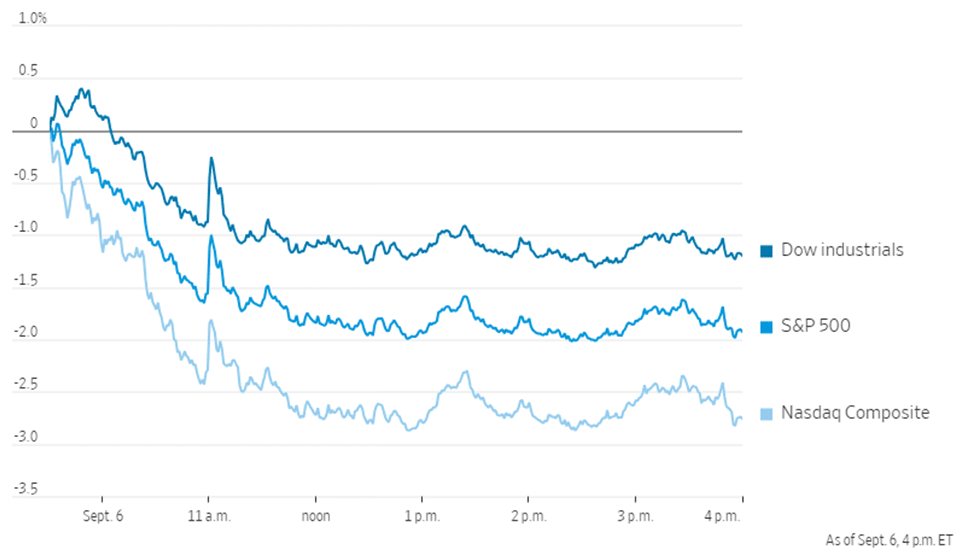
Source: FactSet3
The September report subsequently showed strength, easing concerns for now and igniting an uptick in equities, but volatility remains heightened around jobs reports.
Index Performance, Thursday and Friday
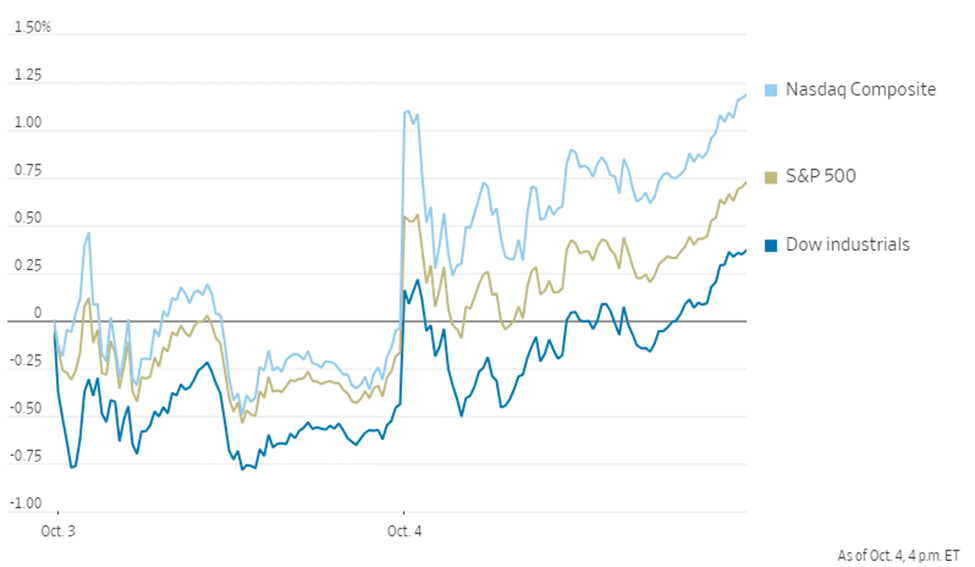
With consensus among economists being a soft landing and equity markets near all-time highs, weak economic data and, specifically, weak jobs data represent material equity market risks.
22. Policy mistake from the Fed
With consensus among economists being a soft landing, the Fed is expected to set rates that will neither contribute to an uptick in inflation nor lead to a recession. What exactly that rate policy looks like is highly disputed even within the Fed, with Fed Governor Michelle Bowman dissenting against the recent half-a-point cut in favor of a quarter-point cut.5 While 11 of the 12 governors agreed on the half-a-point reduction, recent history would suggest that the Fed consensus doesn’t always get it right.
In 2021, inflation went higher than 5%, according to every major metric, before the Fed started raising interest rates in 2022.
Rates and Inflation
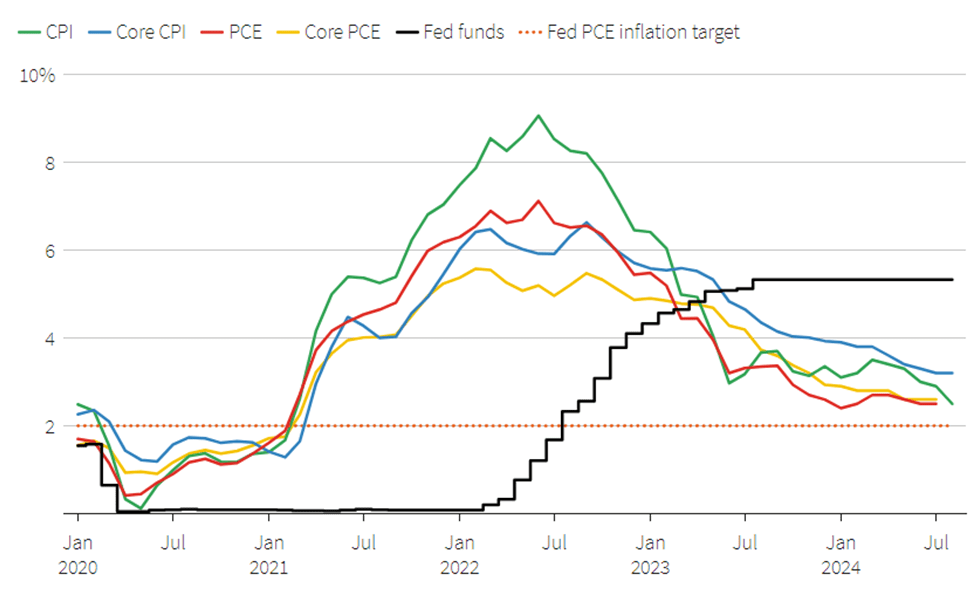
Note: CPI = Consumer Price Index; PCE = Personal Consumption Expenditures Price Index; Core = excluding food and energy; Fed funds = Fed policy rate
Source: Federal Reserve (funds rate and target); Bureau of Labor Statistics (CPI); Bureau of Economic Analysis (PCE); inflation rates are annual.6
All the while, officials kept suggesting that inflation was “transitory” and pricing pressures would ease.7 However, inflation went on to greatly outpace Fed expectations, leaving the Fed behind the curve.8, 9
Legendary fixed income investor Jeffrey Gundlach summarized the state of affairs at the time in February of 2022, saying “the Fed is obviously behind the curve ... It’s going to have to raise rates more than the market still thinks.”10 Those comments proved to be prescient.
Now, we once again face the risk of the Fed falling behind the curve into a weakening labor market, and Gundlach had some more comments prior to the cut. “They seem so out of line… The Fed is way behind the curve, and they should get their act together… We are in a recession already… I see an awful lot of layoffs announcements”, he surmised. 11 With inflation close to the Fed’s 2% target, the biggest risk with the Fed is falling behind the curve once again and not cutting rates fast enough, exacerbating the possibility of a recession.
33. Poor earnings from a bell weather stock
Nvidia’s most recent earnings on August 28th was the most hyped earnings report for a single company in recent memory, with commentators like Wedbush’s analyst Dan Ives calling it the "most important tech earnings in years."12 Of course, the earnings were about more than Nvidia’s company-specific performance. With equity markets rallying to all-time highs on the back of the AI boom and narrative, perhaps more important is the read-through to the rest of the market. If the AI boom is seen as overhyped, that could mean the market rally was unjustified. Nvidia beat and raised on its top and bottom line, but the stock fell roughly 6.4% the next day in reaction. That’s because markets are looking for any cracks in the AI boom narrative that has driven markets to all-time highs. Earnings from Nvidia and their biggest customers such as Microsoft, Google, Meta and Amazon will be major market events for several quarters to come. Any signs of weakness in their AI spending and sales, and the AI boom narrative would be called into question, posing significant risks to the market.
44. Geopolitical risks escalating
The world is facing geopolitical uncertainty on several fronts. The chance of escalation among any of these fronts presents a risk to global markets that should be put in the “unknown unknowns” category, meaning it is difficult to predict what effect a breakout into a major war would have on global markets. In a recently published report from the Commission on the National Defense Strategy,13 we are currently in one of the “most challenging and most dangerous” geopolitical climates since World War II.
The war between Russia and Ukraine has continued grinding on, China has been acting increasingly hostile in the South China Sea, and now the risk of a regional war in the Middle East has risen dramatically.14, 15, 16 After months of increased fire between Israel and Hezbollah along Israel’s northern border, Israel targeted Hezbollah militants with explosive pagers and walkie-talkies and recently initiated a ground offensive.17, 18 In escalation, Iran then directly attacked Israel with missile fire.19 The world now waits for Israel’s response as the risk of a broader regional war grows.
With the world in an increasingly dangerous state, the potential of an escalation on several fronts into a broader conflict represents a major risk to global markets.
55. Weakness in China’s economy
The Chinese economy is facing a gloomy outlook with low growth, tumbling prices, and trade wars. Recently published August data shows China’s home prices recorded their largest fall in 9 years.20 In the face of a weakening consumer, China has continued with investment and manufacturing push rather than improving domestic consumption, which risks falling into a prolonged period of low growth and falling prices, similar to the stagnation seen in Japan.21
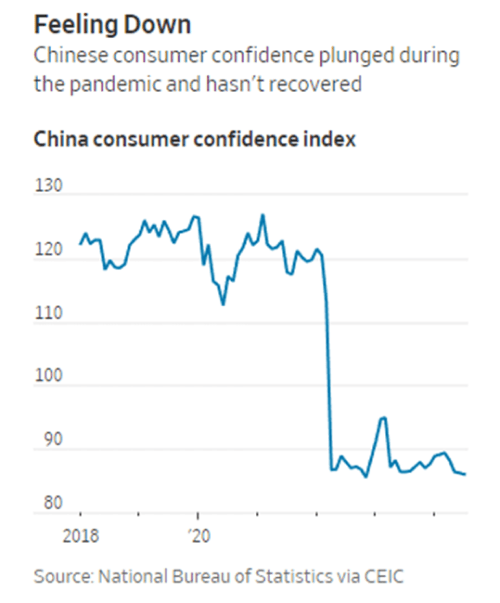
Further, increased manufacturing and exports have been met with criticism from trade partners who have been alarmed by the influx of cheap Chinese goods flooding their markets and threatening their manufacturing.23 China’s overproduction raises the risk of more global pushback via tariffs and other protective measures.
At the root of China’s economic concerns is its ongoing real estate crisis, a product of aggressive development that resulted in spectacles such as the infamous ghost cities – entire cities built with nobody to inhabit them.24

In response to the crisis, the PRC has implemented a blizzard of stimulus packages that have ignited Chinese equities, but many economists question whether the packages will be enough for a durable economic turnaround.26
China’s economic woes have not had a noticeable drag on global equity markets to this point, but as their problems mount and consumption weakens, a spillover into global markets represents a heightened risk.
While it is impossible to capture all major market risks and potential unknowns, this monthly series will attempt to summarize the biggest threats at the time of publishing. With equity markets near all-time highs, it is worth asking “what could go wrong?” and assessing whether you have downside protection in your portfolio. Weak economic data, a policy mistake from the Fed, poor earnings, geopolitical risks, and weakness in the Chinese economy all represent material risks to equity markets.
Sources:
- Financial Times. September 2024. “US economy is heading for soft landing, FT survey says”
- U.S. Bureau of Labor Statistics. September 2024. “Consumer Price Index”
- Wall Street Journal. September 2024. “Stock Market News, Sept. 6, 2024: Nasdaq Leads Losses After Mixed Jobs Report”
- Wall Street Journal. October 2024. “September Jobs Report: How Markets Are Reacting, in Charts”
- Wall Street Journal. September 2024. “Fed Cuts Rates by Half Percentage Point”
- Reuters. September 2024. “Rates and inflation”
- Reuters. November 2021. “Fed sings the 'transitory' inflation refrain, unveils bond-buying 'taper'”
- Federal Reserve. September 2021. “Summary of Economic Projections”
- Bureau of Labor Statistics. September 2024. “12-month percentage change, Consumer Price Index, selected categories”
- CNBC. February 2022. “Jeffrey Gundlach says the Fed is ‘obviously behind the curve,’ will raise rates more than expected”
- Bloomberg. September 2024. “Gundlach Sees a Half-Point Rate Cut With Fed ‘Behind the Curve’”
- Yahoo Finance. August 2024. “All eyes are on Nvidia earnings this week in the stock market”
- Armed-Services. July 2024. “Commission on the National Defense Strategy”
- Wall Street Journal. September 2024. “One Million Are Now Dead or Injured in the Russia-Ukraine War”
- Wall Street Journal. August 2024. “In Beijing’s Quest for Control of the South China Sea, a New Flashpoint Emerges”
- Wall Street Journal. October 2024. “Iran Attacks Israel With Missiles, Drawing Vows of Retaliation”
- Wall Street Journal. September 2024. “Hezbollah Walkie-Talkies Blow Up Across Lebanon in Second Wave of Attacks”
- Wall Street Journal. October 2024. “Israel Reports First Deaths in Lebanon and Bolsters Forces Fighting Hezbollah”
- Wall Street Journal. October 2024. “Iran Attacks Israel With Missiles, Drawing Vows of Retaliation”
- Wall Street Journal. September 2024. “China’s Economy Slowed Further in August, Extending Gloomy Summer Slide”
- Wall Street Journal. September 2024. “China’s Economy Slowed Further in August, Extending Gloomy Summer Slide”
- Wall Street Journal. September 2024. “China’s Economy Slowed Further in August, Extending Gloomy Summer Slide”
- Wall Street Journal. September 2024. “China’s Economy Slowed Further in August, Extending Gloomy Summer Slide”
- CNN. November 2016. “Abandoned architectural marvels in China’s largest ghost town”
- CNN. November 2016. “Abandoned architectural marvels in China’s largest ghost town”
- Wall Street Journal. September 2024. “A Week of Shock and Awe Ignites China’s Stock Markets”
See the hedge funds listed on our platform.
For financial advisors only.