
Published on March 13, 2024
Tracing the Impact of the Forever Renters
Introduction
The residential real estate market remains in transition. While homeownership rates have stayed somewhat consistent over the longer term, for the first time, more affluent households are opting to continue to rent rather than purchase a home. This demographic has been named the forever renters. In this insight, we will explore the data that shows the changing composition renters versus purchasers before considering what impacts forever renters might have on real estate investors and others.
Homeownership in Decline? Not Quite
Homeownership rates peaked in 2004 at 69% and have continued to hover around the longer-term average of 65%. As of the first quarter of 2023, homeownership rates are close to the average at 66%.1 If there is no meaningful change in the number of households renting, then it follows that there may be a shift in the composition of renters versus buyers.
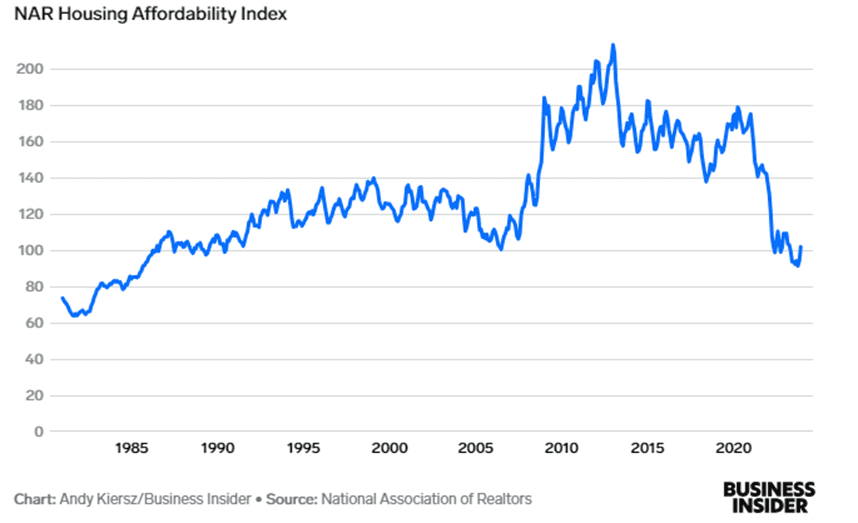
Homeownership is within reach according to the NAR housing affordability index and research put together by Business Insider.2 Based on recent prices, this index measures whether a typical family earns enough income to qualify for a mortgage loan on a typical home at the national and regional levels.3
U.S. Home Affordability Since 1981
Source: 32 Cities Where Home Prices Are Falling in the US: NAR (businessinsider.com)
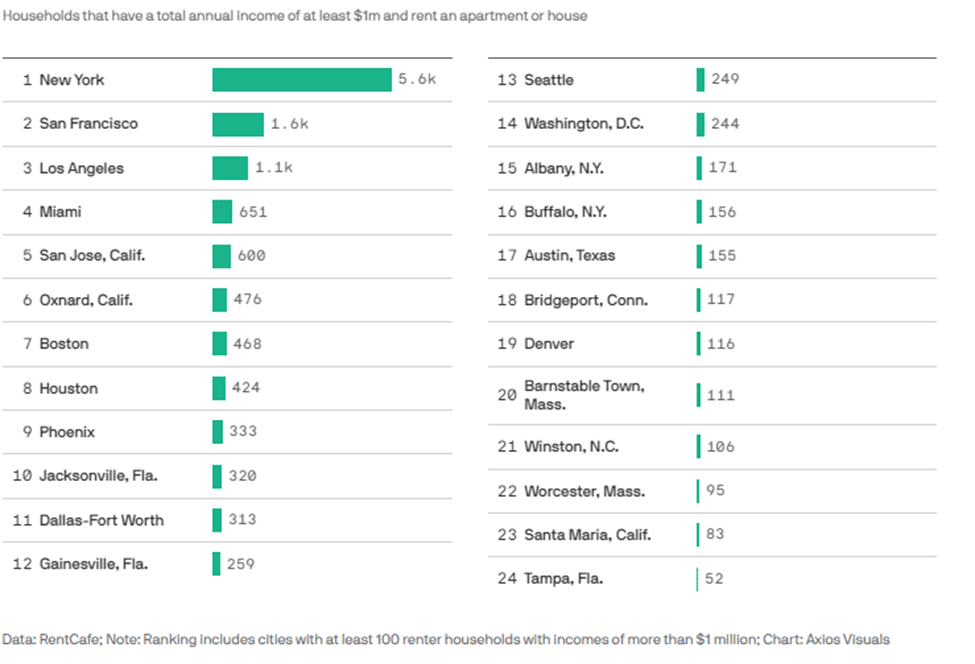
So, while interest rates have increased and mortgage rates have followed, in general, homeownership has become more within reach compared to just a year ago. This data suggests that the increase in the forever renter has less to do with access and affordability, particularly for more affluent households. A recent report from Rent Café backs this assumption, showing that in large metro areas, you have hundreds and, in some cases, even thousands of millionaires that opt to continue to rent versus buy.4
Metro Areas with the Most Millionaire Renter Households, 2022
Source: More Denver millionaires are renting over owning homes - Axios Denver
Moreover, real estate investor GID, which owns and manages approximately 50,000 apartment units across 30 markets, says nearly a quarter of its residents earn more than $200,000 a year. Historically, people with this level of income would have been homeowners according to the Wall Street Journal.5 Both the data and anecdotal evidence support the idea that some households that would have previously been homeowners are now opting to rent. Additional research from Bloomberg and RentCafe found that the number of renters in the high income band of earning greater than $150,000 a year grew by 82% and is the fastest growing category of renters in the country.6 Bloomberg and RentCafe asserts that this group of renters historically would have moved out of the metro areas into surrounding suburbs but are now opting to rent in mid rise and high-rise buildings underpinning their commitment to city living.
Why the Forever Renter Opts to Rent?
There are some obvious reasons why the “Forever Renters” are choosing to rent even though some could comfortably afford to buy a home. The obvious reasons are that some apartments and rentals offer superior amenities, like pools and gyms. Renting provides more flexibility, especially if you have recently moved or are considering moving to a new city. The number of Americans moving to a new state has been well covered since the days of remote work during the pandemic, but to provide an illustrative example, nearly 65,000 New Yorkers obtained a Florida driver’s license in 2022, which topped the previous record of 62,000 the previous year.7 Research from Harvard’s Joint Center for Housing Studies has found that there has been a permanent spike in people moving post-Covid. They have coined this phenomenon as the “Great Reshuffling.”8 Perhaps some choose to buy immediately in their new market, but we posit that this great reshuffle contributes to the changing composition of renters in the United States.
Housing Stock
If the composition and identity of the average homeowner and renter are changing, it follows that housing supply should adjust correspondingly. Considering the forever renters, we have shown that some renters have assets and income that, in previous eras, would have led them to become homeowners. As supply adjusts because of this demographic’s choice to rent, we expect to see more luxury buildings with a greater focus on amenities and premier locations to be developed. Conversely, the increase in relative affordability of homeownership shows that some households that previously felt they couldn’t afford a house now may be able to qualify for a mortgage that allows them to become a homeowner. It is harder to predict how the housing supply might change to match demand, but we can say with high confidence that the real estate market is in transition.
Conclusion
In this insight, we have set forth data showing that the forever renter has changed the demand composition of the residential market. The total effect of the forever renter is hard to predict. Still, we can confidently assert that the residential real estate market is in transition, and during times of change, seasoned investment teams with track records and established relationships tend to generate relatively strong returns. This asset class is massive, and many different types of managers exist within the space. At Crystal Capital Partners, we believe that select, institutional private market investment managers have been and will continue to be more effective than their peers at assessing the potential downside risk and future returns within the residential real estate market – and therefore provide better outcomes for their clients.
Sources:
- Homeowner Data and Statistics 2023 | Bankrate
- 32 Cities Where Home Prices Are Falling in the US: NAR (businessinsider.com)
- Housing Affordability Index (nar.realtor)
- More Denver millionaires are renting over owning homes - Axios Denver
- The Rise of the Forever Renters - WSJ
- Millionaire Renters Are on the Rise in High-Cost US Cities - Bloomberg
- Here's why New Yorkers are moving to Florida in droves (usatoday.com)
- Did More People Move During the Pandemic? | Joint Center for Housing Studies (harvard.edu)
- High-Earning Americans Are More Likely to Rent Than Buy, Report Says – Robb Report
See the private funds that are investing in real estate opportunities.
For financial advisors only.