
Published on February 28, 2025
Trump Tariffs in Focus: How Ongoing Trade Policies Continue to Shape Prices, Portfolios, and the Global Economy
Donald Trump first made headlines in 2018 when he introduced tariffs on steel, aluminum, and a wide range of Chinese imports. Now, after his return to the White House, Trump’s administration is once again ramping up trade duties to protect American industries and jobs. In a development that has garnered attention from businesses and investors alike, Trump has advanced the implementation of 'reciprocal tariffs,' with a Presidential Memorandum issued on February 13, 2025, laying the groundwork for matching foreign tariffs on U.S. goods. As of March 4, 2025, a 20% tariff is in effect on all imports from China, while 25% tariffs on goods from Mexico and Canada.
Economists and policymakers continue to debate whether these tariffs are a short-term negotiation tool, as seen in demands to curb fentanyl trafficking, or a permanent fixture of U.S. trade strategy, evidenced by the reinstatement of steel and aluminum duties.5, 6
Trump Tariffs: Understanding Tariffs and Their Role
Tariffs function as taxes on imported goods. Governments impose them for various reasons—chief among them protecting domestic industries, addressing perceived trade imbalances, retaliating against what they view as unfair practices, or simply generating revenue. When tariffs rise, the cost of importing goods generally increases, which can drive up consumer prices and encourage companies to reconfigure supply chains.
Historically, the United States relied on free trade deals like NAFTA and the World Trade Organization framework to regulate global commerce. However, under the Trump administration, tariffs have become a central policy instrument. By slapping duties on selected imports, President Trump aims to compel trading partners to negotiate what he deems “fairer deals” while safeguarding U.S. workers. Critics worry about potential retaliation, higher consumer prices, and disruptions that may outlast any short-term benefits.
According to the U.S. Census Bureau, in May 2023, the U.S. goods and services deficit stood at $63.0 billion, underscoring continuing imbalances in trade flows.2 While there are myriad factors behind these monthly movements—including energy prices, currency fluctuations, and post-pandemic supply chain bottlenecks—tariffs undeniably change the balance of imports and exports.
Trump Tariffs: Policies
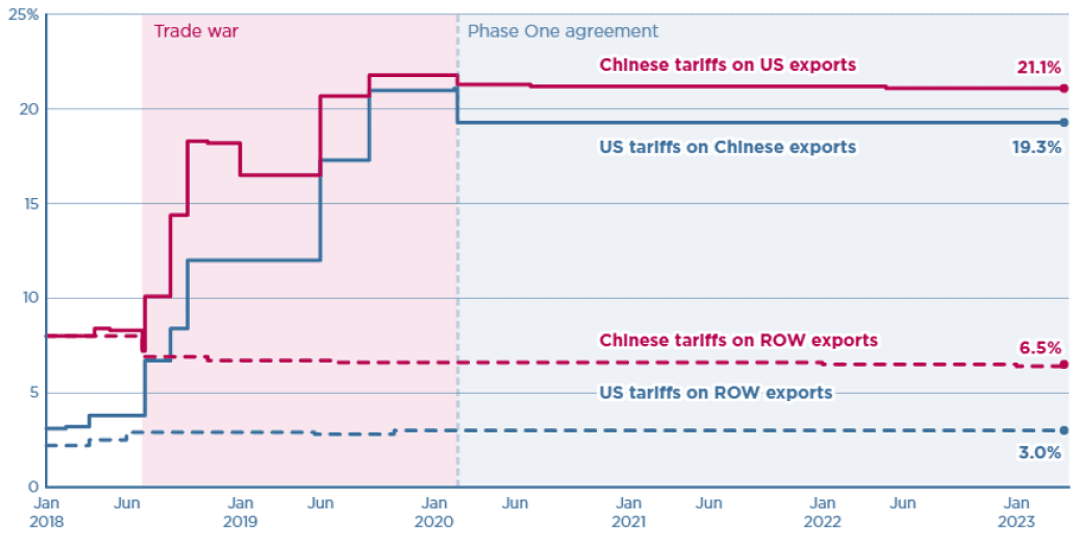
Since his first term in office, President Trump has repeatedly used tariffs as an economic and negotiating tool. By 2019, the Peterson Institute for International Economics estimated that tariffs on Chinese goods had surged to an average rate of 21%, dramatically climbing from about 3.1% in early 2017.1 While some duties dipped slightly during negotiations or “phase one” trade deals, the broader tariff environment remains historically high, with recent announcements suggesting further expansion.
The China-focused tariffs, currently set at 20% as of March 4, 2025, remain notable, targeting products ranging from electronics to apparel. Meanwhile, Trump’s broader push for 'reciprocal tariffs,' outlined in the memorandum on February 13, 2025, extends beyond Asia. His 25% tariffs on Mexican and Canadian imports, in effect since March 4, 2025, demonstrate this approach with close neighbors. According to administration officials, these measures primarily aim to compel Mexico and Canada to address illegal immigration and fentanyl trafficking, while also seeking stricter labor enforcement, fairer agricultural trade terms, and stronger intellectual property protections.5, 6
Trump Tariffs: Negotiation Tool or Long-Term Strategy?
A central question persists: Are tariffs primarily a short-term device to extract concessions, or have they become embedded in the U.S. economic playbook? Supporters point to reworked deals, like the United States-Mexico-Canada Agreement (USMCA), as evidence that tough tariff stances force other countries to the table. By threatening higher duties, the logic goes, America can secure better terms on everything from dairy exports to automotive manufacturing.
Critics argue that tariffs often invite retaliatory duties, hurting U.S. exporters. One well-publicized example comes from American farmers who sell soybeans overseas. According to the U.S. Department of Agriculture, soybean shipments to China plummeted during trade tensions in 2018 and 2019, forcing many producers to rely on federal bailout funds. Although exports have partially rebounded, the episode underscores the fragility of global relationships built over decades.
US-China tariff rates toward each other and rest of the world (ROW)
Trump Tariffs: Effects on Prices, Inflation, and the Economy
One of the most direct consequences of tariffs is the potential for higher consumer prices. When manufacturers pay more for imported inputs, they typically pass on at least some of those costs to consumers. This can boost inflation—which the Federal Reserve follows closely. In an October 2023 Federal Reserve Beige Book report, about 35% of surveyed manufacturers indicated tariffs had “significantly” increased their production costs, compelling them to either absorb losses or raise prices.3
Trump Tariffs: Portfolio Implications
For investors, the evolving tariff landscape under President Trump demands careful consideration. Although these measures are often viewed as short-term tactics, they can produce enduring changes in trade patterns, corporate earnings, and market sentiment. Below are several key points to bear in mind when allocating assets:
- Sector Vulnerability: Technology, automotive, and retail sectors are especially sensitive to import levies, risking higher input costs and reduced margins. In contrast, domestic metal producers may benefit from protectionist measures that price foreign steel or aluminum out of the market.
- Global Diversification: With the new “reciprocal” approach extending tariffs beyond China to Mexico and Canada, diversification remains a cornerstone of risk management. Retaliatory actions by other nations could disrupt multiple industries, underscoring the importance of spreading investments across different regions and asset classes.
- Inflation and Interest Rates: If tariffs elevate consumer and producer prices, the Federal Reserve might raise interest rates or adopt a more hawkish stance to combat inflation. In such a scenario, traditional bond portfolios could face headwinds, making instruments like Treasury Inflation-Protected Securities (TIPS) or certain commodities appealing as hedges.4
- Supply Chain Shifts: Companies that relocate production to avoid tariffs often incur transition costs and temporary inefficiencies. Over the long run, however, such moves might unlock competitive advantages if firms strategically diversify their manufacturing bases.
- China’s Growing Role: Despite Washington’s protectionist stance, many analysts believe China’s ascent as a global economic powerhouse remains inevitable, driven by its large consumer base, technological advancements, and extensive manufacturing capacity. As a result, an outright exclusion of Chinese assets could miss potential growth opportunities. While tariffs inject uncertainty, a prudent approach would be to weigh exposure to Chinese equities, fixed-income instruments, or other regional assets as part of a well-rounded portfolio strategy that anticipates China’s continuing rise.
Trump Tariffs: The Road Ahead
As President Trump pursues “reciprocal tariffs,” the administration’s stance appears to favor using duties to achieve various policy goals— from trade balance improvements to intellectual property protection. The introduction of a 20% levy on Chinese goods has already taken effect, and the mere hint of 25% import taxes on Mexico and Canada has sparked widespread debate about the potential impact on cross-border supply chains.
Should negotiations stall, the Trump administration has made it clear that tariffs could broaden further, capturing more goods or more countries. On the other hand, if key trade partners concede to U.S. demands, certain tariffs might be eased or removed. The fluid nature of these policies underscores the importance of close monitoring for businesses, consumers, and investors alike.
Far from being a temporary stick in trade talks, tariffs have become a defining feature of President Trump’s economic agenda. With immediate implications for import prices, industry competitiveness, and diplomatic relations, they will likely remain a driving force in shaping both the U.S. and the global economy. Anyone managing portfolios or operating internationally should be prepared for ongoing shifts and monitor any further announcements from the White House.
Sources:
- US-china trade war tariffs: An up-to-date chart | Piie. (n.d.-f).
- Bureau, U. C. (2019, April 15). FT900: U.S. International Trade in goods and services- historical releases. United States Census Bureau.
- National summary. Board of Governors of the Federal Reserve System. (n.d.).
- Chemtob, D. (2025, February 13). How will tariffs impact you? here’s what to know about trump’s plans. Forbes.
- The United States Government. (2025, February 13). Reciprocal Trade and tariffs. The White House.
- Ian Saccomanno Samuel Scoles. (2025, March 4). US tariffs on Canada and Mexico enter into effect; tariff on China rises from 10% to 20%. White & Case LLP.
The evolving policy landscape presents challenges and opportunities for investors and advisors and may require institutional hedge fund management for client portfolios.
For financial advisors only.