
Published on November 5, 2024
Understanding Private Credit Strategies: How Investors Can Capitalize
As investors search for alternative sources of yield beyond traditional fixed-income instruments, private credit continues to be an appealing option for portfolio diversification and enhanced returns. The private credit market has experienced rapid growth over the last decade, driven by demand from both borrowers seeking more flexible financing options and investors looking for higher returns. This article explores the fundamentals of private credit, outlines the strategies within this asset class, and provides insights on how investors can successfully incorporate it into their portfolios.
What is Private Credit?
Private credit refers to non-bank lending to private companies. Unlike traditional loans issued by banks, private credit is typically sourced from non-bank lenders like private equity firms, hedge funds, or specialized private debt funds. These loans are not publicly traded, making them less liquid but often more flexible in terms of structure and terms.
Private credit strategies can offer higher yields than public bonds or syndicated loans because of their illiquidity premium and bespoke nature, in which lenders can negotiate directly with borrowers on specific loan terms. As a result, private credit has gained popularity among institutional investors, pension funds, endowments, and high-net-worth individuals seeking higher returns, consistent income, and diversification.
The Rise of Private Credit
The private credit market, which was valued at approximately $300 billion in 2010, has expanded to over $1 trillion in assets under management (AUM) according to Preqin. This surge in growth can be attributed to multiple factors:
- Regulatory Changes: Post-2008 financial regulations, such as Basel III, have forced banks to be more conservative in their lending practices, creating a funding gap that private lenders have been eager to fill.
- Low Interest Rates: With central banks maintaining low-interest rates, traditional fixed-income returns have become less attractive, leading investors to seek alternative sources of yield.
- Demand for Flexible Capital: Many middle-market companies, often too small for public bond issuance but too large for local bank loans, seek private credit due to its flexibility and faster turnaround times.
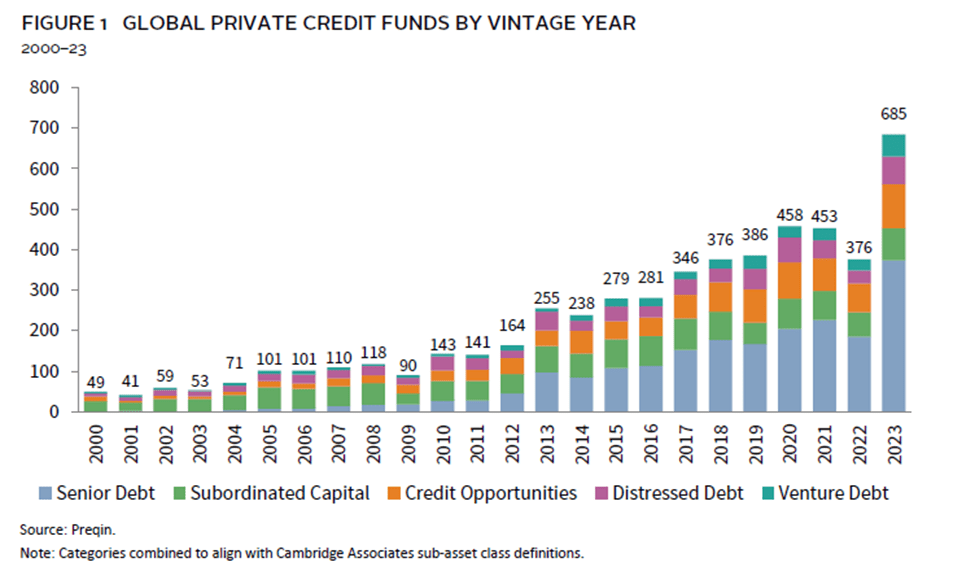
Key Private Credit Strategies
The private credit market is not monolithic; it consists of several distinct strategies, each with unique risk-return characteristics. Here are the primary strategies:
1. Direct Lending
1. Direct Lending
Direct lending is the most common strategy within private credit, targeting middle-market companies with financing needs ranging from $10 million to $250 million. Loans can be used for acquisitions, refinancing, working capital, or growth capital.
Advantages: Direct lending offers predictable cash flows through regular interest payments, typically with interest rates ranging from 6% to 12%. These loans often have floating rates, providing some protection against interest rate risk.
Risks: The main risk is credit risk, as these loans are typically made to companies with below-investment-grade credit ratings, increasing the probability of default.
2. Mezzanine Financing
2. Mezzanine Financing
Mezzanine financing is a hybrid of debt and equity, often used to finance leveraged buyouts, growth capital, or recapitalizations. It sits between senior debt and equity in the capital structure.
Advantages: Mezzanine loans offer higher returns, typically between 12% to 20%, due to their subordinated position in the capital stack. They may also include equity warrants, which can enhance returns if the borrower performs well.
Risks: These loans carry higher default risks than senior loans, making them more susceptible to economic downturns.
3. Distressed Debt
3. Distressed Debt
Special situations and distressed debt strategies involve lending to or acquiring the debt of companies facing operational or financial challenges.
Advantages: This strategy can deliver outsized returns, often exceeding 20%, by purchasing debt at significant discounts or restructuring it on favorable terms.
Risks: These investments are highly risky, requiring deep expertise in restructuring and turnaround strategies. Investors may face prolonged periods of illiquidity, as these loans often involve complex negotiations.
4. Real Estate Debt
4. Real Estate Debt
Real estate debt strategies involve lending against commercial or residential real estate, often through bridge loans or construction loans.
Advantages: Real estate-backed loans offer investors asset-backed security, mitigating some of the credit risks. Returns typically range from 8% to 15%, depending on the type of loan and market conditions.
Risks: The primary risks are property value volatility and the potential for delayed or stalled projects, especially during economic downturns.
5. Asset-Backed Lending
5. Asset-Backed Lending (ABL)
ABL strategies focus on lending against specific assets, such as inventory, equipment, receivables, or other collateral. These loans are common in industries like manufacturing, retail, and logistics.
Advantages: ABL generally offers a lower-risk profile due to the collateral backing, making it appealing for investors seeking a safer way to access private credit returns.
Risks: While asset-backed loans are generally less risky than unsecured loans, they can still face liquidity challenges if the underlying assets are difficult to sell or depreciate quickly.
How to Invest in Private Credit
Investors can access private credit through various channels, including:
- Private Credit Funds: These funds pool capital from multiple investors to lend across a diversified portfolio of loans. They offer broader access to private credit strategies and require less hands-on management than direct investments.
- Co-Investments: Some investors prefer co-investing directly in specific loans alongside a lead investor, typically a private equity or debt fund. This approach offers more control over investment decisions but requires substantial expertise.
- Business Development Companies (BDCs): BDCs are publicly traded vehicles that lend to middle-market companies. They offer retail investors a liquid way to access private credit returns, though their publicly traded nature exposes them to market volatility.
Key Considerations for Investors
While private credit offers attractive returns, investors should weigh the following considerations:
- Liquidity: Private credit investments are typically illiquid, with holding periods ranging from 3 to 7 years. Investors must be prepared for longer investment horizons.
- Due Diligence: Rigorous due diligence is critical to assessing credit quality, borrower management, and market conditions. It’s essential to understand the risk profile and potential recovery strategies in case of defaults.
- Interest Rate Environment: As private credit loans often have floating interest rates, they can perform well in rising rate environments. However, rising rates can also strain borrowers’ ability to service debt, increasing default risks.
Conclusion
Private credit strategies provide investors with an opportunity to enhance yields, diversify portfolios, and achieve consistent income in today’s challenging fixed-income landscape. By understanding the distinct strategies within private credit and carefully assessing associated risks, investors can effectively navigate this complex but rewarding asset class. As always, a well-informed approach, combined with rigorous due diligence, will be key to maximizing returns and minimizing risks in private credit investing.
Sources:
- Contributor, A. B. J. G. (2023, December 12). The Basel III Endgame Proposal: Yet another gift to private credit funds. ABA Banking Journal.
- Deloitte. (2024, August 23). How can banks adapt to the growth of private credit?. Deloitte Insights.
- Private credit strategies. (n.d.-b).
- Phan, M. (2024, May 20). Private credit strategies: An introduction. Cambridge Associates.
See the private credit funds available on our platform to include in your clients' portfolios.
For financial advisors only.