

Published on March 28, 2024
U.S. EV Sales Sluggishness - a Blip or Cause for Concern
Introduction
EV sales are slowing. While the 2022 Inflation Reduction Act increased clean-energy subsidies, propelling manufacturers from General Motors to Audi to Stellantis (Fiat Chrysler and PSA Group) to tout all-electric future fleets by 2035, the sector has hit a sizeable speed bump.1
Running Low on Juice: Sales of Battery-Electric vehicles, m
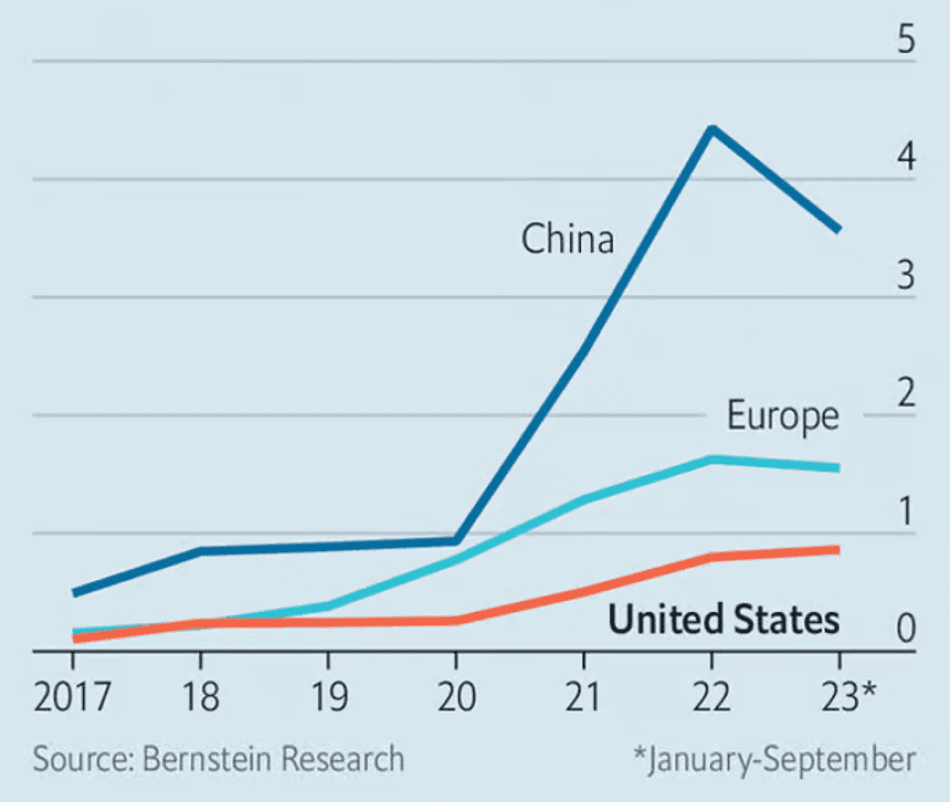
Source: The Economist. Nov 27, 2023. “Is America’s EV Revolution Stalling?”
What’s Behind the EV Sales Slowdown?
EVs are no longer a novelty. Despite roughly 4.6 million EVs sold in the US since 2016, early adopters might be phasing out.2 As with any new product, the fans purchase first, and when the price eventually comes down, the rest of the public follows. EV prices have dropped, but there are additional barriers that are hampering the red-hot growth that was supposed to usher in an electric future.
A Pew Research Centre poll revealed less than two-fifths of Americans would even consider purchasing an EV.3 The same poll reported only 17% are extremely or very confident that there will be sufficient charging stations despite the $5 billion President Biden’s administration set aside in 2022 to spur their construction.4
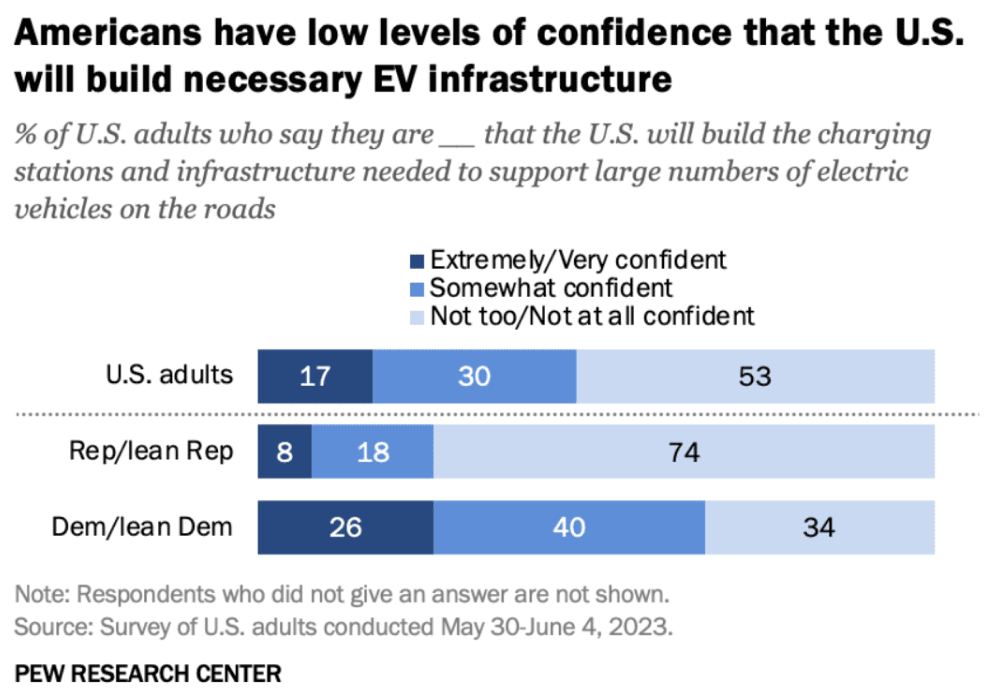
Early adopters were likely independent of reliable and plentiful charging stations to get them through their commutes. But that is not something much of the country can ignore. The charging station roll-out has been extremely slow, with only $790 million (11%) of the earmarked funds having been dispersed.5 “Range anxiety” is real and taking its toll on EV sales.
Lastly, EVs are getting cheaper, but the $7,500 tax credit that was supposed to make US EV sales competitive only applies to cars that follow strict protocols surrounding the origin of the EV’s components. Buyers must also file a form on their federal income tax return (many forget), and combined with high interest rates, enthusiasm for an electric vehicle is waning.
An Inside Look at General Motors
When General Motors (GM) first unveiled early prototypes of the electric Chevy Silverado, even the naysayers had a tough time ignoring the eye-popping aesthetics of the new addition. The designers had hit a home run, and GM was ready to usher in the coming electric wave.
Yet, the breakneck demand from EV sales in 2021 and 2022 slowed, and in December 2023, one of GM’s flagship EV plants in Orion Township, Michigan, shed 1,000 workers, roughly the entire plant.6
While employees knew the landscape had changed, most thought 2024 would be a transition year. Just two years earlier, Michigan Governor Gretchen Witmer and GM management announced the company’s investment of $4 billion to renovate the entire facility for the electric Silverado. This investment was also intended to be part of a larger $7 billion investment in Michigan to support up to 5,000 jobs.7
The about-face in such a short time is not unique to GM. Ford has cut back on the production of the F-150 Lightening amid lagging EV sales and eliminated 1,400 workers from a Dearborn production line. This came on the heels of Ford’s decision to delay nearly $12 billion in previously earmarked EV spending.8
EV Darlings on the Ropes
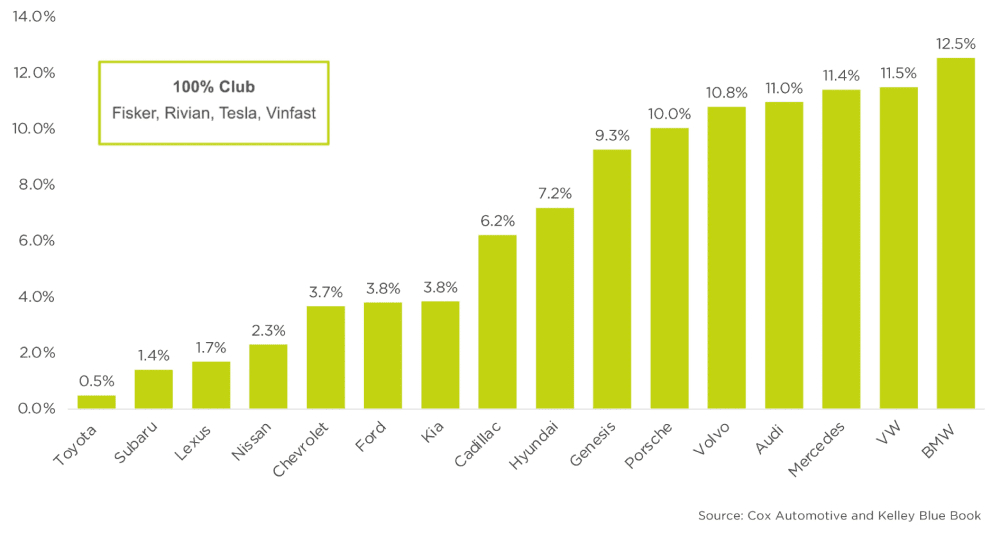
While GM and Ford can return to internal combustion engine (ICE) manufacturing, pure electric manufacturers may be on the ropes. Major manufacturers like BMW and VW have devoted 12.5% and 11.5%, respectively, to EV cars. Meanwhile, Fisker, Rivian, Tesla, and VinFast are part of the “100% Club” —all EVs or nothing.
Share of EVs as a % of Total Manufacturing
With a 100% electric fleet, American start-up Rivian faces a very uncertain 2024. The company has lost $16.8 billion dollars over the past three years and is forecasting EV sales of 57,000 vehicles in 2024 —a figure nearly identical to 2023’s sales (57,232).9
In February, Rivian announced it would be cutting 10% of its workforce, prompting Tesla CEO, Elon Musk, to opine over X that the company would go bankrupt in roughly 6 quarters at the current trajectory.10 Musk then added, for good measure, “They need to cut costs massively, and the exec teams need to live in the factory or they will die.”
Although Tesla aims to begin producing a more affordable model, Musk also warned his investors that 2024 Tesla EV sales are likely to be “notably lower.” Tesla reported quarterly revenue of $25.17 billion, falling short of analyst estimates of $25.64 billion.11
Fisker and VinFast also reported disappointing Q4 2023 earnings results, and early March was one of the single worst trading days for Fisker since its IPO in late 2020.12
A Regulatory Driven Future
Regulatory pressures on new vehicle sales have been implemented in an attempt to pave the path towards a greener future. In 2021, the federal government set a goal to have over half of new vehicle purchases in the US be electric by 2030, and in specific markets, namely California, all new vehicle sales are required to be electric by 2035. Additionally, the Biden administration's recent rollout of new tailpipe rules is the latest attempt toward bolstering electric vehicles and hybrids.
The announcement of new regulations arrives at a crucial juncture; with sales decelerating, the eagerness to pivot to an electrified future meets the reality of the marketplace head-on. With EV sales representing a mere fraction of total vehicles sold since 2016, rather than mandating that automakers sell more EVs to meet rigorous pollution targets, the administration is now permitting plug-in hybrids to have a more significant role in the transition to electric vehicles. The proposed legislation is targeting a range of 35% to 56% for EVs by 2032, and 13% to 36% for plug-in hybrids. This adjustment is projected to cut pollution levels almost as significantly as the initial proposal.13
Initiatives like the 2022 Inflation Reduction Act, while amplifying clean-energy subsidies, have not sufficed to maintain the momentum, as highlighted by sluggish sales and a demonstrable "range anxiety" among potential buyers. The new tailpipe rules serve not just as an incentive but as a mandate for U.S. automakers to decisively spark the transition.
Fleet Electrification Outlook
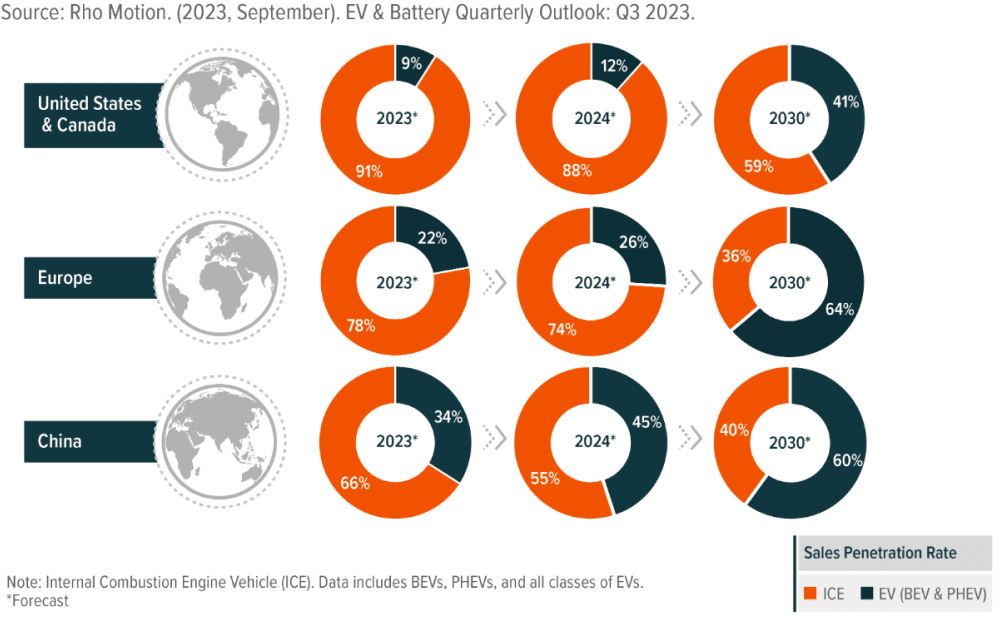
The Chinese EV giant BYD recently announced it is considering building an assembly plant in Mexico. BYD’s EVs are much cheaper than anything in the US, but they currently face a 25% tariff on Chinese car imports.
If the US is really headed to an electric future, the Big Three (GM, Stellantis, and Ford) will need to play a meaningful role. The current problem is that fast-paced scale is neither attractive nor profitable.
Conclusion
In summary, the dynamism within the U.S. EV market presents a multilayered narrative of both promise and unease. The investment landscape of the EV ecosystem has displayed breadth, with hedge funds and private equity diversifying their portfolios beyond auto Original Equipment Manufacturers (OEMs) and into the broader supply chain to encompass raw materials and key components of the battery supply chain. This strategy is perhaps a testament to the belief in the sector’s long-term viability despite short-term hiccups.
The current slowdown in EV sales, influenced by a gamut of factors from consumer hesitancy to regulatory roadblocks, sheds light on the intricate balance between innovation ambition and market realities. For automakers, especially the established giants like GM and Ford, the situation demands agility; a pivot back to internal combustion engines is neither sustainable nor in alignment with the bullish electric projections they have committed to.
However, for 100% EV manufacturers, the outlook is starkly more precarious, as their existential grounding hinges on the electric narrative's triumph—a triumph which now appears muddied by underwhelming earnings and skeptical market sentiments.
Regulatory imperatives loom large, with stringent standards pushing for a decidedly electric future. Yet, the industry's ability to meet such mandates without compromising profitability remains an open question. The stern regulatory measures, while clearly signaling the direction of transit, may need to be supplemented by more than just penalties for non-compliance to nurture an environment where EVs can truly flourish.
Amidst these cross-currents, we witness market behemoths from abroad, like China's BYD, considering strategic maneuvers that could upset the delicate competitive balance and fuel a race to affordability and scale—an area where U.S. manufacturers currently lag.
The "Fleet Electrification Outlook" reflects optimism for an electric future, but the bumps along the way are palpable. For automakers, the challenge and opportunity lie in navigating a regulatory-driven future without losing sight of consumer demand and market solvency. For investors, the landscape is ripe for those with the acumen to identify resilient innovators and the audacity to forge through volatility. And that is where we believe institutional asset management comes into play.
Understanding the current complexities can empower stakeholders to sculpt a future where electric vehicles move from being a hallmark of environmental progressiveness to becoming a ubiquitous mode of transportation and, in due course, an economically sensible investment.
Ultimately, in this pivotal chapter of automotive history, what prevails may be the visionaries who not only foresee the destination but are also adroit in surmounting the inevitable twists and turns of the journey.
Sources:
- The Economist. April 14, 2023. “The Future lies with electric vehicles.”
- The International Energy Agency. April 26, 2023.
- Spencer, Alison, Ross, Stephanie, and Tyson, Alec. July 13, 2023. “How Americans view electric vehicles.” Pew Research Center.
- Spencer, Alison, Ross, Stephanie, and Tyson, Alec. July 13, 2023. “How Americans view electric vehicles.” Pew Research Center.
- Fisher, Ryan. Jan 16, 2024. “How the US Can Emerge From Its EV Charging Woes.” Bloomberg.
- Pettypiece, Shannon. February 11, 2024. “As electric vehicle demand slows, workers caught in the middle face an uncertain future.” NBC News.
- Pettypiece, Shannon. February 11, 2024. “As electric vehicle demand slows, workers caught in the middle face an uncertain future.” NBC News.
- Pettypiece, Shannon. February 11, 2024. “As electric vehicle demand slows, workers caught in the middle face an uncertain future.” NBC News.
- Randall, Chris. February 2, 2024. “Rivian records billions in losses in 2023.” Electrive.
- Mollman, Steve. February 22, 2024. “Elon Musk says Rivian needs to ‘cut costs massively and its execs should ‘live in the factory’ or the Tesla rival will die.” Fortune.
- Krisher, Tom and The Associated Press. January 25, 2024. “Tesla warns investors that 2024 sales could be ‘notably lower’ as it’s caught between two big growth waves.” Fortune.
- Callahan, Sean. March 1, 2024. “Downgraded: Fisker Stock Hits All-Time Low.” Fiskerati.
- CNN, March 20, 2024. "Biden administration rolls out new tailpipe rules that will boost EVs and hybrids"
For a deeper look at how funds are navigating the EV sector turbulence, and to view which funds on our platform are investing in the EV space, please see below.
For financial advisors only.