
Published on October 16, 2024
The US National Debt: How Much Is Too Much for the U.S. Economy?
The Beginnings of the US National Debt
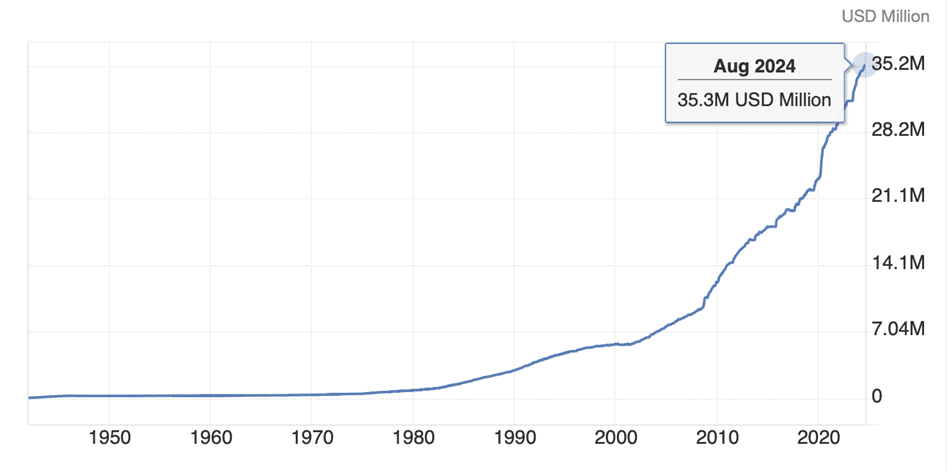
Since the founding fathers fought for freedom, the US has been in debt. To fund the Revolutionary War, the 13 colonies took out the new country’s first loan, borrowing $75 million from France and the Netherlands1. Since then, the US national debt has fluctuated, currently standing at over $35 trillion.
Since the founding fathers fought for freedom, the US has been in debt. To fund the Revolutionary War, the 13 colonies took out the new country’s first loan, borrowing $75 million from France and the Netherlands1. Since then, the US national debt has fluctuated, currently standing at over $35 trillion.
The United States debt, foreign and domestic, was the price of liberty. The faith of America has been repeatedly pledged for it...
The US national debt surged after the Great Financial Crisis. Leading up to the crisis, low interest rates and loose lending standards resulted in government intervention with massive bailout programs. Since then, government spending has steadily increased, including the $5 trillion for Covid-19 stimulus.3
Repercussions of the US National Debt
In theory, the rising US national debt causes a decline in investor confidence, reducing demand for US government securities and pushing bond prices down and yields higher.4 However, looking at data from the past 12 months, the yield on the 10-year Treasury is currently lower than when it closed near 5% in October 2023, indicating that investors may be overlooking the current debt situation.
And the US Treasury continues to borrow. In the first quarter of 2024, $748 billion was borrowed, followed by $234 billion in the second quarter and an additional $740 billion in the third quarter—although this was $100 billion less than initially projected.5
The cost for all this borrowing? As of August 2024, it costs $1049 billion to service the US national debt, which comprises 17% of the total federal spending in fiscal year 2024.1
But Does the US National Debt Matter?
While the US national debt is the highest by gross debt, it ranks lower relative to other borrowers in terms of debt to GDP.
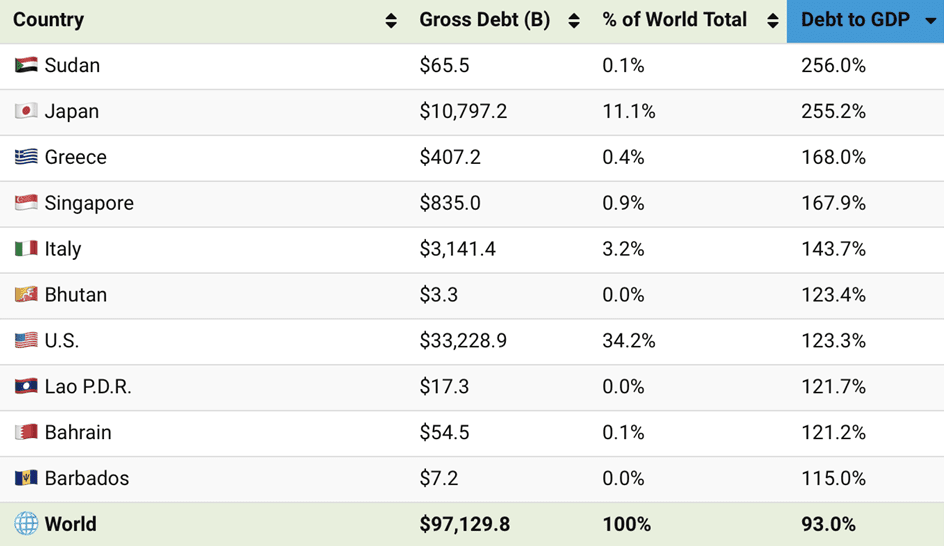

Instead of looking at total debt, which the US leads with, the debt-to-GDP ratio looks at a country's ability to pay back its debts. A lower debt-to-GDP ratio is generally ideal because it signals that a country is producing more than it owes.
While the United States fares better than other countries using this view, it still has a debt-to-GDP ratio of 121 percent—a worrisome threshold to cross for any country, particularly one not at war. Our debt is currently larger than our economy.
What’s Next for the US National Debt?
While the US national debt is over $35 trillion, it has not been a major point in the current US presidential election. Both candidate’s plans will increase the amount of debt the country is in. However, the debt load has caught the attention of bipartisan lawmakers and the nonpartisan Committee For A Responsible Federal Budget, which published a letter to Vice President Kamala Harris and former President Donald Trump asking for their plans for addressing the national debt.
Even the Secretary of the Treasury, Janet Yellen, remarked on the national debt, given the rise in interest payments. Not including interest, the US government will spend $1.21 for every $1.00 it collects in revenue this year. Add interest, and that will climb to $1.39.
The US national debt continues to increase without any solution in sight. The repercussions loom large. With the increasing debt comes larger interest payments, resulting in fewer dollars for other government spending or less flexibility to respond to future crises. It can also mean fewer opportunities for businesses looking to expand or invest in education.
Sources:
- U.S. Treasury. (n.d.). Fiscal Data explains the National Debt. Understanding the National Debt | U.S. Treasury Fiscal Data.
- U.S. Treasury (n.d.) The history of the debt. TreasuryDirect. (n.d.).
- Pandemic Oversight. (2024, July 3). $6.4 billion in pandemic funding was received by foreign recipients.
- Adrian, T., Gaspar, V., & Gourinchas, P.-O. (2024, March 28). The fiscal and financial risks of a high-debt, slow-growth world. IMF.
- The impact of U.S. National Debt On Investments: U.S. bank. The Impact of U.S. National Debt on Investments | U.S. Bank. (2024, September 19).
Learn which institutional managers have a proven track record in macro trading and relative value arbitrage and are available for your clients’ portfolios.
For financial advisors only.