
Published on May 7, 2024
VIX Levels are Trending Up: Alternative Investments Can Help
Introduction
On April 15, 2024, the VIX cleared 20 for the first time since October 27, 2023, making the streak of more than 120 sessions without crossing this threshold the longest since 2018.1 With geopolitical tensions, uncertain federal reserve policy and inflation forecasts, and election season looming, volatility levels seem to be trending higher. While this may be concerning for directional investment exposures, this could be positive for hedge funds compared to traditional asset classes. In this insight, we will explore what forces are impacting the VIX, what higher potential VIX levels might mean for markets, and how alternatives have navigated volatility in the past.
VIX Primer
The VIX, or by its proper name, the CBOE Volatility Index, projects the probable range of movement in the U.S. equity markets. The VIX measures the implied volatility of the S&P 500 for the next 30 days based on the average weighted prices of a wide range of call-and-put options. Since implied volatility is a major input into option pricing models, an upward movement in volatility will cause options to become more expensive and existing long option positions to appreciate (all else being equal).2 This background is important, especially when considering hedge funds that are active participants in options markets.
Current Volatility Backdrop
It is hard to overstate how little volatility markets have experienced since the beginning of 2023 relative to longer-term averages. As the figure below shows, these few trading days with sub-25 VIX levels are unprecedented.3
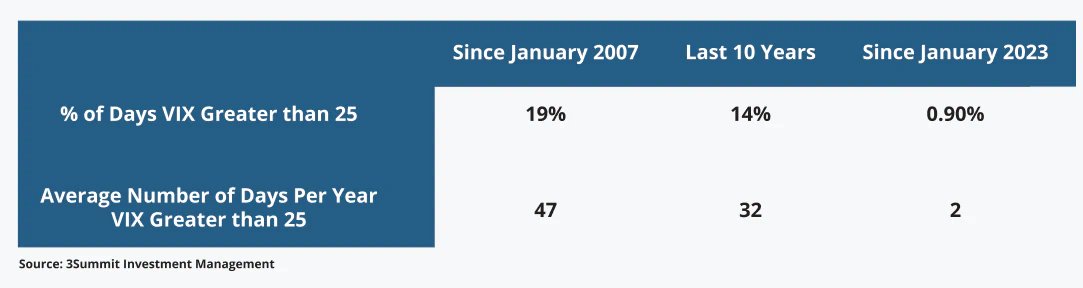
This muted volatility might seem surprising when observing day-to-day market moves and financial news that regularly pushes a binary narrative of mania or doom.
Although not straightforward and linear, VIX levels are trending up, and none of the concerns underpinning market uncertainty seem close to resolution. Given that backdrop, we wanted to examine periods of high volatility to see how hedge funds and other alternatives have navigated choppy markets.
Historic Periods of Volatility and Asset Class Performance
Going back to the three most recent selloffs when equity markets sold off by more than a third (the dot-com bubble, the GFC, and the COVID drawdown), alternatives provided essential diversification and drawdown-dampening returns, as shown by the chart below.4 This is not to say that alternatives like long/short equity and trend-following managers will certainly deliver during the next bout of volatility and market drawdowns. But it is an important reminder that, relative to traditional asset classes, alternatives have delivered positive return streams during market stress.
Returns of Various Assets Through Last Three Major Equity Sell-Offs
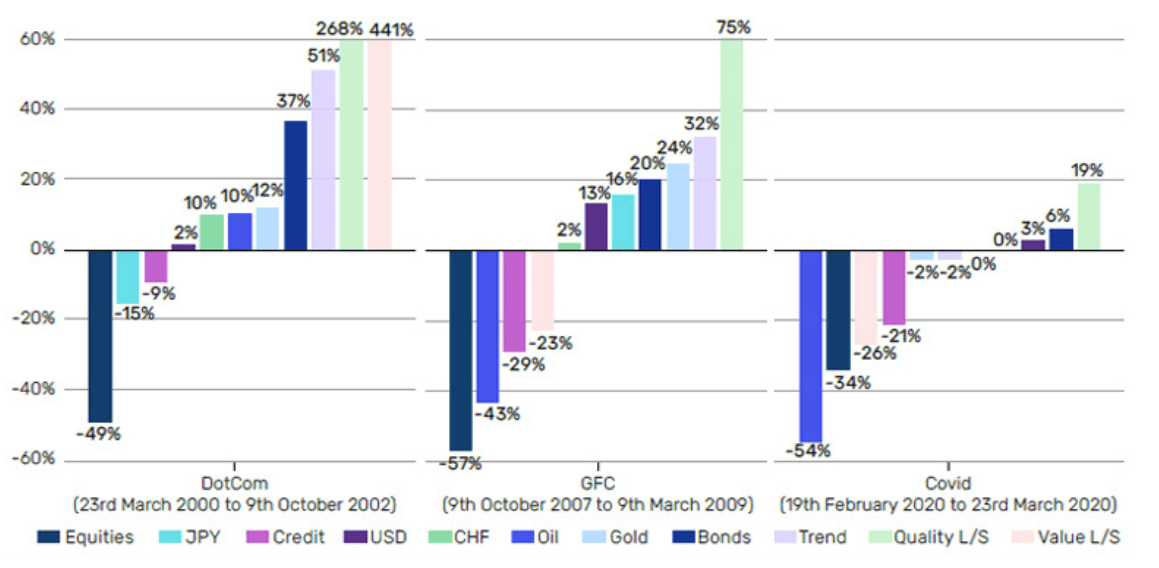
1. Time periods defined as the peak to trough of the S&P 500 Index in each of the pertinent episodes. Equities are represented by the S&P 500 price return. Currencies are against the USD. The USD itself is the DXY cross currency average. Credit is Bloomberg Barclays USD Corporate High Yield Total Return Index. Bonds are Bloomberg Barclays 7-10 Yr Treasury Total Return Index. Gold and oil are returns to the near end futures contract and do not include the roll yield. Quality and value long-short (L/S) are Morgan Stanley’s L/S factor baskets. Trend is Société Générale Trend peer group.
Outlook: Vol on the Horizon?
As we outlined in the introduction, there are several reasons why we could see volatility meaningfully tick up in the near future: geopolitical uncertainty in the Middle East, the fed’s back-and-forth fight with inflation, and a global election cycle (culminating in the U.S. presidential election in November).
Another factor to consider when observing low VIX levels is significant short vol trade inflows. This trade, which was incredibly popular in 2018 and 2020, has taken a slightly different shape, wherein investors are no longer allocating assets in straightforward short-VIX ETFs and are instead allocating to other strategies that sell options on stocks or indices to juice returns but through that approach maintain short volatility exposure. The research below shows that assets in these products have nearly quadrupled in two years.5
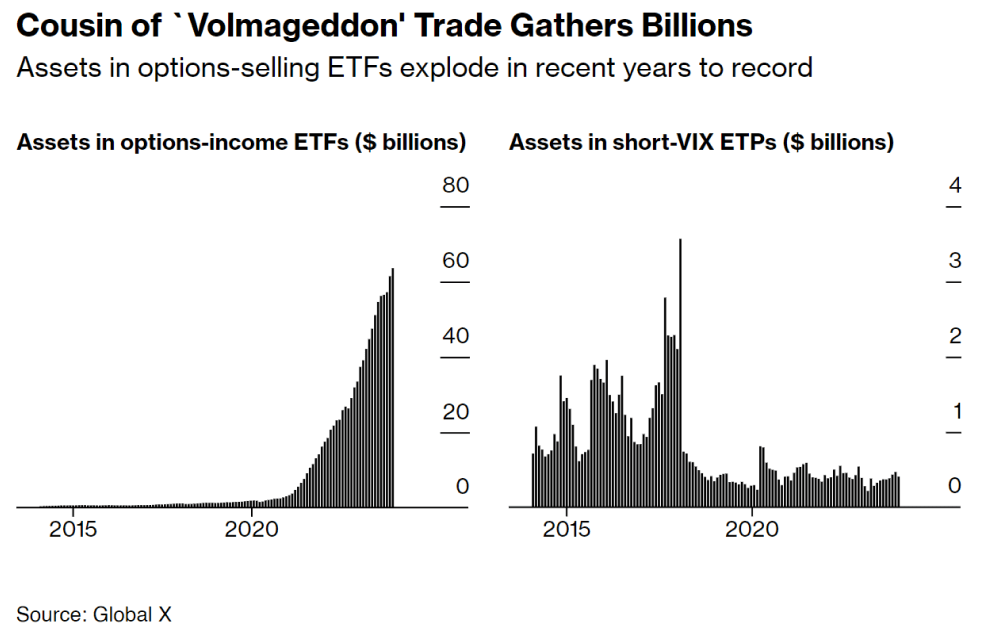
The demand for these strategies has undoubtedly put pressure on VIX levels. Historically, short volatility trades have consistently yielded positive returns. But a geopolitical or market shock could blow up the trade and untether VIX levels to move higher, as we saw in 2018 and 2020, when VIX levels peaked above 30 and 60, respectively. While these volatile markets would likely be an unwelcome development for most portfolios, history has shown that investors allocated to alternatives have better experiences.
Conclusion
VIX levels are under downward pressure right now, but if that downward pressure abates, we could see a significant spike in volatility. Rather than attempting to forecast which specific strategy type or asset class will perform best during the next period of market volatility, Crystal Capital Partners believes the best approach is to build and maintain an allocation to alternative managers, the best shepherds for an unpredictable remainder of 2024.
Sources:
- Wobbling US stocks could push volatility-linked funds to ramp up selling | Reuters
- https://www.spglobal.com/spdji/en/vix-intro/
- What Lies Ahead For The S&P 500 Following Unprecedented Tranquility? (forbes.com))
- The Road Ahead: On Pain | Man Institute | Man Group
- The Short-Volatility Trade Roars Back on Wall Street - Bloomberg
See the list of third-party Hedge Funds with a track record of navigating volatile markets.
For financial advisors only.