
Published on March 24, 2025
What’s Behind the Stock Market Volatility?
It wasn’t too long ago that folks were celebrating a bull market. We kicked off the New Year on a roll, but by Monday, March 10th, for the first time since October 2023, the S&P 500 closed below its 200-day moving average.
When stock market volatility results in major banks cutting their S&P 500 forecasts, it’s time to take notice:
- Goldman Sachs slashed its price target from 6,500 to 6,200 noting question marks surrounding the economy’s health.1
- HSBC and Citigroup downgraded US stocks to “neutral.”2
- BCA Research downgraded all equities to underweight.3
There are reasons the market is volatile, and clarity on the “why” is key to forging a constructive path forward.
The Four Factors Fueling Market Turbulence
Four factors lie at the heart of our current stock market volatility:
-
1. Trade Wars
Trade wars, provoked through tariffs, hurt consumers. Importers pay taxes on what comes into a country, and then raise the price of the goods to recoup the cost of the tariff.

Source: Donald Trump X Account.
To his credit, President Trump was transparent throughout his campaign regarding tariffs. Voters either ignored it, supported tariffs, or simply didn’t care. The tariff “tit-for-tats” change by the day, and markets are struggling to keep pace. Not only do tariffs disrupt predictable trading and cost structures, but the lifting and adjusting of tariffs cause additional disruption, making it difficult for firms to plan and invest. This leads to uncertainty, and capital remains on the sideline, making it reticent to engage.
-
2. Waning Growth & Confidence
The Atlanta Fed is estimating a first-quarter GDP decline of 2.8%.4 Morningstar, meanwhile, predicts that a 10% uniform tariff hike and a President Trump proposed 60% tariff hike on China would lessen the long-run level of US GDP by 1.6%.5
Consumer spending accounts for the bulk of economic growth, and views on employment and inflation have worsened considerably.
Couple this with American household debt leaping to $5 trillion in January, and renewed spending and investing at previous levels is unlikely.6
-
3. Artificial Intelligence (AI) Concerns
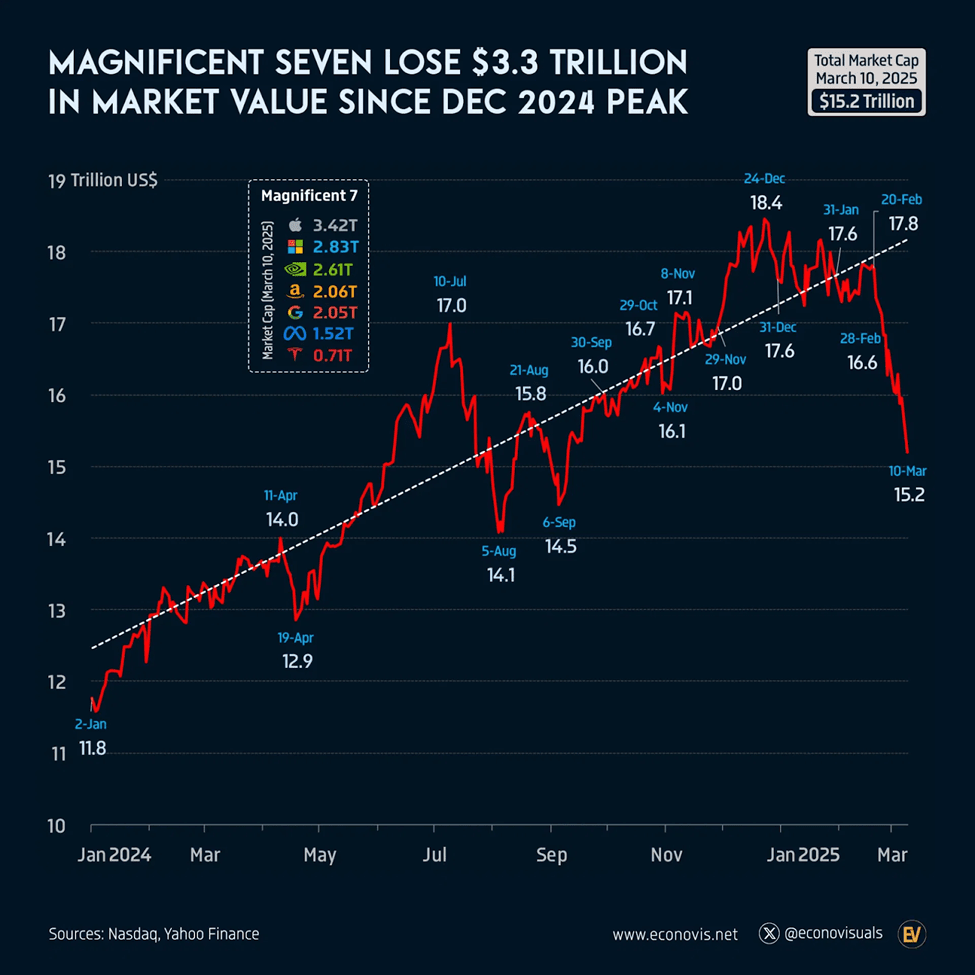
The looming spectre of an AI bubble is nothing new. But DeepSeek’s recently released AI model and emerging competition has sent the Magnificent Seven (among others) tumbling.
From late December to mid-March, these seven companies accounted for 87% of the S&P 500’s total market cap decline. Exactly 25 years ago in March, the Nasdaq Composite Index hit its dot-com era high, and then went tumbling. For those old enough, it was a time of roughly 500% growth over five years, but the good days didn’t last for long. Many are worried we’re in a similar environment with AI.
-
4. Fed Rate Uncertainty
Lastly, the Fed is “trapped” at the moment, reluctant to make any significant policy moves until they can gauge the true effects of President Trump’s policies. During the Fed’s most recent March 18-19 meeting briefing, Fed Chair Jerome Powell cited a form of the word “uncertainty” a worrisome 18 times. The target range for the federal-funds rate remains at 4.25% to 4.5%, and Fed officials are projecting stagflation – lower growth and potentially higher inflation – for the year.7 The Fed would likely lower rates to boost the economy should an economic downturn occur, but if tariffs end up stoking inflation, the plausible move would be to keep interest rates high. Again, uncertainty is contributing to stock market volatility.

Correction Territory
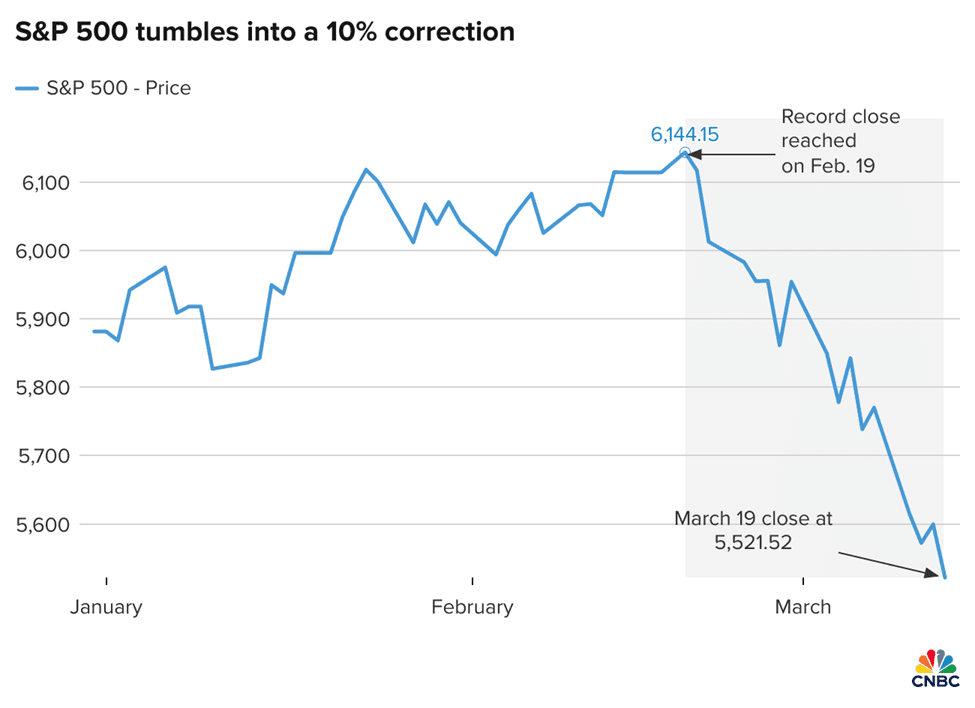
Stock market volatility has sent the S&P 500 into correction territory since its record peak on February 19th.
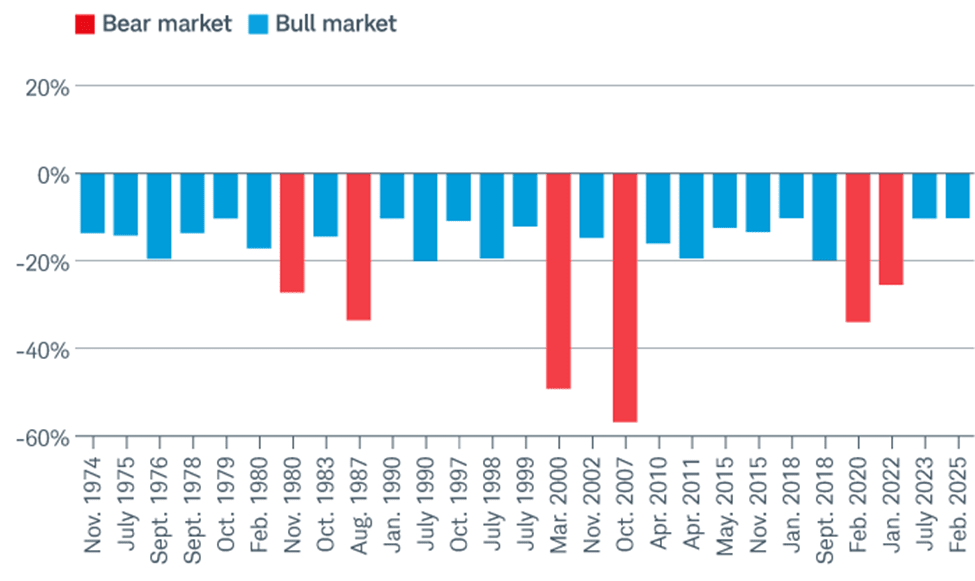
The Nasdaq is also down and the Russell 2000 is approaching a bear market.8 Since November 1974 there have been 27 market corrections. Of those 27, however, only 6 became bear markets.
Meanwhile, the Cboe Volatility Index (VIX) is spiking. Colloquially known as the “fear gauge,” the VIX measures the volatility of the S&P 500. A VIX reading from 0 to 15 indicates market optimism and low volatility. From 15 to 25 is increased volatility, while 25 and higher is market turbulence. The VIX spent January and February below its average of 19.5, but surged as high as 27.1 on March 10th.9
Amidst stock market volatility and elevated VIX readings, analysts look to key VIX levels to map out future strategies. Currently, the VIX reading at 27.3 is one-standard deviation from the long-term average. This represents a scare, but two-standard deviations - 35.1 - could indicate a bear market is upon us.10
Gold and European Defense Stocks
As to be expected, gold is surging.

Stock market volatility always brings investors back to gold, and while prices remain below the 1980s peak, over the last quarter century gold prices have risen 10-fold.
Meanwhile, for those seeking alternative equity investments to the S&P 500, European defense stocks have rallied. Companies such as Italy’s Leonardo, Germany’s Rheinmetall, and France’s Thales are up 67% or more on estimates that eventual US defense spending drawbacks will naturally bolster the continent’s domestic defense industries.11
Conclusion
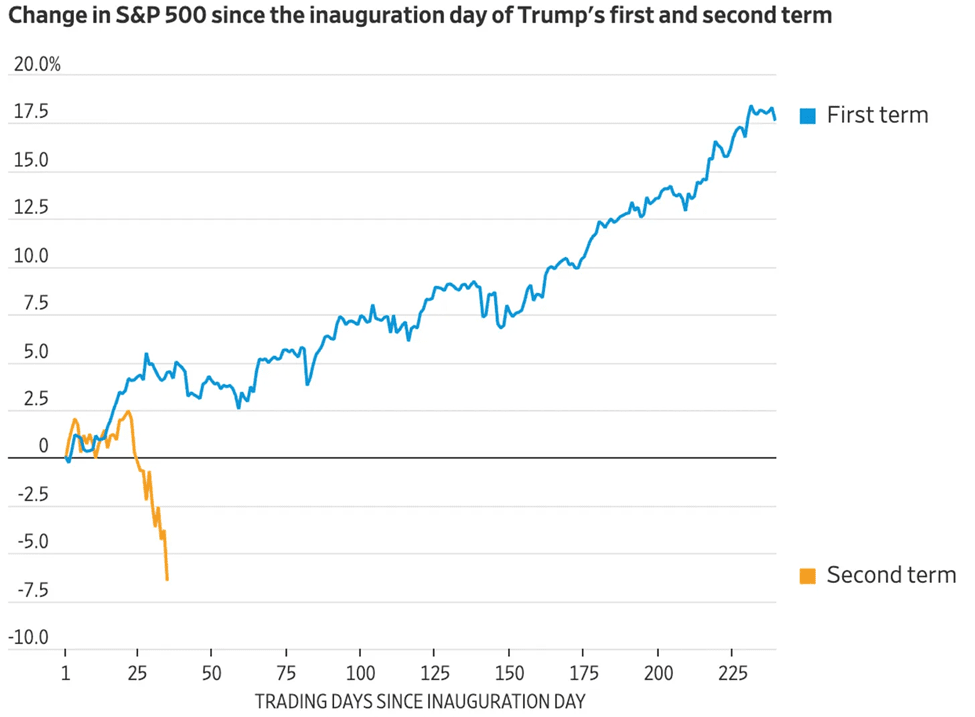
In his first term, President Trump was fond of taking credit for the market’s solid performance. This time around, however, the President has been rather tight-lipped.
The current market volatility underscores the importance for financial advisors to consider diversifying portfolios beyond traditional investments. While uncertainty in equities persists, alternative investments such as real estate, private equity, hedge funds, or commodities offer the potential to hedge against these market fluctuations. These investments not only provide greater stability during turbulent times but typically showcase an expanding opportunity to generate returns uncorrelated to public markets.
Sources:
- Vishnoi, Abhishek. March 12, 2025. “US Stock Skepticism Deepens as Goldman Cuts S&P 500 Target.” Bloomberg.
- Evans, Brian. March 10, 2025. “HSBC upgrades European stocks, downgrades U.S. at it rethinks Trump optimism.” CNBC
- Li, Yun. March 10, 2025. “BCA Research says DOGE and tariffs tipping economy into recession, downgrades stocks.” CNBC.
- Smith, Connor. March 4, 2025. “Atlanta Fed’s GDPNow Estimate Falls Again.” Barron’s.
- Caldwell, Preston. March 13, 2025. “Tarrifts Will Hurt US Economic Growth but Likely Won’t Reduce the Trade Deficit.” Morningstar.
- Dickler, Jessica. March 10, 2025. “Consumer credit rose to $5 trillion in January - ‘small cracks are starting to emerge,’ analyst says.” CNBC.
- Leonhardt, Megan. March 19, 2025. “The Fed Pencils in 2 Rate Cuts. Anything Could Happen.” Barron’s.
- Hyatt, Diccon. March 14, 2025. “What To Expect From The Federal Reserve’s Interest Rate Decision on Wednesday.” Yahoo Finance.
- Han, Lisa Kailai. March 14, 2025. “S&P 500 closes in correction territory Thursday as stocks tumble again on Trump tariff threats.” CNBC.
- Salisbury, Ian. March 11, 2025. “The VIX Is Spiking. Don’t Be Tempted Into Buying Stocks Just Yet.” Barron’s.
- McCabe, Caitlin. March 8, 2025. “How Overlooked European Defense Stocks Became a Hedge-Fund Home Run.” The Wall Street Journal.
Explore the hedge fund strategies that can immediately diversify your client portfolios from equity volatility.
For financial advisors only.