
Published on November 22, 2024
Why Modern Portfolios Need a Third Dimension
The 60/40 portfolio worked as intended from 1980 to 2010 but has experienced tough periods since such as in 2022. The 60/40 portfolio tends to perform well in high bond yield environments but can run into trouble in times of lower yields and a lower carry of bonds vs. stocks.1 Further, the negative correlation between stocks and bonds has protected 60/40 portfolios historically but that negative correlation has broken down in recent years. To fill the exposures that 60/40 portfolios have shown in years such as 2022, many investors have allocated a portion of their portfolio to low correlated alternatives that can offer downside protection in bear markets, while maintaining upside exposure during bull market conditions. Others with long-term investment horizons have ignored the year-to-year noise and allocated to funds that can pay an illiquidity premium and outperform the market such as buyout or venture capital alternatives. For further portfolio protection in the current market environment, investors may consider adding alternatives to their portfolio and evolving to a 50/30/20 portfolio.
60/40 portfolios performed well historically for three key reasons: the strong principal protection that higher yields offered, the high positive carry of bonds vs stocks, and the negative correlation of stocks and bonds over the period. Higher yields on bonds offer a bigger cushion for principal protection. The average aggregate bond yield was 7.7% from 1980-2010, which meant bonds could withstand a 0.40% increase in rates in any quarter while still offering a positive return.1 Bonds also offered a positive carry by yielding 5% more than stocks on average over the same period. Further, there was a strong negative correlation between stocks and bonds, which meant that when one was faltering, the other would pick up the slack. These core tenets have faltered since 2010, calling into question some of the basic assumptions about the 60/40 portfolio.
From 2010 to the end of 2020, the aggregate bond average yield had been 2.4%, meaning a 0.11% increase in rates would erase the entire income for any given quarter.1 With the low rates, holding bonds vs stocks had a barely positive carry, meaning bonds only yielded 0.5% more than the S&P 500 over the period.1 Further, the negative correlation between stocks and bonds evaporated over the same time. These 3 break downs in the core tenets of the 60/40 portfolio were on full display during 2022 when stocks and bonds fell dramatically at the same time.2 While holding stocks and bonds still provides valuable diversity, some investors have looked to alternatives to complement their portfolio to avoid another 2022.
Introducing the 50/30/20 Portfolio
For investors looking to avoid another 2022 drawdown, the 50/30/20 portfolio can be a compelling option. By having 50% of the portfolio in stocks and 30% in bonds, investors can still draw upon most of the benefits of the 60/40 portfolio. By adding a 20% allocation to alternatives, investors further diversify their portfolio and can protect against environments like 2022. In other words, alternatives can open investors up to an expanded investment universe outside of traditional stocks and bonds.
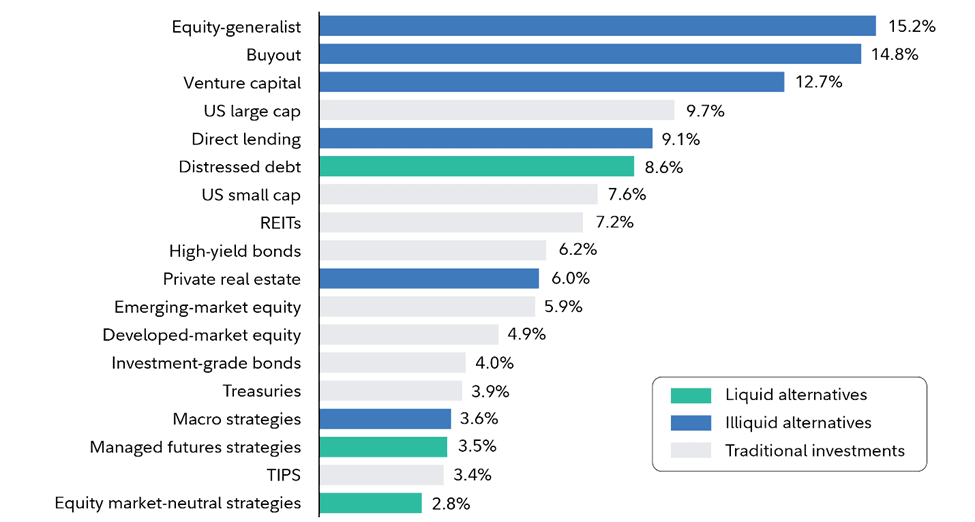
Annualized returns, 2005-2024
Source: Fidelity. September 2024. “Why you might consider alternatives”
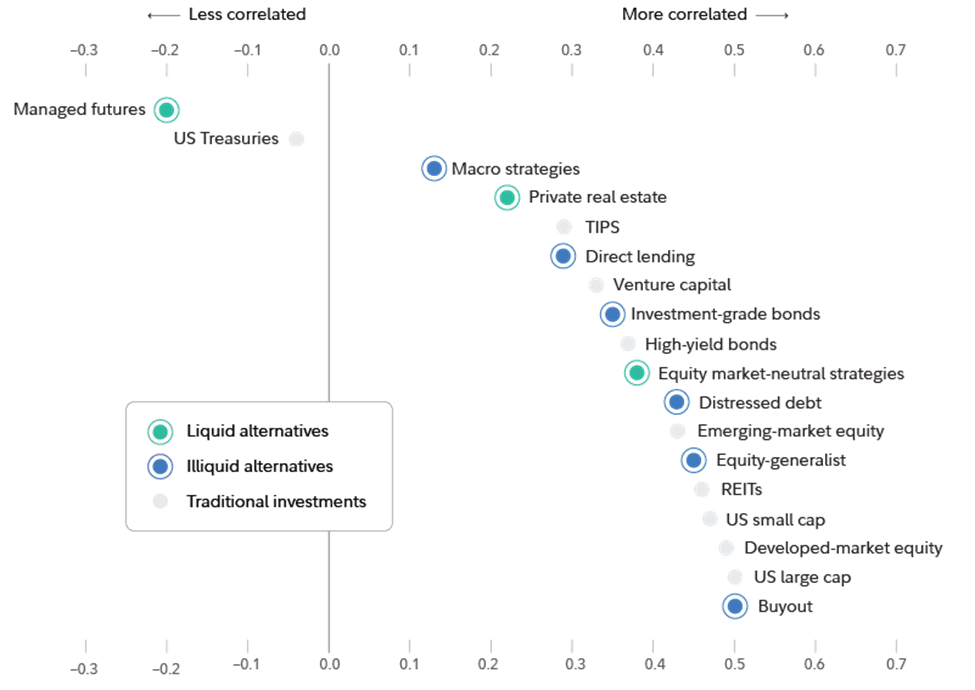
Alternative asset classes such as buyout or venture capital can offer an illiquidity premium that generates excess returns over stocks and bonds. Some investors have chosen these to generate high long-term returns while tuning out the year-to-year noise. Others such as managed futures funds or macro strategies can offer a strong diversity benefit with low to negative correlations vs. traditional stocks and bonds.
Average correlation with 17 other asset classes, 2005-2023
Source: Fidelity. September 2024. “Why you might consider alternatives”
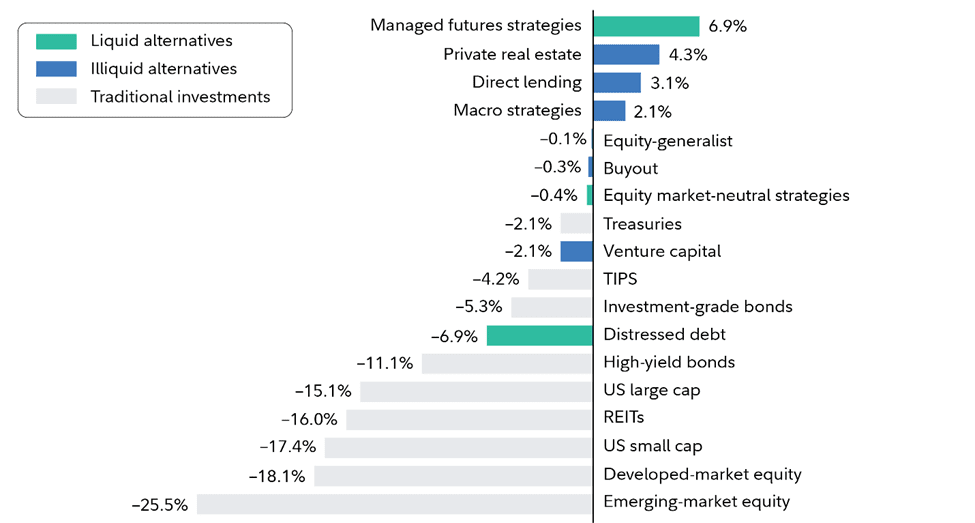
Private real estate and direct lending funds have offered positive returns during some of the worst performing years for equities and can offer a further diversification benefit.
Average annual returns in the 4 worst return yearsFor the Russell 1000 Index, from 2005-2024
Source: Fidelity. September 2024. “Why you might consider alternatives”
Real asset alternatives such as real estate offer protection vs inflation, which was the driving force behind the 2022 downturn. Other real asset alternatives such as commodities can also offer protection against inflation.
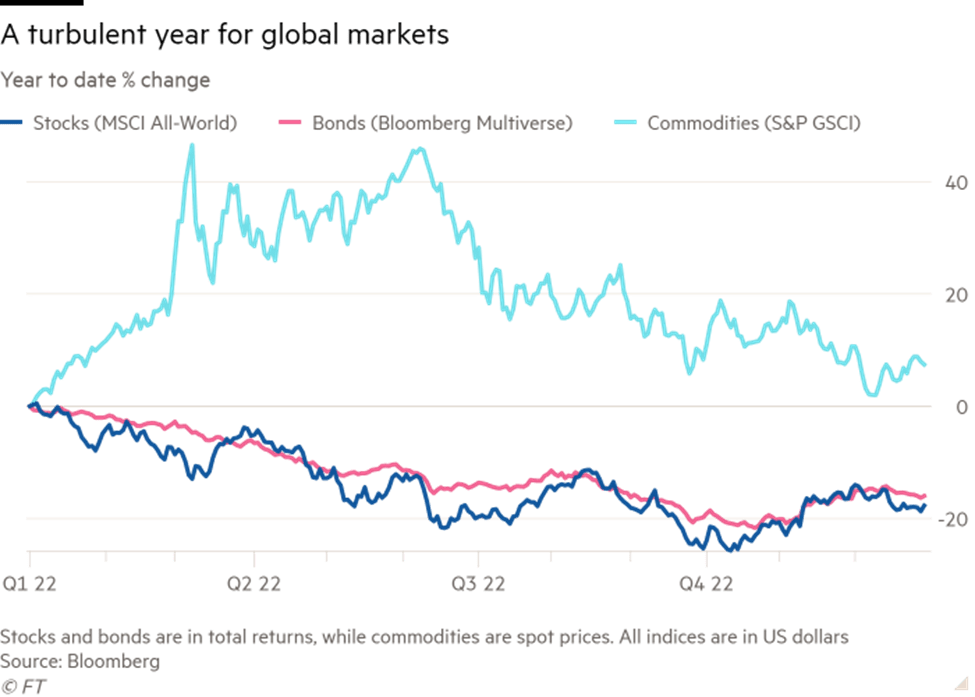
The 60/40 portfolio has shown gaps in times of low interest rates when principal protection from income decreases, the positive carry of bonds is lower, and negative correlations between stocks and bonds are down. These gaps have led to simultaneous downturns of stocks and bonds such as in 2022. Investors have increasingly been looking to alternatives to fill the gaps of a traditional 60/40 portfolio by employing the 50/30/20 model.
Conclusion
As with any asset class, diversification is key. Blending alternatives into a traditional 60/40 portfolio can help cover some of the downside exposures that have shown in recent years while maintaining upside exposure. Different alternatives can offer different complements to a classic 60/40 portfolio. Buyout and venture capital funds can offer an illiquidity premium and drive portfolio outperformance. Managed futures funds and macro strategies can offer low to negative correlations vs. traditional stocks and bonds which can help account for the breakdown of the negative correlation between stocks and bonds since 2010. Private real estate and direct lending funds have offered positive returns during the worst years for equities. Real asset alternatives such as real estate or commodity-based funds can offer protection vs inflation which was the driving force behind the 2022 downturn.
In the past, many forms of alternatives were only available to high-net-worth investors who had flexibility with their short-term liquidity. However, accessibility to alternatives has greatly increased for individuals in recent years. By adding alternatives to a 60/40 portfolio and evolving to a 50/30/20, investors may address the shortcomings of recent years and better prepare for the market environments of today and tomorrow.
Sources:
- Robinson Funds. October 2020. “A Brief History of the 60/40 Balanced Portfolio—Cradle to Grave in 40 Years”
- Callan. May 2022. “Unprecedented Territory—and the Inherent Limits of Diversification”
- MarketWatch. January 2023. “2022 was the ‘biggest outlier year’ in markets history as stocks and bonds both plunged, Deutsche Bank says”
- Fidelity. September 2024. “Why you might consider alternatives”
- Financial Times. January 2023. “Stock and bond markets shed more than $30tn in ‘brutal’ 2022”
View the institutional private investments on our platform and build customized portfolios for your clients.
For financial advisors only.