
Published on October 4, 2024
Why a Nuclear Revival Could Be the Future's Brightest Prospect
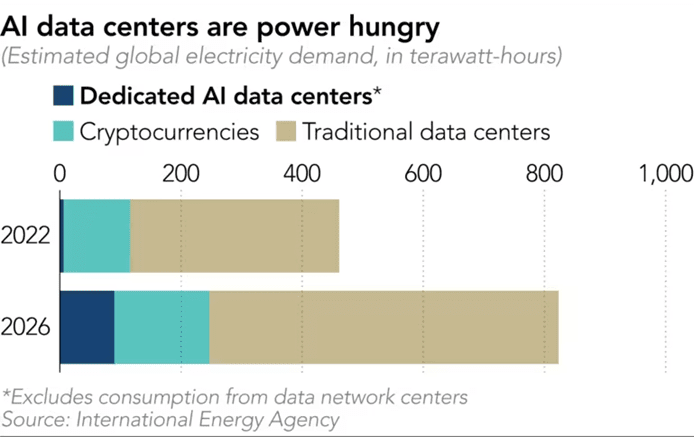
The demand for reliable and clean energy is ramping up worldwide. There are still approximately 1.18 billion people with no, or unreliable, electricity.1 Companies and governments are under intense scrutiny to meet clean energy targets, and artificial intelligence data centers are consuming electricity at rates previously unseen.
Roughly 60% of U.S. electricity generation is from fossil fuels (coal, petroleum, and natural gas).2 The global community has subsidized wind and solar for decades, but they simply cannot compete with fossil fuel production. This leaves a handful of alternatives, yet only nuclear energy has the power to generate anything close to coal, petroleum or natural gas.
The Radiation Shadow
Nuclear has been a controversial energy source for close to 80 years. During the mid-1950s, scientists developed the “linear no-threshold” (LNT) model to explain nuclear radiation exposure. LNT might sound complicated, but it is quite simple - any level of radiation exposure greater than zero will inflict some damage to human DNA.
LNT sat at the heart of the anti-nuclear movement for decades, obstructing any semblance of a nuclear revival. Yet, human beings are surrounded by naturally occurring radiation every waking second of our lives. Extreme levels of radiation are verifiably dangerous, but not all radiation.
In fact, the World Health Organization estimates 4.2 million people die yearly from outdoor pollution, a figure that towers above the number of deaths from both the Nagasaki and Hiroshima atomic bombs, as well as every attributable death to nuclear accidents combined.3
The specter of radiation poisoning from nuclear accidents has had the public on edge, but a nuclear revival appears to be approaching.
Shifting Perceptions
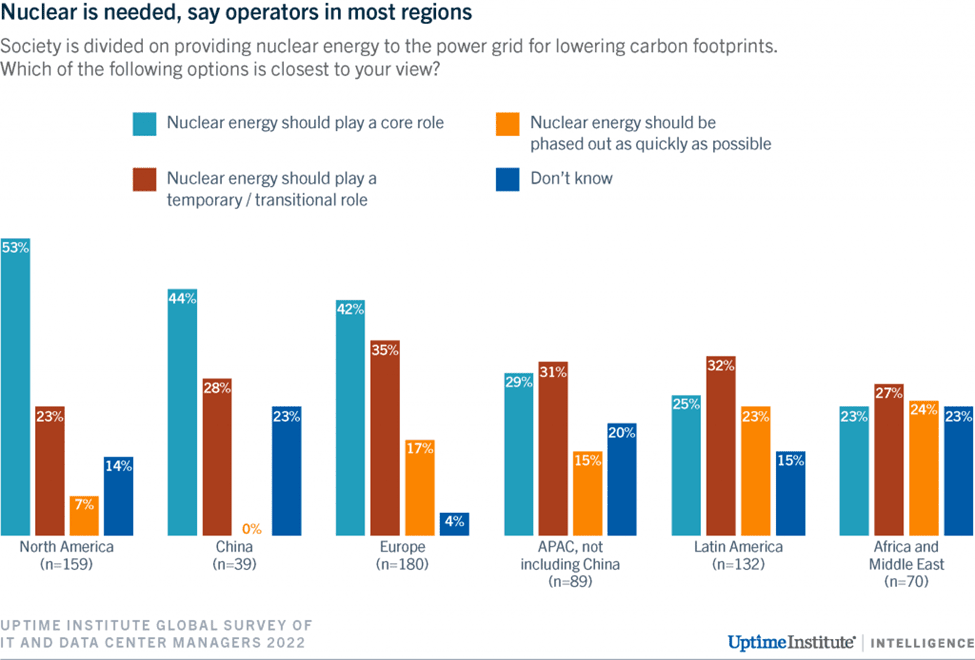
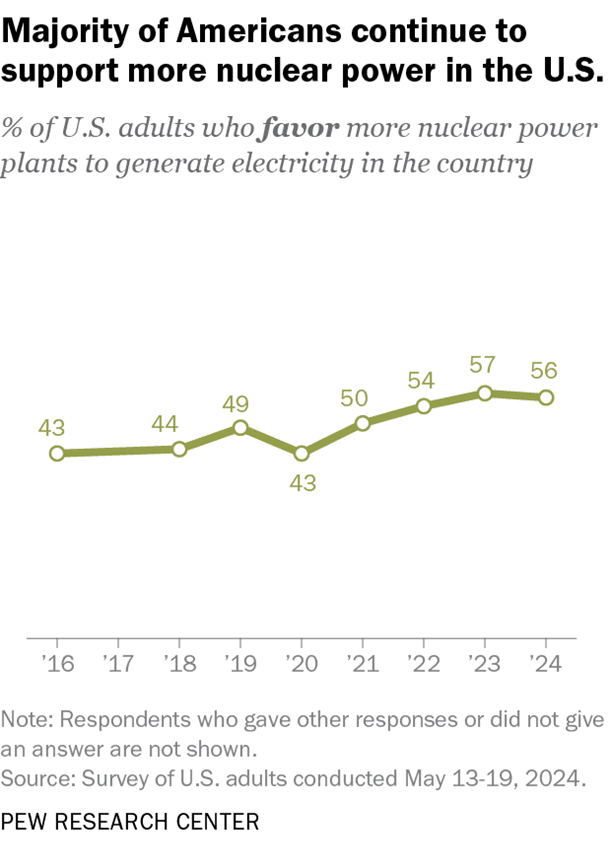
North America, China, and Europe are now more open to nuclear powering the energy grid. In the U.S. alone, support for more nuclear power to generate electricity has climbed steadily since 2020.
AI’s Role
While it’s safe to assume most people are for a minimized carbon footprint, a nuclear revival would largely be due to market forces. AI data centers devour electricity, and tech companies struggle to keep pace while not straying from their challenging emissions goals. Wind and solar projects depend on weather conditions to generate energy, and while natural gas is a popular alternative, it is not emissions-free.
Nearly one-third of nuclear power plants are in conversations with tech companies to provide electricity to their growing data centers. Amazon Web Services is nearing a deal with Constellation Energy, the nation’s largest owner of nuclear plants. Earlier in March, Amazon.com acquired a nuclear-powered data center for $650 million in Pennsylvania.4
Constellation and peer firms such as Vistra employ a “co-locating” model where data centers and nuclear power plants commence operations together on day one.5 This makes a lot of sense for large tech players like Amazon, who are willing to pay for stable sources of energy.
A Nuclear Revival Won’t be Cheap
Here is where the nuclear pessimists generally chime in. In addition to safety concerns, nuclear plants are very expensive to build. Regulatory requirements have increased labor costs over time, and nuclear is also a sector that receives few federal subsidies, comparatively speaking.6
In 2018, solar received $3.3 billion in federal tax incentives per unit of energy produced. Wind came in second at $2 billion, while nuclear registered a paltry $13 million.7 Incentives matter, as do regulatory red tape and slow licensing processes.
Small Modular Reactors Key to a Nuclear Revival
Paving the road to a nuclear revival are small modular reactors (SMRs). These reactors are approximately a third of the size of a typical plant and are prefabricated, thus reducing the capital costs that larger plants contend with. Oracle recently announced plans to power a new data center with three SMRs.8
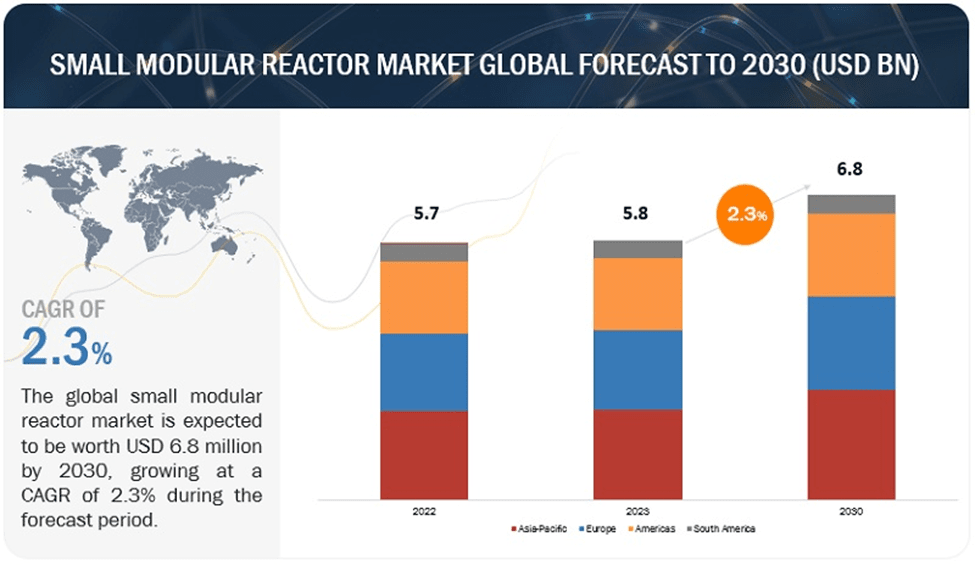
To date, there are only three SMRs operational in the world. Constellation is in talks to build an SMR at one of its facilities, but most experts agree that SMRs won’t reach a commercial stage until the next decade. Last year an SMR project in Idaho was canceled as the project’s costs skyrocketed from $5 billion to $9 billion due to high interest rates and inflation.9
While the barriers to a robust nuclear roll-out are evident, the political winds are blowing favorably. For example, in February of this year, the European Parliament and the Council of European Union member states agreed to label nuclear power as a technology that can contribute to the region’s decarbonization efforts.10
Meanwhile, during the most recent United Nations Climate Change Conference (COP28) nuclear energy was identified as one of the official solutions to fight climate change. Pro-nuclear arguments have long argued that nuclear death rates are not even in the same stratosphere as other sources of energy.
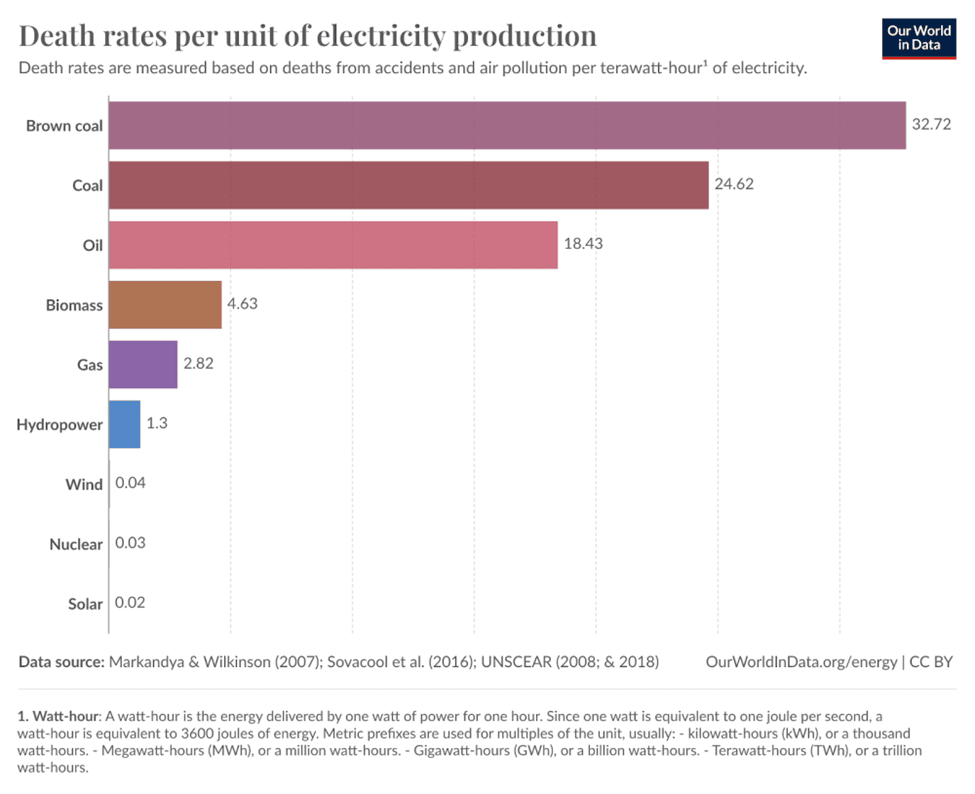
However, when events like Fukushima occur, emotional and non-rational reactions follow. Perhaps what nuclear needed was to be framed as a solution to something. The collective business world is betting on AI continuing to advance, and decarbonization efforts are a priority for most firms. Most of those 1.18 billion with no or unreliable electricity reside in Africa, and it is clear that wind and solar are not making a sizeable enough dent.
A nuclear revival appears poised to be the best long-term bet. The remaining work will center on subsidies, safety, and less red tape.
Sources:
- Min, Brian, et al. June 12, 2024. “Beyond access: 1.18 billion in energy poverty despite rising electricity access.” World Bank Blogs.
- U.S. Energy Information Administration. February 29, 2024. “What is U.S. electricity generation by energy source?”
- Ritchie, Hannah. January 29, 2024. “Deaths from air pollution are high, but the data contains hope.” Clean Air Fund.
- Hiller, Jennifer. July 1, 2024. “Tech Industry Wants to Lock Up Nuclear Power for AI.” Wall Street Journal.
- Clark, Kevin. August 7, 2024. “Constellation touts co-locating data centers with nuclear.” Power Engineering.
- Potter, Brian. May 1, 2023. “Why Does Nuclear Power Plant Construction Cost So Much?” Institute for Progress.
- Quattry, Steven. September 20, 2023. “The Nuclear Revival: Embracing a Clean, Reliable and Safe Source of Energy.” Morgan Stanley.
- Kimball, Spencer. September 10, 2024. “Oracle is designing a data center that would be powered by three small nuclear reactors.” CNBC.
- Kimball, Spencer, and Cortés, Gabriel. September 7, 2024. “Small nuclear reactors could power the future – the challenge is building the first one in the U.S.” CNBC.
- Messad, Paul. February 7, 2024. “Nuclear power officially labelled as ‘strategic’ for EU’s decarbonization.” EURACTIV.
Learn about the institutional fund managers investing across the nuclear energy value chain.
For financial advisors only.